
How to Play the A6 Chord on Guitar (Shape and Easy Version)
The open A6 guitar chord shape, the one-finger easy version, why it buzzes, and how it compares to A major, A7, Amaj7, and F#m7.

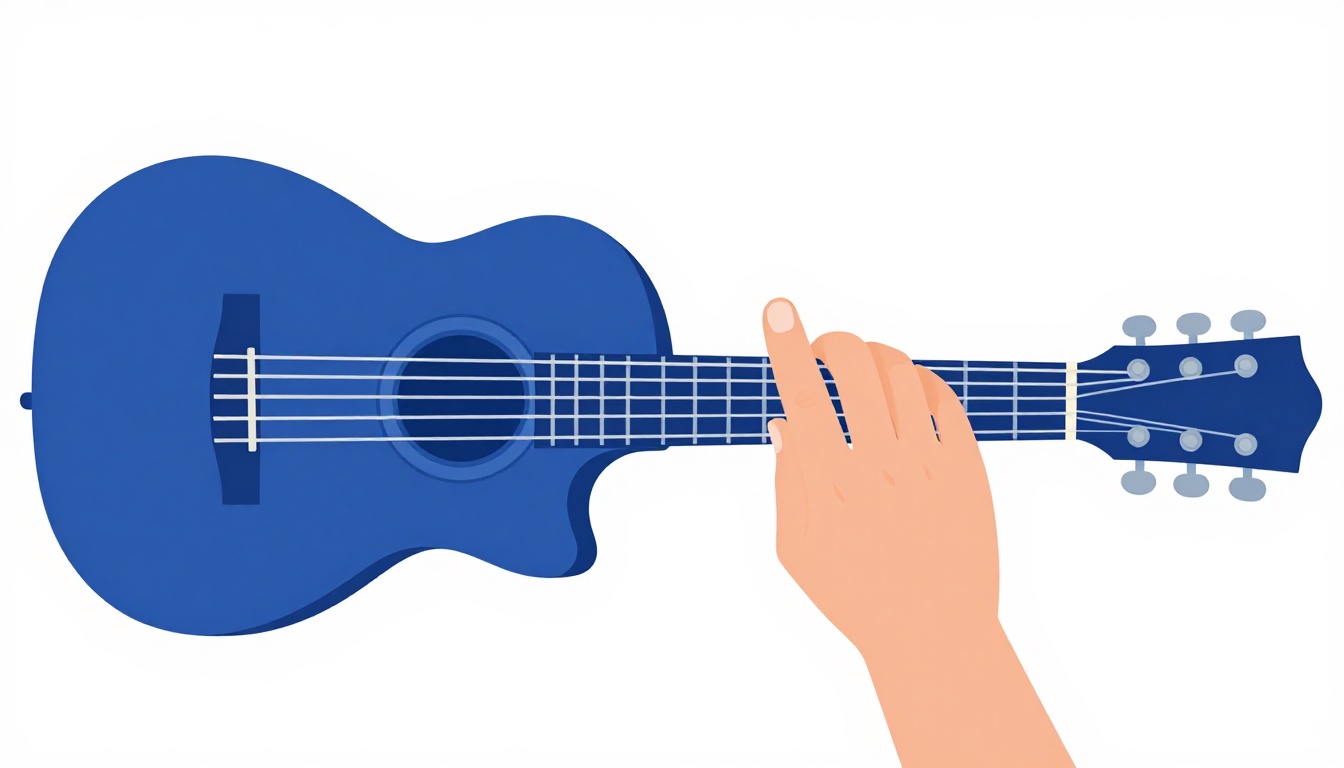
To play an A6 chord on guitar, mute the low E string, leave the A string open, then lay one finger flat across the D, G, B, and high E strings at the 2nd fret. That is the whole shape, written as x02222. Strum from the open A string down through the high E string. What you get is A, E, A, C#, and F#, the four notes an A6 chord needs: root, major 3rd, perfect 5th, and major 6th. Below is the same shape broken into a table, an easier way to finger it if the one-finger barre feels stiff, why it buzzes when it does, and how it actually differs from a plain A chord, an A7, and an Amaj7.
The A6 chord, string by string
Here is the full shape as a table. "Finger" uses standard numbering: 1 is your index finger, 2 is your middle finger, 3 is your ring finger, 4 is your pinky.
| String | Fret | Finger |
|---|---|---|
| 6 (low E) | Muted, do not play | - |
| 5 (A) | Open | - |
| 4 (D) | 2 | 1 (index) |
| 3 (G) | 2 | 1 (index) |
| 2 (B) | 2 | 1 (index) |
| 1 (high E) | 2 | 1 (index) |
That is a mini barre: one finger laid flat across four strings at the same fret, with nothing else fretted. It is a different kind of challenge than the standard open A chord, where three fingertips have to squeeze onto the same fret side by side. Here you only need one finger, kept flat and just behind the fret wire.
Which strings to strum
Strum the top five strings only, from the 5th string (A) down through the 1st string (high E). Leave the 6th string (low E) out of the strum, even though no finger is muting it.
The reason is the same one that trips people up on every open chord with a muted low string: the low E note is E, and E is already a chord tone in A6 (the perfect 5th), so it will not sound like a wrong note if it rings. What it does instead is confuse the ear about the root. When the lowest, loudest note in a strum is E instead of A, the chord starts to read as something built on E rather than a clean A6 with A firmly in the bass.
Two habits fix it:
- Start your downstroke on the A string, not the low E. It takes conscious effort for the first week, then becomes automatic.
- Let the underside of your index finger rest lightly against the low E as it barres the four strings above. Because the finger is already lying flat across the fretboard, its edge often falls against the low E without any extra work, damping it before your pick reaches it.
Two ways to finger the same shape
The x02222 shape can be played two different ways, and which one suits you depends on your hand.
The one-finger mini barre
Lay your index finger flat across the D, G, B, and high E strings, all at the 2nd fret. Keep the finger straight and close to the fret wire, and roll it very slightly onto its side rather than pressing flat with the pad, so the bony edge of the finger does the work instead of the soft cushion. This is the fastest way in and out of the chord once it clicks, because it is a single motion instead of four fingers landing independently.
Four individual fingers
If the mini barre buzzes no matter what you try, use one finger per string instead: index on the D string, middle on the G string, ring on the B string, pinky on the high E string. All four still land on the 2nd fret, just side by side rather than as one flat finger. This spreads the pressure out, which is often easier for a hand that has not built barre strength yet, at the cost of being slower to move into and out of.
Neither version is more "correct." Try both for a few days each and keep whichever rings cleaner for you.
Where to put your thumb
Whichever fingering you use, your thumb does more work than people expect. For the mini barre especially, bring your thumb down to roughly the middle of the back of the neck, pointing up toward the headstock rather than wrapping over the top. That gives your index finger a firm surface to press against, which is what lets it flatten evenly across four strings instead of rocking side to side. A thumb that creeps too high, wrapping around toward the low E string, tends to twist the barre finger and is a common hidden cause of an uneven mini barre.
Warm-ups for the mini barre
If the one-finger version feels stiff, spend a minute on it away from the full chord before you try to strum it.
- Flat-finger presses. Lay your index finger across the D, G, B, and high E strings at the 2nd fret with no other fingers involved. Press, release, press again, twenty times, focusing on even pressure across all four strings rather than speed.
- String-by-string check. With the finger down, pluck each of the four strings one at a time and listen for buzz. Adjust the angle of the finger until all four ring clean, then memorize what that angle feels like.
- Barre and release. Practice placing the mini barre from a fully open hand, not from another chord shape, so the motion becomes independent of whatever comes before it in a song.
A few minutes of this a day builds the specific hand strength a mini barre needs faster than trying to force it inside a full chord change.
Building A6 from the A chord you already know
If you can already play an open A major chord, you are one finger away from A6. Standard open A is played x02220: the same low E muted, A string open, and D, G, B strings fretted at the 2nd fret, but the high E string is left open instead of fretted.
A6 changes exactly one thing: fret the high E string at the 2nd fret too, instead of leaving it ring open. That turns the open E on the top string into an F#, which is the note that makes the chord a 6 instead of a plain major triad. Everything else about the shape, and the sound of the strum, stays the same.
What the "6" in A6 actually means
A major triad is three notes: A (the root), C# (the major 3rd), and E (the perfect 5th). A6 adds a fourth note, F#, which sits a major 6th above the root. That single added note is the entire difference between A and A6.
The 6th does not clash with the major triad the way a 7th sometimes can. It sits a whole step above the 5th and a minor 3rd below the root, which gives it a warm, settled color rather than a tense one. That is why 6 chords are common as a place to land or end a phrase, in a way a 7 chord rarely is.
"A6" and "Amaj6" mean the same chord. In modern chord notation, a bare number like "6" is understood to mean the major version unless it is written "Am6" or "Amin6," so you will see both spellings in songbooks and both are correct.
The interval math, if you want it
Counting in semitones from the root gives you the exact recipe for any 6 chord, not just this one. A major 3rd is 4 semitones above the root, a perfect 5th is 7 semitones above the root, and a major 6th is 9 semitones above the root. From A, that lands on C# (4 semitones up), E (7 semitones up), and F# (9 semitones up), which is exactly the A6 chord. The same recipe, root plus 4 plus 7 plus 9 semitones, builds a 6 chord from any root on the neck, which is worth knowing if you ever want to work out a 6 chord shape somewhere the chord charts do not cover.
Why A6 and F#m7 share the same four notes
This is one of the more useful pieces of theory a 6 chord teaches you. A6 is built from A, C#, E, and F#. F#m7 is built from F#, A, C#, and E, the root and minor 3rd and 5th and minor 7th of F# minor. Line them up and they are the exact same four notes, just named from a different root.
That means anywhere you see an A6 chord, you could substitute F#m7 and the pitches in the chord would not change at all, only which note the bass emphasizes as the root. It also explains why A6 has a slightly ambiguous, floating quality compared to a plain A major: your ear can hear it as A6, or it can hear it as F#m7 over an A bass note, and both are technically true at once. Jazz players lean on this relationship constantly, treating 6 chords and the minor 7 chord a major 6th below them as interchangeable colors for the same harmony.
This is more than trivia when you are comping behind a singer or another player. If a chart calls for F#m7 and your hand is more comfortable reaching for A6, or the reverse, you can play either one and the harmony underneath a melody will not clash, since the four notes ringing are identical either way. The only thing that changes is which note you choose to emphasize as the root, in your bass movement or your voicing, and that choice is yours to make based on where the chord sits in the progression.
Why your A6 isn't ringing clean
If some notes in the strum are dead or buzzing, it is almost always one of these five things. Work through them one at a time rather than guessing.
The mini barre isn't flat enough
If you are using the one-finger version and the high E or B string sounds thin or buzzy while the D and G strings ring fine, your finger is probably dipping in the middle, the natural low point between your first and second knuckle. Straighten the finger slightly and roll it onto its outer edge, where the bone is closer to the surface, rather than pressing with the soft pad.
One of the four fingers is collapsing
If you switched to the four-finger version and one string buzzes, check that finger's first joint. A joint that bends backward under pressure, instead of staying arched, loses contact with the string. Arch that finger more and bring your thumb further behind the neck for support.
A neighboring finger is leaning into the next string
In the four-finger version, fingers packed tightly at the same fret tend to lean sideways. A middle finger fretting the G string that leans toward the B string will deaden it even though nothing is technically wrong with the finger meant to fret the B string. Narrow the angle of each finger so it presses straight down.
The open A string isn't ringing
Because nothing is fretting the A string, it can go quiet if your index finger's mini barre creeps too far to the left and brushes against it, or if your strumming hand starts the stroke too far down and catches the low E and A together at an angle that deadens the A. Check that the barre sits cleanly above the A string, not overlapping it.
Your fingernails are getting in the way
Even short nails that are just slightly too long on the fretting hand push the fingertip back at an angle, which stops the bony pad from making full contact with the string. This shows up specifically on a mini barre, where even one nail catching the fretboard tilts the whole finger off its flat line. If buzzing is isolated to the barre version but disappears in the four-finger version, check your nails before anything else.
Your guitar's setup is fighting you
If every chord on your guitar buzzes near the first few frets no matter how carefully you fret, the issue is likely the instrument, not your technique: action set too low, a neck with too much relief or not enough, or old strings that have lost their tension. A setup at a guitar shop resolves this permanently in a way practice never will.
A6 in Drop D tuning
If you play in Drop D, where the low E string is tuned down a whole step to D, the open-position A6 shape is unaffected. The low E string is already muted and unplayed in this chord, so it does not matter what note it is tuned to. You can drop into Drop D for a set, play A6 exactly as written above, and come back out again without the chord changing at all, which is not true of most open chords that rely on the low E string ringing.
A6 for left-handed guitarists
Everything above describes a right-handed guitar, strung with the low E string closest to the ceiling when the guitar is held in playing position. On a left-handed guitar, strung and flipped as a mirror image, the shape is identical but reversed: the fretting hand is the left rather than being described from the player's right, and the mini barre still lands across the same four strings by name (D, G, B, high E), the physical direction of the barre finger and its position in the room simply flips left to right. String names, fret numbers, and finger numbers stay exactly the same either way.
A6 on twelve-string guitar
A twelve-string guitar pairs each of the six strings with a second string, usually tuned in unison on the four thinner strings and an octave apart on the two thickest. The A6 shape itself does not change, you fret the same four strings at the same 2nd fret, but each fretting finger is now pressing two strings instead of one, which takes noticeably more pressure to avoid buzzing on either half of the pair. If you are moving this chord from a six-string to a twelve-string guitar, expect to need a firmer mini barre than you are used to, and check both strings of each pair individually while you are still building the strength for it.
A compact A6 voicing higher up the neck
Once the open shape is solid, there is a second A6 voicing worth knowing, played higher up the neck with the A and high E strings left open around three fretted notes in between.
| String | Fret | Finger |
|---|---|---|
| 6 (low E) | Muted, do not play | - |
| 5 (A) | Open | - |
| 4 (D) | 4 | 1 (index) |
| 3 (G) | 6 | 3 (ring) |
| 2 (B) | 5 | 2 (middle) |
| 1 (high E) | Open | - |
This is written as x04650. Fret the D string at the 4th fret with your index finger, the B string at the 5th fret with your middle finger, and the G string at the 6th fret with your ring finger, all three fingers landing in ascending order from index to ring as the frets climb. The open A and open high E strings ring on either side of that three-finger cluster.
This voicing has a brighter, more open sound than the low, dense open-position shape, which is why it turns up in jazz and soul playing more often than the x02222 version. It is not a movable barre shape you can slide to other keys, because the two open strings only supply the right notes for A specifically, but as an A6 voicing on its own it is worth adding once the open version feels automatic.
Extending it further: the A6/9 chord
Add a B note, the 2nd or 9th of the A major scale, to an A6 chord and you get A6/9, a five-note color chord common in jazz and film-score guitar parts. One common way in is to take the open A6 shape and, instead of fretting the B string at the 2nd fret with the rest of the barre, lift it and let it ring open, giving you the notes A, E, A, B, F#. That drops the C# (the 3rd), which some players prefer for the extra brightness and others find too far from a "true" A6 sound, so treat it as a color to reach for rather than a replacement for the full chord.
In practice, A6/9 works best as an occasional substitute rather than a chord you play every time A6 shows up. Try ending a progression on the full A6 most of the time, then swap in A6/9 once, on the final chord of a whole song, and notice how much brighter and more open that one small change makes the ending feel.
A6, Aadd6, and Amaj6: the same chord, three names
You will see the same shape written three different ways in different songbooks: A6, Aadd6, and Amaj6. All three mean exactly the same four notes, A, C#, E, and F#. "Aadd6" is the most explicit about what happened to the chord (you added a 6th to a major triad), "Amaj6" spells out that it is the major rather than minor version, and plain "A6" is simply the shorthand everyone defaults to once they know a bare 6 means major. Play whichever one you see the same way.
A6 vs A7 vs Amaj7 vs Asus2: four ways to color an A chord
All four of these start from the same open A major shape and change one note. Seeing them side by side makes it clear what each one is actually doing.
| Chord | Shape | Notes | What changed |
|---|---|---|---|
| A (major) | x02220 | A, E, A, C#, E | The plain major triad |
| A6 | x02222 | A, E, A, C#, F# | High E fretted at the 2nd fret instead of open |
| A7 | x02020 | A, E, G, C#, E | G string left open instead of fretted |
| Amaj7 | x02120 | A, E, G#, C#, E | G string fretted at the 1st fret instead of the 2nd |
| Asus2 | x02200 | A, E, A, B, E | B string left open instead of fretted |
A7 adds a flat 7th and pulls toward resolution, the sound of a chord that wants to move somewhere. Amaj7 adds a natural 7th and feels dreamy and suspended rather than urgent. Asus2 removes the 3rd entirely, which is why it sounds neither major nor minor, just open. A6 is the odd one out in that it neither pulls toward resolution like A7 nor floats without a clear major or minor identity like Asus2. It sounds settled, which is exactly why it works as a chord to land on rather than pass through.
A6 and Aadd9: two chords that get mixed up
Both A6 and Aadd9 take a plain A major triad and add one extra note, which is why the names get confused, but they add different notes and land on different sounds. A6 adds a major 6th, F#. Aadd9 adds a major 2nd an octave up, B, without touching the 6th at all, giving you the notes A, C#, E, and B. Play them back to back and the difference is clear: A6 sounds warm and settled, while Aadd9 sounds bright and slightly unresolved, closer to Asus2 in character than to A6. If a chord chart just says "A add" with no number, it almost always means add9, not A6, so it is worth checking the actual notes before assuming the two are interchangeable.
Recognizing A6 by ear
Once you can play A6 cleanly, spend a few minutes just listening to it against a plain A major. Strum A, let it ring, then strum A6 and let that ring too. The 6th adds a slightly wistful, rounder quality that is easy to miss the first few times but becomes obvious once you have heard it enough times in a row. A useful trick: with the mini barre down, strum A6, then rock the very tip of your barring finger back just enough to lift it off the high E string only, letting that string ring open. That turns the chord back into plain A major mid-strum, and hearing the F# drop out live teaches your ear its exact function faster than reading about it does.
Where A6 sits in the key of A
The notes of A major are A, B, C#, D, E, F#, and G#. Every note in A6, which is A, C#, E, and F#, comes directly from that scale, so A6 is entirely diatonic to the key of A and works as a substitute for the plain I chord (A major) in progressions written in that key. The diatonic chords in A major are A, Bm, C#m, D, E, F#m, and G#dim, and A6 slots into the A major spot in any of those without introducing an outside note.
A6 as a borrowed chord in other keys
A6 is not limited to songs in the key of A. Because A major is also a diatonic chord in several nearby keys, A6 can stand in wherever a plain A chord would naturally occur, which is worth knowing if you only ever learned this shape as "the A chord" and assumed it belonged exclusively to songs written in A.
In the key of E major (E, F#, G#, A, B, C#, D#), A is the IV chord, so A6 works as a warmer substitute for the IV anywhere a progression in E calls for it. In the key of D major (D, E, F#, G, A, B, C#), A is the V chord, so A6 can replace a plain A or even an A7 as the dominant, trading the pull of the 7th for the more settled color of the 6th. Both substitutions keep every note diatonic to the key you are actually in, since C# and F#, the two notes A6 adds beyond a plain A triad, belong to both the E major and D major scales as well.
A6 with a capo
A6 keeps its exact shape and finger pattern with a capo, the same way any open chord does, it just sounds higher. Capo 2 and play the A6 shape and you are sounding a B6 chord; capo 3 and you get C6; capo 5 gets you D6. If a song calls for a 6 chord in a key that has no comfortable open shape of its own, a capo plus this A6 fingering is often the easiest route in rather than learning a new barre shape from scratch. This is especially useful for 6 chords built on sharp or flat roots, like C#6 or Eb6, which have no simple open-position shape of their own but are just a capo position away from the A6 fingering you already know.
Why guitarists reach for A6 instead of plain A
The extra F# rounds off the sharper edge a plain major triad has, giving the chord a warmer, slightly nostalgic character without changing its function. It shows up often in jazz, soul, and blues rhythm playing, and in guitar parts with a retro or vintage feel, because 6 chords were the default "warm major" sound of popular music before extended 7th and 9th chords became common. Reaching for A6 in place of a plain A is a way of adding color to a progression without changing what the chord is doing harmonically, since both are functioning as the same I chord in the key.
Because the change from A to A6 is only one note, it is also one of the least disruptive ways to make a familiar progression sound slightly different on a second pass through a song, playing the plain A chord the first time through a verse and swapping in A6 the second time, for instance, without the listener necessarily being able to say exactly what changed.
Playing A6 with a full band
In a band setting, A6 behaves differently depending on what else is happening around it. If a bass player is holding a steady A root, the guitar's open A string in this shape reinforces that root rather than competing with it, which is part of why the shape avoids the low E string in the first place, to keep the guitar's lowest note aligned with the bass rather than muddying it. If a keyboard or second guitar is already voicing an extended chord, like Amaj7 or A9, doubling that with A6 on top can clash slightly since the two chords do not share every note. In that situation, it is often cleaner to let one instrument hold the 6th and the other hold whatever extension it is voicing, rather than layering both on every instrument at once.
A6 as an ending chord
Because the 6th sits comfortably rather than pulling toward another chord, A6 is a common choice for the very last chord of a song, in place of a plain A major or an Amaj7. Where a 7th chord (major or dominant) tends to feel like it wants one more chord after it, a 6 chord feels finished. If you are arranging an ending and a plain final A chord feels a little flat, try letting the last strum be A6 instead.
A classic progression built on A6
A6, F#m, D, and E together give you the I-vi-IV-V pattern often called the doo-wop changes or the 50s progression, one of the most recognizable chord cycles in popular music. Swapping the plain A for A6 at the top of the cycle softens the transition into F#m, since A6 and F#m7 already share three of their four notes, so the ear barely notices the chord change until the color shifts. Loop A6, F#m, D, E slowly and you will hear how much of that cycle's familiar sound comes from how smoothly each chord leans into the next.
Changing from A6 to D
D major (xx0232) shares two open strings with A6, the G string and the B string, though they land on different frets: G is open in D and fretted at the 2nd fret in A6, and B is fretted at the 3rd fret in D versus the 2nd fret in A6. Rather than lifting your whole hand and resetting, focus on the D string and G string fingers moving together as a unit while your other fingers find their new spots. Practice the change slowly on its own, A6 to D and back, until it stops needing a pause.
Changing from A6 to E or E7
E major (022100) and E7 (020100) both use the low E and A strings as open, ringing notes, which A6 mutes and leaves open respectively. The shift is mostly about your fretting hand jumping down toward the nut while your strumming hand widens back out to include the low E string, which A6 deliberately excluded. If you have already worked through the full E7 shape and its buzzing fixes, the E7 guitar chord breakdown covers exactly that jump in more depth.
Changing from A6 to F#m
Since F#m7 shares every note with A6, moving to plain F#m (which drops the 7th) is a short, natural step, more a change of color than a change of key center. The full barre version of F#m sits at the 2nd fret and uses the same fret as the A6 mini barre, just extended across all six strings and with two extra fingers added on top, so your fretting hand does not have to travel far. If the full barre is still shaky, the F#m guitar chord guide has a capo trick that skips the barre entirely.
Changing from A6 to Bm7
Bm7 is the ii chord in the key of A, and pairing it with A6 and E7 gives you a full ii-V-I in A, one of the most common progressions in jazz standards. Bm7 can be played as x24232 or, more simply for a first pass, as a two-finger shape muting the low strings. The B minor guitar chord post covers several no-barre versions of Bm that also work as a starting point before adding the flat 7th.
Practicing the ii-V-I turnaround on its own
Play Bm7, then E7, then land on A6, holding each chord for four beats before moving to the next. This three-chord move, ii to V to I, is the backbone of an enormous amount of jazz repertoire, and A6 as the destination chord instead of a plain A gives the resolution a rounder, more settled landing than a plain major triad would. Loop it slowly with a metronome before trying to speed it up, and listen for how much smoother the ending feels with the 6th in it compared to swapping in plain A. For a wider set of these three-chord jazz shapes and why they are built the way they are, the jazz chords for guitar guide is a useful next stop.
Fingerstyle vs strumming A6
Strummed, A6 reads as a full, slightly jazzy chord, especially with the mini barre giving you a clean four-string sweep. Fingerpicked, it opens up in a different way: pluck the open A string with your thumb, then pick the D, G, B, and high E strings individually or in a rolled pattern with your remaining fingers, and the F# on top rings out as a clear, singing note rather than being buried in a strum. Because the top four strings are all on the same fret, arpeggiating them one at a time is also a good way to check that every string in the barre is actually ringing before you commit to strumming it.
Palm-muted A6 for rhythm playing
For a tighter, more percussive rhythm part, especially on electric guitar, rest the side of your strumming hand lightly across the strings right where they meet the bridge while you strum A6. This shortens the ring of each note without killing it entirely, which suits the choppy, staccato rhythm parts common in soul and R&B guitar playing far better than letting the chord ring out fully. Keep the mute light: press too hard and the F# and C# lose enough definition that the chord stops sounding like A6 at all and just becomes rhythmic noise.
Does A6 feel different on electric versus acoustic guitar
The shape and fingering are identical on either instrument. Where it differs is tone: on a clean electric tone, especially with a little chorus or reverb, A6's warmth comes through as a lush, almost keyboard-like color, which is part of why it shows up so often in soul and R&B rhythm parts. On acoustic, the same shape reads as brighter and more percussive, especially when strummed rather than picked, since the open A and B strings ring with more natural sustain on acoustic strings.
Strumming-hand mistakes with A6
Fretting-hand problems get most of the attention, but a few strumming-hand habits work against A6 specifically.
Starting the stroke too wide
Because the low E string has to stay out of the strum, a wide, loose downstroke that works fine on a six-string chord like E or G will catch the low E on A6 more often than not. Narrow your stroke slightly and aim the strings you actually want, rather than trusting a wide swing to land in the right place by feel.
Strumming at the same intensity as a full six-string chord
A6 only asks five strings to ring, four of them fretted at the same low fret. It does not need the force a full barre chord across six strings does. A heavy strum tends to expose any weak spot in the mini barre as a buzz, where a lighter, more controlled stroke lets a slightly imperfect barre still sound clean.
Anchoring the pick hand too far from the strings
A pick or strumming hand that hovers too high above the strings loses control over exactly which five strings it catches. Resting your palm or forearm lightly against the body of the guitar, close to the strings, gives you the precision to consistently skip the low E without thinking about it mid-song.
Common mistakes beyond buzzing
- Fretting the D, G, B, and high E strings at different frets by accident. All four need to land on the 2nd fret exactly. A mini barre that drifts, even slightly, out of a straight line across the fretboard will put one string a fret off and the chord will sound wrong rather than just muted.
- Strumming the low E string out of habit. This is the single most common leftover from playing plain open A chords, where some players strum all six strings anyway. In A6 specifically, that open low E competing with the root note in the bass is more noticeable than in a plain A.
- Confusing A6 with A/F#, a slash chord notation for an A major triad with F# in the bass. They share three of the same notes but A/F# puts F# as the lowest note, which changes the chord's function entirely. A6 keeps A in the bass.
- Pressing much harder than the chord needs. A6's open strings and single-fret barre do not require the grip strength a full six-string barre chord does. Overgripping tires your hand out for no tone benefit.
When A6 isn't the right call
A6's warmth is not always what a song wants. In a minor-key progression, A6 has no place at all, since it is built entirely from the major scale and will clash with the minor 3rd a minor-key song is built around. Even in a major key, a song that leans on the stark, bright openness of a plain A chord, particularly fast, driving strumming patterns where the extra barre finger costs you speed, is often better served by the plain open A shape. Treat A6 as a color you reach for deliberately, on a chorus, an intro, or an ending, rather than a default replacement for every A chord in a song.
What each note is doing when you hear A6
Isolating the four notes one at a time, on their own, sharpens your ear for what A6 is actually made of. Pluck the open A string alone: that is the root, the note the whole chord is named after and the one your ear locks onto as "home." Add the C# on the B string: that is the note that decides the chord is major rather than minor, the single most important note in the whole shape. Add the E on the D and G strings: the perfect 5th, which reinforces the root without adding new color, which is why a chord missing its 5th, like a power chord, still sounds recognizably like the same root. Only the F# on the high E string is new information beyond a plain A major triad, and it is worth playing the chord slowly, listening specifically for that top note, until you can pick it out inside the full strum.
A practice routine for today
- Two minutes, static shape. Fret A6 with the mini barre, strum once, check every string rings clean, adjust, repeat.
- Three minutes, A to A6 and back. Alternate between plain open A and A6, four strums each, focusing on just the high E finger lifting and landing.
- Five minutes, the turnaround. Loop Bm7 to E7 to A6, four beats per chord, with a metronome at a slow, comfortable tempo.
- Five minutes, fingerpicked A6. Thumb on the A string, fingers rolling through D, G, B, and high E, listening for the F# ringing clearly on top.
Fifteen minutes total, done consistently, is enough to make the mini barre feel automatic within a couple of weeks. In the first few days, expect the barre to buzz more often than not, that is normal rather than a sign you are doing something fundamentally wrong. By the end of the first week, aim for the static shape to ring clean on the first try, most of the time, before moving your practice time toward the chord changes instead of the shape itself. By the second week, fold A6 into whatever songs or progressions you are already working on, since a chord only really sticks once it shows up inside real playing rather than isolated drills.
FAQ
What notes are in an A6 chord? A, C#, E, and F#: the root, major 3rd, perfect 5th, and major 6th of the A major scale.
Is A6 the same as A major? No. A6 has one extra note, F#, the major 6th, on top of the same A, C#, and E that make up plain A major. It is A major with an added color tone, not a different chord family.
What is the easiest way to play A6 on guitar? The open shape, x02222, played as a one-finger mini barre across the D, G, B, and high E strings at the 2nd fret, with the low E muted and the A string ringing open.
What's the difference between A6 and Amaj7? A6 adds a major 6th (F#) above the root. Amaj7 adds a major 7th (G#) instead. They are built from the same A major triad but color it in two different directions, and they use different frets on the G string to get there.
Can I use A6 instead of a plain A chord? In most progressions, yes, since A6 contains the full A major triad plus one added note. It works especially well as a substitute where the chord is meant to feel settled or is the final chord of a phrase, and less well where the song specifically wants the plainer, more open sound of a bare major triad.
Why does my A6 chord sound muddy instead of clean? Almost always one of the four barred strings is not getting even pressure, most commonly the high E or B string where the mini barre tends to dip. Straighten your index finger and roll it slightly onto its outer edge rather than pressing flat.
Is A6 a jazz chord? It is used heavily in jazz, but it is not exclusive to it. Sixth chords were a common color in popular music generally before extended 7th and 9th chords took over, and A6 still turns up in soul, blues, and retro-leaning pop and rock as often as it does in jazz standards.
Does A6 have a barre chord version further up the neck? There is a compact voicing at the 4th to 6th frets that keeps the A and high E strings open around three fretted notes, covered above, but it depends on those two open strings and is not a shape you can slide to other keys the way a true movable barre chord is.
Does the A6 shape change with a capo? No, the fingering stays identical. A capo just raises the pitch of the whole shape, so capo 2 turns the same A6 fingering into B6, capo 3 into C6, and so on.
Why do some chord charts show A6 with a different fingering than others? Because more than one shape produces the same four notes. The open x02222 version, the four-finger version of the same shape, and the compact voicing higher up the neck are all genuinely different fingerings for the same chord, and different sites default to different ones. Learn the open version first and treat the rest as options once it feels solid.
Is A6 harder than a regular A chord for beginners? Not really. The mini barre replaces three fingertips squeezed onto the same fret with one flat finger, which many beginners find easier once it clicks, even though it takes a few days to build the specific strength a barre needs. If it feels harder at first, that is normal for any new barre-style movement, not a sign that A6 itself is an advanced chord.
Do I need to learn A6 if I already know plain A? Not urgently, but it is a small addition once plain A feels comfortable. Since A6 only changes one finger from the shape you already know, it is one of the lowest-effort chords to add to your vocabulary, and it opens up a noticeably different color the moment you need it.
GuitarLowKey
Ready for fifteen focused minutes?
Open the web app and train the change that is blocking your song.