
Bass Guitar Notes and Strings: The Complete Map
The four bass strings, every natural note across the neck, sharps and flats, string gauges, and the fastest way to actually memorize where they all are.

A standard four-string bass has four open strings tuned, from thickest to thinnest, to E, A, D and G. That thickest string is the 4th string and the thinnest is the 1st. Every note on the neck is one of the twelve notes in music, A through G with sharps and flats between most of them, repeated in a pattern that is identical on every string, so once you learn where the notes fall on one string you already know the shape for all four.
| String | Number | Open note | Thickness |
|---|---|---|---|
| Low E | 4th | E | Thickest |
| A | 3rd | A | |
| D | 2nd | D | |
| G | 1st | G | Thinnest |
That table is the whole instrument in miniature. Everything else in this post is what happens once you move your fretting hand off those open strings, plus the physical strings themselves, since "notes and strings" is really two different questions that happen to share one instrument.
The Four Open Strings, and Why They Are in This Order
Standard bass tuning is E-A-D-G, low to high, and it did not happen by accident. Each string is tuned a perfect fourth above the one below it: A is a fourth above E, D is a fourth above A, and G is a fourth above D. That is the same interval relationship as the bottom four strings of a standard six-string guitar, and it is the reason a bass line built around root notes and fifths falls so naturally under your fingers once you know the shapes.
The thickest string carries the lowest pitch because a thicker string vibrates slower for the same tension and length. Low E on a bass sits a full octave below the low E on a guitar, which is the whole reason the instrument exists: it fills the low end a guitar cannot reach on its own, sitting underneath the chords and locking in with the kick drum.
Mixing up the order is the single most common early mistake. Players who learned guitar first sometimes expect the thinnest string to be tuned first, or expect the numbering to run the other way. On bass, as on guitar, string 1 is always the thinnest and highest-pitched string, and string 4 (or 5, or 6, on extended-range basses) is always the thickest and lowest. Say that out loud once before you keep reading, because almost every mistake in this post traces back to that one reversal.
Where This Tuning Actually Comes From
The E-A-D-G layout is not a bass guitar invention. The double bass, the bowed and plucked orchestral instrument the electric bass guitar was built to replace on stage, has used the same four notes in fourths tuning for well over a century, after an earlier era of tuning double basses in fifths fell out of favor. When Leo Fender designed the first mass-produced electric bass guitar in the 1950s, he kept the double bass's string names and their fourth-apart spacing, shrank the body so it could be played standing up like a guitar, and added frets for clean intonation. That is why a bass guitar and a double bass read the same written notes and share the same open strings, even though one is bowed in an orchestra pit and the other is strapped on in a rock band.
Knowing this is not trivia for its own sake. It explains why bass parts you find written in notation for double bass, or borrowed from an old bassline written for orchestra, drop straight onto a bass guitar without any translation. The names, the octave, and the spacing between strings are the same instrument by another name.
If You Already Play Guitar
The bottom four strings of a standard six-string guitar, low E, A, D and G, are the exact same four note names in the exact same order as all four bass strings. That is not a coincidence useful only for trivia: the interval pattern between guitar's 6th, 5th, 4th and 3rd strings and bass's 4th, 3rd, 2nd and 1st strings is identical, both tuned in fourths, so if you already know where the notes fall on the low half of a guitar neck, you already know the shape for the entire bass neck.
Two things change, and both are physical rather than musical. First, pitch: bass strings sound a full octave lower than the same note name on guitar, so a bass's open low E rings noticeably deeper than a guitar's open low E, even though both are called E. Second, spacing: bass necks are longer and the strings are thicker, so the same interval, say the whole step between the 3rd and 5th frets, covers more physical distance under your fingers than it does on a guitar. Your ear and your note-naming instincts transfer immediately; your hand needs a short adjustment period to the wider reach.
Guitar's top two strings, B and high E, have no equivalent on a standard four-string bass, since the instrument stops at G. If you pick up a five-string or six-string bass with a high C string, that added string still will not match guitar's B or high E; it is simply the next fourth above G, following the same fourths pattern the rest of the bass uses, not a borrowed guitar tuning.
A Trick for Remembering E-A-D-G
The order sticks faster with a mnemonic than with rote repetition, because you are hanging four unfamiliar letters on a sentence you already know how to say. A few that bass teachers use:
- Eddie Ate Dynamite (Good Bye)
- Elvis Always Dug Good
- Every Apple Dies Green
Pick whichever one actually makes you smile, since that is the one you will remember at 11pm three weeks from now. Say it out loud while you pluck each open string in order, low to high, until naming the string and hearing the pitch happen at the same moment without you translating between them. Most players get this solid within a single practice session; the harder part, covered later in this post, is doing the same thing for every fretted note.
String Numbering: Which String Is Which
This trips up more beginners than the note names themselves, mostly because the numbering direction feels backwards the first time someone says it out loud. Bass strings are numbered from the floor up when the instrument is in playing position, thinnest to thickest:
| String number | Note | Common name |
|---|---|---|
| 1st | G | "G string," the thinnest |
| 2nd | D | "D string" |
| 3rd | A | "A string" |
| 4th | E | "low E," the thickest |
Tab notation, sheet music that mentions string numbers, and most teachers all use this same convention, so it is worth locking in early. When someone says "3rd fret of the 4th string," they mean your thickest string, three frets up from the nut, which lands on G. Reverse the numbers in your head and you would land on a completely different note on a completely different string, so this is worth over-checking until it stops needing checking at all.
The Twelve Notes and How Frets Work
Music uses twelve notes before the pattern repeats: A, A#, B, C, C#, D, D#, E, F, F#, G, and G#. Every sharp note (marked with a #) can also be named as a flat (marked with a b) belonging to the note above it. A# and Bb are the same physical pitch, just spelled two different ways depending on the key you are in.
Each fret on a bass raises the pitch by one half step, the smallest distance between two notes in this system. Two frets equal a whole step. Almost every pair of natural, letter-named notes is a whole step apart, except for two pairs that sit only a half step from each other: B to C, and E to F. That single exception is why the natural notes do not fall on evenly spaced frets, and why the note name on a given fret is not simply "count up the alphabet one letter per fret."
This is also why the interval between adjacent open strings, a fourth, equals exactly five frets. Fret the low E string at the 5th fret and you get A, the same note as the next open string up. That relationship holds for every pair of neighboring strings in standard tuning and is the backbone of how bassists tune by ear without an electronic tuner.
How a String Becomes a Note: Length, Tension and Gauge
Frets work because pitch on a stringed instrument comes down to three things: how long the vibrating part of the string is, how tight it is wound (its tension, set by tuning), and how heavy it is (its gauge). Fretting a string does only one of those three: it shortens the vibrating length between your finger and the bridge, which is why pressing down closer to the bridge always raises the pitch, never lowers it.
The nut, the grooved strip at the top of the neck where the headstock meets the fretboard, and the bridge at the bottom set the two fixed ends of that vibrating length when a string is open. Every fret in between is a precisely placed point where your finger can create a new, shorter "end," which is also why fret spacing gets narrower as you move up the neck: each fret shortens the remaining string by the same proportion, not the same physical distance, so the frets bunch closer together the higher up the neck you go.
This is also the reason gauge and tension, not just fret position, affect what you feel and hear even when the note name stays the same. A heavier string needs more tension to reach the same pitch as a lighter one, which is part of why a low B string on a five-string bass feels noticeably stiffer under your finger than the G string on the same instrument, even though both are, in their own register, just following the same fret math described in this section.
The Natural Notes on Each String
Here is where every natural note (no sharps or flats) lands on the first twelve frets of each string, using standard EADG tuning. Fret 0 is the open string, and fret 12 brings you back to the same note name one octave higher.
Low E string (4th string)
| Fret | 0 | 1 | 3 | 5 | 7 | 8 | 10 | 12 |
|---|---|---|---|---|---|---|---|---|
| Note | E | F | G | A | B | C | D | E |
A string (3rd string)
| Fret | 0 | 2 | 3 | 5 | 7 | 8 | 10 | 12 |
|---|---|---|---|---|---|---|---|---|
| Note | A | B | C | D | E | F | G | A |
D string (2nd string)
| Fret | 0 | 2 | 4 | 5 | 7 | 9 | 10 | 12 |
|---|---|---|---|---|---|---|---|---|
| Note | D | E | F | G | A | B | C | D |
G string (1st string)
| Fret | 0 | 2 | 4 | 5 | 7 | 9 | 11 | 12 |
|---|---|---|---|---|---|---|---|---|
| Note | G | A | B | C | D | E | F | G |
Notice the shape repeats: each string is simply the previous string's pattern moved five frets over, because that is exactly the interval, a perfect fourth, between adjacent strings. Learn the E string cold and you can transpose the same fret-to-fret spacing onto the A, D and G strings without memorizing four separate maps. This is the single most useful shortcut in this whole post: three of your four strings are "free" once the first one is solid.
The Full Chromatic Map: Every Note on the Low E String
The natural-note tables above skip the sharps and flats to keep things readable, but every one of those skipped frets is a real, playable note. Here is the complete picture for the low E string, all twelve frets, nothing left out:
| Fret | 0 | 1 | 2 | 3 | 4 | 5 | 6 | 7 | 8 | 9 | 10 | 11 | 12 |
|---|---|---|---|---|---|---|---|---|---|---|---|---|---|
| Note | E | F | F#/Gb | G | G#/Ab | A | A#/Bb | B | C | C#/Db | D | D#/Eb | E |
Every other string uses this exact same sequence of intervals, just starting from a different open note and shifted five frets to line up with the tables earlier in this post. If you can recite this row for the low E string without pausing, forwards and backwards, you already know the complete interval pattern for the whole instrument; the only thing left is transposing it onto A, D and G, which is a matter of a different starting letter, not a new pattern to learn.
Sharps, Flats, and Why One Fret Can Have Two Names
The frets you skipped in the tables above are not blank. Between F and G on the low E string, for instance, the 2nd fret is either F# or Gb, the same pitch with two valid names depending on context. These are called enharmonic notes, and every fretted note that is not one of the seven natural letters has one.
Which name is correct depends on the key you are playing in, not on the fret itself. In the key of G major you would call that note F#, because G major's key signature uses sharps. In a flat key like Db major, the same fret would more naturally be called Gb. For everyday playing and for reading most tab, either name gets you to the right fret, but knowing both keeps you from getting stuck when a chart uses the one you were not expecting. A quick way to build this habit: every time you learn a natural note's fret, also say the name of the fret directly below it, since that fret is always either that note's sharp or the next note's flat.
The Octave Shape: Finding the Same Note on Two Strings
Every natural note also appears on the next string up, two frets higher and two strings over. Concretely: whatever note you are fretting, move to the string two strings higher (skip one string) and two frets further up the neck, and you land on the exact same note, one octave up.
Play the open low E string, then find the E an octave higher on the D string at the 2nd fret. Or fret G at the 3rd fret of the low E string, then find the same G two strings up and two frets over, at the 5th fret of the D string, matching the table above.
This "two strings up, two frets up" shape is the single most useful pattern for cross-checking yourself while you learn the neck, and it is also how bass players walk an octave up mid-phrase without shifting their whole hand position. It works in reverse too: two strings down and two frets down always lands you an octave lower, which is useful when a bassline calls for a low root note but your hand is already sitting higher up the neck.
Landmark Notes: Anchors You Do Not Have to Calculate
You do not need to count frets from the nut every time. Most basses mark specific frets with dot inlays, usually the 3rd, 5th, 7th, 9th and 12th frets, and those become free reference points once you know what sits on them.
| Fret marker | Low E string | A string | D string | G string |
|---|---|---|---|---|
| 3rd fret | G | C | F | Bb/A# |
| 5th fret | A | D | G | C |
| 7th fret | B | E | A | D |
| 9th fret | C#/Db | F#/Gb | B | E |
| 12th fret | E (octave) | A (octave) | D (octave) | G (octave) |
The 5th fret row is worth memorizing on its own: fretting any string at the 5th fret gives you the same note as the next open string up, which is also why bassists traditionally tune by ear against that exact fret, matching the fretted note against the neighboring open string until the two ring together with no waver.
Past the 12th fret, the whole pattern above simply repeats one octave higher: the 15th fret mirrors the 3rd, the 17th mirrors the 5th, the 19th mirrors the 7th, and so on. A 20-fret bass never asks you to learn a genuinely new pattern, only the same map shifted an octave up.
The Full Range of a Bass Guitar
An open low E on a standard four-string bass rings at roughly 41 Hz, deep enough that you feel it as much as hear it. On a 20-fret bass, the highest note on the thinnest string, the G string at the 20th fret, lands more than three octaves above that, well into the range most people would call a guitar note rather than a bass note. That span, from a note you feel in your chest to one that cuts through a mix, is what makes the instrument as versatile as it is: the same four strings cover a sub-bass rumble and a melodic lead line without retuning.
For comparison, a standard guitar's low E sits an octave above the bass's low E, at roughly 82 Hz. That octave gap is exactly why a bass and a guitar playing the "same" note name are not competing for the same space in a mix; the bass is doing a job an octave lower that the guitar physically cannot reach.
Five-String and Six-String Bass Tuning
A five-string bass usually adds a low B below the standard E, tuning the instrument B-E-A-D-G, low to high. That extra string extends the range down a fourth, common in modern rock, metal and gospel playing where the bass needs to sit under a drop-tuned guitar or reach a lower root note than standard tuning allows. A smaller number of five-string players go the other direction instead, keeping the standard low E and adding a high C above the G, tuning E-A-D-G-C, which favors chordal playing, solos and melodic lines over extended low range.
A six-string bass typically combines both extensions, tuning B-E-A-D-G-C. The middle four strings, E-A-D-G, are identical to a standard four-string bass, so every fret map in this post transfers directly; the low B and high C are simply added on either end.
| Bass type | Tuning, low to high | What it adds |
|---|---|---|
| 4-string (standard) | E-A-D-G | The baseline every shape in this post is built from |
| 5-string | B-E-A-D-G | A lower fourth for extended low range |
| 5-string (alternate) | E-A-D-G-C | A higher fourth for chords and lead lines |
| 6-string | B-E-A-D-G-C | Both extensions at once |
If you are learning on a four-string, none of this changes anything about how you learn the neck. It only matters when you sit down at an instrument with extra strings and need to know what the new ones are called, and when it does matter, heavier gauge strings built specifically for the tuning are worth using rather than tuning a standard set down or up to fit.
Standard Tuning vs. Alternate Tunings
Everything in this post assumes standard tuning. Some bass players drop the low E down a whole step to D, giving D-A-D-G, often called drop D, to reach a lower root note without adding a fifth string. Others tune the whole instrument down a half step or a full step, sometimes to make heavy strings looser and easier to bend, sometimes to match a singer's range.
The fret patterns themselves do not change in an alternate tuning, since the interval relationship between strings usually stays a fourth apart even when the starting pitch moves. What changes is which actual note name sits at which fret, so if you suspect your bass might not be in standard tuning, check an electronic tuner against the open strings before you trust any note chart, including this one.
What Bass Strings Are Made Of: Roundwound vs. Flatwound
The physical strings shape your tone as much as your amp does, and the two main construction styles sound genuinely different. Roundwound strings, wrapped in wire with a ridged, round cross-section, are brighter, with a stronger attack and more high-end detail; they are the default on most basses sold today and the usual choice for rock, punk and pop. Flatwound strings, ground smooth after winding, trade away some of that top end for a warmer, rounder, more focused sound with less finger noise, which is why they show up often in reggae, R&B, jazz and old-school Motown-style basslines.
The metal itself matters almost as much as the winding shape. Nickel-plated strings tend to sound warmer and smoother, while stainless steel strings push more brightness, attack and presence. Most flatwound sets are made from stainless steel, so a flatwound and a roundwound set in the same metal can still sound noticeably different from each other, and swapping metals within the same winding style changes the tone again.
None of this changes where the notes are. A roundwound G string and a flatwound G string, tuned correctly, are still both G at the open position and every fret above it; this section is about tone and feel, not about the note map covered earlier in this post.
String Gauge: What the Numbers Mean
String gauge is the diameter of a string measured in thousandths of an inch, and it is usually written as a two-digit number: a string marked 45 is 0.045 inches thick, one marked 105 is 0.105 inches thick. A full set is described by its thinnest and thickest string together, so a "45 to 105" set means the G string measures .045 inches and the low E measures .105 inches.
| String | Typical gauge (inches) |
|---|---|
| G (1st) | .045 |
| D (2nd) | .065 |
| A (3rd) | .085 |
| E (4th) | .105 |
That 45-105 set is the standard, most common gauge for a four-string bass in standard tuning, and it is what most basses ship with from the factory. Lighter sets exist for players who want less string tension and an easier stretch, and heavier sets exist for lower alternate tunings, where a thin string tuned far below its usual pitch turns floppy and loses definition. Gauge affects feel and tone, but like winding style, it has no bearing on which note lives at which fret; a lighter or heavier G string is still a G string.
Why Knowing the Notes (Not Just the Frets) Actually Matters
It is possible to play along to a lot of songs by ear and by fret number without ever naming a note, and plenty of working bass players started exactly that way. But note names stop being optional the moment you want to:
- Read a chord chart or lead sheet instead of tab, since those are written in note names, not fret numbers.
- Talk to a bandmate or teacher about what you are playing, since "the third fret" means nothing on its own until you both know which string.
- Transpose a bassline into a different key when a singer needs it higher or lower.
- Understand why a scale or a walking bassline works, instead of memorizing it as a disconnected shape you cannot vary.
None of this requires perfect, instant recall on day one. It requires the notes to stop being new information every time you see them, which is a matter of repetition, not talent.
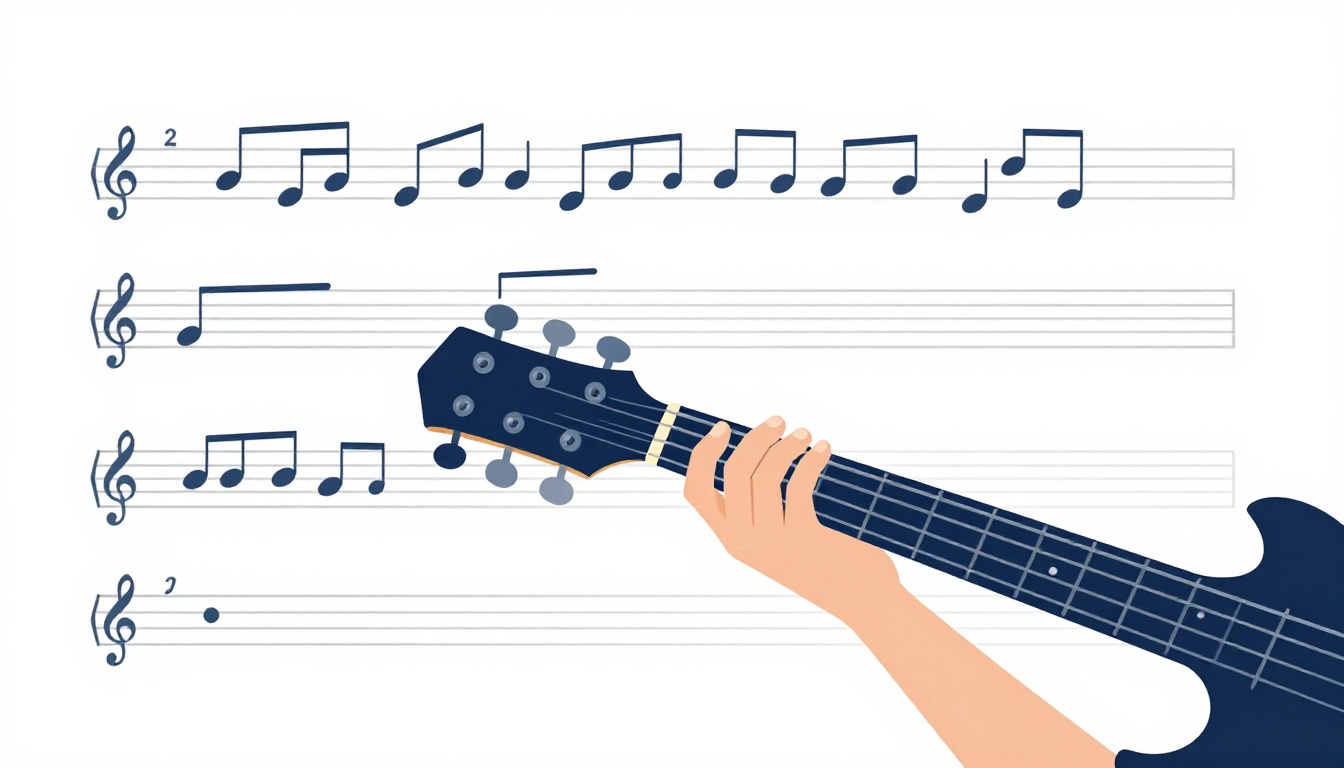
Why Bass Notes on Sheet Music Look Lower Than They Sound
If you ever open standard notation written for bass, you will see it in bass clef (the F clef), the staff most associated with low, dense-looking lines full of ledger lines below the bottom line. There is a quirk worth knowing before it confuses you: bass guitar, like guitar, is what is called a transposing instrument. The notes are written a full octave higher than they actually sound, a convention that exists purely to avoid stacking an unreadable number of ledger lines under the staff.
In practice this means a note printed on the bass clef staff that looks identical to where a cellist or a keyboard player's left hand would read the same pitch is not, in fact, the same pitch on a bass guitar; it sounds an octave lower than written. This is not something you need to correct for yourself while playing, since every method book, chart and arranger who writes for bass already accounts for it. It only matters if you ever compare a bass part directly against a piano part or a cello part written for the same passage and wonder why the bass sounds an octave lower than the page seems to say; nothing is wrong, that gap is built into how bass notation has always worked.
Turning Tab Numbers Into Note Names
Tab is written as string and fret, not as note letters, which is exactly why it is possible to play tab for years without ever naming a note. Here is a short line of tab, low E string on the bottom, the way it is normally written:
G|--------------|
D|--------------|
A|--------------|
E|--0---3---5---0|
Read left to right: open low E, then 3rd fret, then 5th fret, then back to open. Cross-reference the low E string table earlier in this post and that line translates to E, G, A, E. Nothing about the tab changes; you are just attaching the name that was always implied by the string and fret.
This translation is worth doing deliberately with a few basslines you already know by fret number, precisely because you already know how they sound. Hearing "E, G, A, E" while your fingers confirm it feels correct is a far stronger memory hook than drilling an unfamiliar note in isolation, and it is the fastest bridge between the fretboard charts in this post and music you actually want to play.
Open Strings, Muting, and Dead Notes
Notes are not only about which fret you press. An open string left ringing when you meant to stop it, or a neighboring string buzzing because your fretting hand brushed it by accident, changes what actually reaches the amp regardless of what the chart says you played.
Bass players control this with two habits. The first is fretting-hand muting: after you pluck a note, the same finger that is about to fret the next note lightly touches the previous string to stop it ringing, so notes stop cleanly instead of bleeding into each other. The second is palm muting with the plucking hand, resting the edge of your palm lightly across the strings near the bridge to shorten every note's sustain uniformly, common in punchier, more percussive basslines.
Open strings deserve their own mention here because they behave differently from fretted notes: an open string rings until you physically stop it, since no fretting-hand finger is touching it to release. A bassline that alternates a fretted note with the open string next to it can end up muddier than intended if the open string is left ringing under the fretted one, which is one of the few places where knowing the note name matters less than knowing which string is currently vibrating.
A Real Bassline Using Nothing but Open Strings
The open strings are not just a starting point for learning frets, they are usable notes in their own right, and a huge number of basslines lean on them deliberately for their extra sustain and their consistent tone. Here is a simple root-note pattern using only open E and open A, the kind of line that could sit under a two-chord verse:
E|--0---0---0---0---|
A|----------------0-|
Played as steady quarter notes, that is E, E, E, A, four notes, zero frets, and it already sounds like a bassline rather than an exercise, because it is one. Add the D and G open strings and the same idea covers a huge range of simple chord progressions without your fretting hand doing anything but staying out of the way.
The tradeoff is that open strings ring longer and louder than most fretted notes, since an open string has nothing damping it until you touch it again, so a line built entirely on open strings can sound a little uncontrolled next to a fretted line where your finger naturally cuts the note short when you lift off. Mixing one open string into an otherwise fretted line, rather than relying on it for every note, is usually the more useful skill once you are past the first few weeks.
When to Change Your Bass Strings
Strings are the one part of this whole picture that wears out, and old strings do not just go out of tune, they change what a correct note actually sounds like. Dirt, oil and sweat work into the winding over weeks of playing, and as that buildup increases, a string that once rang bright starts to sound muffled, dull and shorter in sustain even when it is perfectly in tune and fretted correctly.
Visually, strings nearing the end of their life often look discolored, dark, or faintly corroded compared to their original shine, and they can feel rough or gritty under your fingers instead of smooth. None of this changes which note lives at which fret, covered earlier in this post, but it does mean a fretboard chart is only half the picture: a dead string playing the "right" note can still sound wrong in a mix, which is a strings problem, not a notes problem, and the fix is a fresh set rather than more practice.
Common Mistakes When Learning the Fretboard
Trying to Memorize All the Fretboard Positions at Once
Twelve frets across four strings is close to fifty individual note positions, and trying to hold all of them in your head simultaneously is exactly why most flashcard apps get abandoned in a week. Learn one string fully before moving to the next, since the shape repeats and the second string takes a fraction of the time the first one did.
Skipping the Open Strings
The four open notes, E-A-D-G, are the foundation every other note is measured against. If you are shaky on which open string is which, every fretted note built on top of that confusion inherits the same shakiness.
Confusing String Number With Fret Number
"Play the 3rd string" and "play the 3rd fret" are unrelated instructions that happen to share a number. Slow down and confirm which one a chart or teacher means, especially early on, until the vocabulary stops colliding in your head.
Only Practicing Ascending
It is much easier to rattle off E-F-G-A going up the neck than it is to reverse it on demand. Real playing requires jumping around, not marching in one direction, so drill the notes backwards and out of order as often as you drill them in sequence.
Ignoring Enharmonic Spelling
Treating F# and Gb as two different mystery notes instead of one familiar fret slows you down every time a chart happens to use the name you did not learn. Learn both names for every sharped or flatted note from the start.
Relearning Each String From Scratch
Because the shape repeats every five frets across strings, treating the A, D and G strings as brand new puzzles wastes the head start the E string gave you. Once one string is solid, actively look for the same pattern shifted over rather than starting the memorization from zero each time.
Assuming an Untuned String Still Matches the Chart
Every table in this post assumes the open strings actually ring at E, A, D and G. A bass that has drifted out of tune, even slightly, makes every fret map technically wrong until it is corrected, and a beginner who has not yet learned to trust their ear can spend weeks convinced they have memorized the wrong note when the real problem is a flat open string. Check tuning with an electronic tuner before a practice session that involves naming notes, not just before a performance.
A Practice Routine to Actually Learn This
Fifteen minutes a day, in this order, gets most players fluent across the whole neck within four to six weeks:
- Minutes 1-3: Say the open strings out loud while plucking each one, low to high and then high to low, until it is automatic.
- Minutes 4-8: Pick one string. Play every fret from open to the 12th, saying the note name out loud as you play it, natural notes and sharps or flats both. Then do it backwards.
- Minutes 9-12: Call out a random note (E, C#, Bb, whatever) and find it on the string you just drilled, in more than one position if you can. Time yourself; the goal is under two seconds per note within a couple of weeks.
- Minutes 13-15: Play the octave shape a few times, low E to D string, A string to G string, until finding an octave up the neck stops requiring a pause to count.
Rotate to the next string the following day rather than trying to cover all four strings in one sitting. By the time you have cycled through all four strings twice, most players find the whole neck starting to feel less like a chart and more like a map they already know.
Testing Yourself: Methods Beyond a Printed Chart
A chart taped to your amp is a fine reference while you learn, but it will not force your recall the way active testing does, and recall under a little pressure is what actually sticks.
- Call and respond, alone. Name a note out loud, then find it on a string before you allow yourself to check a chart. Wrong answers you catch yourself are worth more than right answers you looked up.
- Backwards recitation. Reciting E-F-G-A-B-C-D-E is easy. Reciting it E-D-C-B-A-G-F-E is a genuinely different skill, and it is the one that matters when a bassline moves down the neck instead of up.
- Cross-string check. Every time you land on a note, immediately find the same note on a neighboring string using the octave or unison shapes covered earlier, so you are building redundant paths to the same answer instead of one fragile one.
- Silent fretting. Once out-loud naming feels solid, try naming notes in your head while fretting them, since gigging and jamming never give you a moment to speak the answer first.
- Play along, then check. Learn a simple bassline by ear, then go back afterward and name every note you just played. This is where fretboard knowledge and actual playing finally merge into one skill instead of two.
- Space out your repetition. Testing yourself on a string the day after you learned it, then again three days later, then again a week later, builds recall that survives longer than cramming the same string for an hour straight and never returning to it.
Using Note Names to Actually Play Something
Knowing the notes on paper and using them while playing are two different skills, and the gap between them closes fastest with material, not more charts. Once the open strings and the first five frets on each string feel solid, bass scales are the next step: the same note names arranged into the shapes that basslines are actually built from, starting with the minor pentatonic scale that most riffs already lean on.
If your hands are small or you are finding the stretch across frets uncomfortable while you drill this, it is worth knowing that not every bass is the same scale length; a shorter-scale instrument puts the frets closer together while you are still building this muscle memory, without changing a single note name covered in this post.
Frequently Asked Questions
What are the 4 strings on a bass guitar called?
From thickest to thinnest, the four strings on a standard bass are E, A, D and G, tuned in that order low to high. They are numbered 4th (low E) through 1st (G) when talking about string number rather than note name.
Is bass tuned the same as guitar?
The bottom four strings of a standard six-string guitar are also E-A-D-G, so the note names match, but a bass sounds a full octave lower than a guitar tuned to the same letters. The fret spacing is also wider on most basses because the strings are longer and thicker.
How many notes are on a bass guitar fretboard?
There are twelve unique note names, repeating in the same order up the neck, but the total number of playable positions depends on how many frets your bass has. A 20-fret four-string bass has 80 fretted positions plus 4 open strings, though many of those positions duplicate the same pitch an octave apart.
Do I need to memorize sharps and flats or just the natural notes?
Learn the natural notes first, since they give you the skeleton of the neck and are what most scale and chord names are built from. Add the sharps and flats once the naturals feel automatic; trying to learn all twelve at once on every string is usually what causes people to give up.
Why does the note pattern skip a fret between B and C, and between E and F?
Because those two pairs are only a half step apart in Western music, while every other pair of natural notes is a whole step apart. It is not an exception you need to fix, just a fact about how the twelve notes are spaced that shows up as an uneven-looking pattern on the fretboard.
What is the easiest way to memorize the bass fretboard?
Learn one string completely, out loud, forwards and backwards, before starting the next. Because every string uses the identical pattern shifted five frets over, the second, third and fourth strings take a fraction of the time the first one did.
Does a 5-string or 6-string bass use different notes?
No. The core E-A-D-G strings and every note on them stay exactly the same. Extended-range basses simply add a low B, a high C, or both, so everything you learn on a four-string bass carries over directly.
Does string gauge or roundwound versus flatwound change the notes?
No, gauge and winding style change tone, feel and how much tension the string carries at pitch, not which note lives at a given fret. A heavier gauge or a flatwound string tuned to standard pitch produces the exact same note names as a lighter roundwound set.
Why does bass sheet music sound lower than it looks on the page?
Bass guitar, like the double bass and the standard guitar, is a transposing instrument: what is printed on the bass clef staff sounds a full octave lower than written. This is a long-standing notation convention, not an error, and every method book or chart written for bass already accounts for it.
Do I need to learn note names if I only ever play from tab?
You can get a long way on tab alone, since it tells you exactly which string and fret to play. Note names become useful the moment you want to read a chord chart, discuss a part with another musician, or understand why a line works instead of only where your fingers go, and tab and note names describe the exact same fretboard positions either way.
Does anything about the notes change for a left-handed bass?
No. A bass strung for a left-handed player still runs E-A-D-G, thickest to thinnest, and every fret map in this post still applies exactly as written. What changes is only which physical side of the neck each string sits on and which hand frets versus plucks, not the note names or the intervals between them.
GuitarLowKey
Ready for fifteen focused minutes?
Open the web app and train the change that is blocking your song.