
The C Major Chords on Guitar: All 7, With Every Shape
The seven chords in the key of C major on guitar (C, Dm, Em, F, G, Am, Bdim), the exact shape for each, and the progressions that use them.

The seven chords in the key of C major are C, Dm, Em, F, G, Am, and Bdim. Three are major (C, F, G), three are minor (Dm, Em, Am), and one is diminished (Bdim). Every one of them comes from the C major scale, no sharps or flats anywhere in the key, which is why C is usually the first key a beginner learns to play in on purpose rather than by accident. Below is the shape for each chord, where the seven of them come from, the progressions that use them in real songs, and the trouble spots that show up once you start switching between them at tempo.
| Degree | Chord | Type |
|---|---|---|
| I | C | Major |
| ii | Dm | Minor |
| iii | Em | Minor |
| IV | F | Major |
| V | G | Major |
| vi | Am | Minor |
| vii° | Bdim | Diminished |
Where These Seven Chords Come From
Every major key has exactly seven chords, one built on each note of its major scale. The C major scale is C, D, E, F, G, A, B, and back to C, the only major scale with no sharps or flats at all.
| Degree | Note | Interval |
|---|---|---|
| 1 | C | Root |
| 2 | D | Major 2nd |
| 3 | E | Major 3rd |
| 4 | F | Perfect 4th |
| 5 | G | Perfect 5th |
| 6 | A | Major 6th |
| 7 | B | Major 7th |
Stack a note, skip one, add the next, skip one, add the next again (a third on top of a third) starting from each degree of that scale, and you get the seven chords in the first table. C, E, G gives you C major. D, F, A gives you D minor. E, G, B gives you E minor. F, A, C gives you F major. G, B, D gives you G major. A, C, E gives you A minor. B, D, F gives you B diminished.
The pattern behind which chord is major, minor, or diminished never changes, no matter which key you are in. The 1st, 4th, and 5th degrees are always major. The 2nd, 3rd, and 6th degrees are always minor. The 7th degree is always diminished, because the notes stacked on top of it do not line up into a clean major or minor triad. Once that pattern is in your hands for C, it transfers directly to every other key you learn later.
Chords vs. the Scale They Come From
It is worth being precise about one distinction before going further, because the two get mixed up constantly. The C major scale is a sequence of seven single notes played one at a time, C, D, E, F, G, A, and B. The C major chords covered in this post are what you get when you group three or more of those same notes and play them together. The scale is the raw material. The chords are specific combinations pulled from it.
This matters practically because the two get practiced completely differently. A scale is a finger exercise, run up and down the neck to build speed and familiarity with where the notes live. A chord is a shape you hold down and strum or pick. You do not need to know the scale to play the chords, and knowing the scale will not automatically teach you the chord shapes, they are related but separate skills that both happen to draw from the same seven notes.
The Notes Inside Each Chord
Every chord shape you fret is a physical way of sounding three specific notes at once. Knowing which three notes make up each chord is what lets you understand why a shape works, not just where to put your fingers.
| Chord | Notes | Formula |
|---|---|---|
| C | C, E, G | 1, 3, 5 |
| Dm | D, F, A | 1, b3, 5 |
| Em | E, G, B | 1, b3, 5 |
| F | F, A, C | 1, 3, 5 |
| G | G, B, D | 1, 3, 5 |
| Am | A, C, E | 1, b3, 5 |
| Bdim | B, D, F | 1, b3, b5 |
The formula column shows each chord's notes measured against its own root, not against C. A major chord is always root, major 3rd, perfect 5th (1, 3, 5). A minor chord flattens the middle note to a minor 3rd (1, b3, 5). A diminished chord flattens both the middle note and the top note (1, b3, b5). That is the entire difference between a bright chord, a darker chord, and a tense one, one or two notes moved by a single fret's worth of pitch.
Notice how the notes overlap between neighbors. C major (C, E, G) and Am (A, C, E) share two notes, C and E. Em (E, G, B) and G major (G, B, D) share two notes, G and B. That overlap is not a coincidence, it is why chords next to each other on this list tend to sound close in color, and it is part of why Am can stand in for C in a pinch, and Em can lean toward G.
The C Chord
To play a C chord, mute the low E string, put your ring finger on the 3rd fret of the A string, your middle finger on the 2nd fret of the D string, and your index finger on the 1st fret of the B string, then strum from the A string down through the high E string.
| String | Fret | Finger |
|---|---|---|
| 6 (low E) | Muted | - |
| 5 (A) | 3 | 3 (ring) |
| 4 (D) | 2 | 2 (middle) |
| 3 (G) | Open | - |
| 2 (B) | 1 | 1 (index) |
| 1 (high E) | Open | - |
C is the tonic of the key, the chord that sounds like home. Almost every progression in this key starts and ends on it.
The Dm Chord
To play a D minor chord, mute the low E and A strings, keep the D string open, put your middle finger on the 2nd fret of the G string, your ring finger on the 3rd fret of the B string, and your index finger on the 1st fret of the high E string.
| String | Fret | Finger |
|---|---|---|
| 6 (low E) | Muted | - |
| 5 (A) | Muted | - |
| 4 (D) | Open | - |
| 3 (G) | 2 | 2 (middle) |
| 2 (B) | 3 | 3 (ring) |
| 1 (high E) | 1 | 1 (index) |
Dm is the ii chord. Its most common job is setting up G in a ii-V-I move (Dm to G to C), a resolution that shows up in jazz standards and pop choruses alike.
The Em Chord
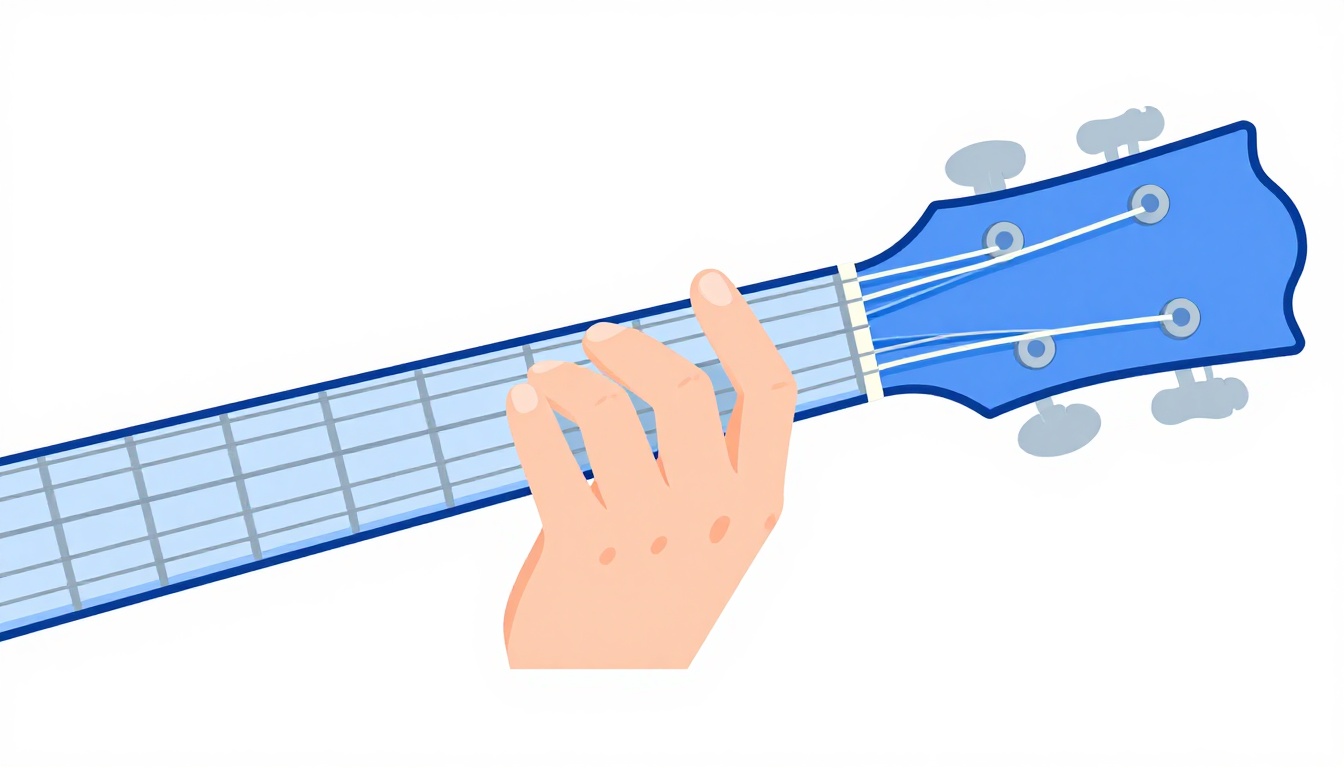
To play an E minor chord, put your middle finger on the 2nd fret of the A string and your ring finger on the 2nd fret of the D string. Every other string, low E, G, B, and high E, stays open.
| String | Fret | Finger |
|---|---|---|
| 6 (low E) | Open | - |
| 5 (A) | 2 | 2 (middle) |
| 4 (D) | 2 | 3 (ring) |
| 3 (G) | Open | - |
| 2 (B) | Open | - |
| 1 (high E) | Open | - |
Em is the iii chord and the easiest shape in this key, only two fingers, all six strings ring. It is usually the first minor chord a beginner ever plays.
The F Chord
F is the one shape in this key that trips people up, because the full version is a barre chord. To play the full F, lay your index finger flat across all six strings at the 1st fret, then add your middle finger on the 2nd fret of the G string, your ring finger on the 3rd fret of the A string, and your pinky on the 3rd fret of the D string.
| String | Fret | Finger |
|---|---|---|
| 6 (low E) | 1 | 1 (index, barre) |
| 5 (A) | 3 | 3 (ring) |
| 4 (D) | 3 | 4 (pinky) |
| 3 (G) | 2 | 2 (middle) |
| 2 (B) | 1 | 1 (index, barre) |
| 1 (high E) | 1 | 1 (index, barre) |
There is an easier version that skips the barre entirely. Mute the low E and A strings, put your ring finger on the 3rd fret of the D string, your middle finger on the 2nd fret of the G string, and your index finger on the 1st fret of the B string, then strum only those three middle strings.
| String | Fret | Finger |
|---|---|---|
| 6 (low E) | Muted | - |
| 5 (A) | Muted | - |
| 4 (D) | 3 | 3 (ring) |
| 3 (G) | 2 | 2 (middle) |
| 2 (B) | 1 | 1 (index) |
| 1 (high E) | Muted | - |
This three-string version leaves out the low root note the barre version has, but it contains the same three notes, F, A, and C, so it functions as a real F chord, not a substitute. It is the shape to start with if the barre is not solid yet.
The two versions are not fully interchangeable in every context, though. The full barre gives you a low F root note that anchors the chord and fills out the bottom end when you are playing alone or with a bassist who is not covering that note. The three-string version sounds lighter and sits higher in pitch, which works well in a band setting where something else is already covering the low end, but can feel thin when it is the only instrument playing. Neither is wrong, they are two tools for two different situations.
The G Chord
To play a G chord, put your middle finger on the 3rd fret of the low E string, your index finger on the 2nd fret of the A string, and your ring finger on the 3rd fret of the high E string. The D, G, and B strings stay open.
| String | Fret | Finger |
|---|---|---|
| 6 (low E) | 3 | 2 (middle) |
| 5 (A) | 2 | 1 (index) |
| 4 (D) | Open | - |
| 3 (G) | Open | - |
| 2 (B) | Open | - |
| 1 (high E) | 3 | 3 (ring) |
G is the V chord, the dominant, the one that creates the pull back toward C. A song can wander through Dm, Em, F, and Am, but a G chord almost always signals that C is about to come back.
The Am Chord
To play an A minor chord, keep the A string open, put your index finger on the 1st fret of the B string, your middle finger on the 2nd fret of the D string, and your ring finger on the 2nd fret of the G string.
| String | Fret | Finger |
|---|---|---|
| 6 (low E) | Muted | - |
| 5 (A) | Open | - |
| 4 (D) | 2 | 2 (middle) |
| 3 (G) | 2 | 3 (ring) |
| 2 (B) | 1 | 1 (index) |
| 1 (high E) | Open | - |
Am is the vi chord, also called the relative minor of C, because it shares every note with the C major scale. It is the chord that gives a progression in this key its sadder or more reflective moment without ever leaving the key.
The Bdim Chord
To play a B diminished chord, mute the low E and high E strings, put your index finger on the 2nd fret of the A string, your middle finger on the 3rd fret of the D string, your ring finger on the 3rd fret of the B string, and your pinky on the 4th fret of the G string.
| String | Fret | Finger |
|---|---|---|
| 6 (low E) | Muted | - |
| 5 (A) | 2 | 1 (index) |
| 4 (D) | 3 | 2 (middle) |
| 3 (G) | 4 | 4 (pinky) |
| 2 (B) | 3 | 3 (ring) |
| 1 (high E) | Muted | - |
Bdim is the vii° chord, and it is by far the least played of the seven. Its three notes, B, D, and F, sit close together in pitch, which is what gives every diminished chord its tense, unresolved character. In practice it almost never gets strummed on its own in a song. It shows up as a passing chord, a brief step between two other chords in the progression, or gets replaced entirely by a G7, which contains the same tension and resolves the same way but is easier to grab.
All three of Bdim's notes, B, D, and F, are also inside G7 (G, B, D, F), which is the real reason the two chords are so often used in place of each other. A guitarist reading a chart that calls for Bdim will frequently just play G7 instead, since the ear hears the same tension resolving to C either way, and G7 is a shape most players already know from elsewhere in this key.
Which Chord to Learn First
The seven shapes above are listed in scale-degree order, C through Bdim, but that is not the order most players should learn them in. A more useful order follows how much each shape asks of your fretting hand.
Start with Em, two fingers, all six strings open and ringing, the easiest full chord in the key. Am comes next, three fingers, still only one string muted. C follows, the same three-finger difficulty as Am but with a bigger stretch for the ring finger. G is a comfortable fourth, three fingers again, spread a little wider across the neck. Dm is a reasonable fifth, three fingers on only three strings, which some players find easier than G and others find harder, depending on hand size. F, the barre chord, comes second to last on purpose, since it benefits from the finger strength and independence the first five chords build up. Bdim comes last, both because it asks for four fingers packed into three frets and because you will use it the least once you are actually playing songs.
That order gets you playing real progressions fast. C, Am, and Em alone already cover a huge number of simple songs, and adding G gets you into the I-IV-V and I-V-vi-IV progressions from the table below well before the barre chord is holding you back.
Why These Seven Chords Sound Like They Belong Together
Every chord in this key comes from the same seven notes, so nothing you play using only C, Dm, Em, F, G, Am, and Bdim can land on a note outside the key. That is the entire reason a beginner can strum almost any combination of these seven and have it sound intentional. The notes were never going to clash, because they are all drawn from one scale.
The three major chords, C, F, and G, carry the most weight. C is the tonic, the chord a progression rests on. F is the subdominant, a chord that moves away from home without creating much tension. G is the dominant, the chord that creates the strongest pull back to C. Almost every chord progression in this key is built around those three functions, with the minor chords, Dm, Em, and Am, adding color and variation along the way.
The tonic: C
C is where a progression in this key starts and, almost always, where it ends. Landing on C after a run of other chords is what makes a phrase feel finished rather than left hanging. Every other chord in the key gets defined by how far it sits from this one.
The subdominant: F (and Dm)
F is the chord most often used to step away from C without creating real tension, which is why so many progressions move C to F before anything else happens. Dm shares two of F's roles as a stepping-away chord too, since it sits a similar harmonic distance from home, which is part of why Dm and F both work as a lead-in to G in a longer progression.
The dominant: G (and Em)
G is the chord with the strongest pull back to C, built on the note a perfect 5th above the root. That pull is strong enough that a progression can sit on G for an extended stretch and the ear will keep expecting C to arrive. Em, sharing two notes with G, can lean into some of that same dominant color in a softer way, which is why it often appears just before a G chord rather than a C chord.
How this resolves: cadences
The specific move from one chord to another at the end of a phrase has its own name in music theory, and three of them account for almost everything you will play in this key.
| Cadence | Chords | Effect |
|---|---|---|
| Authentic | G to C (V-I) | The strongest, most finished-sounding resolution |
| Plagal | F to C (IV-I) | A softer resolution, sometimes called the "Amen" cadence |
| Half | Any chord to G (ending on V) | Sounds unfinished on purpose, expects more to follow |
You do not need to name these while you are playing them, but recognizing the sound of each one is what lets you predict where a progression is headed the first time you hear it, rather than only after you have looked up the chords.
The Chord Progressions Built From These Seven Chords
A handful of patterns account for most songs written in this key. Each one uses the Roman numerals from the first table, so the same shape transposes directly to any other major key once you know it by number instead of by letter.
| Progression | Chords in C | Feel |
|---|---|---|
| I-IV-V | C, F, G | The most common progression in popular music |
| I-V-vi-IV | C, G, Am, F | The four-chord pattern behind a huge number of modern songs |
| I-vi-IV-V | C, Am, F, G | The classic 1950s doo-wop progression |
| ii-V-I | Dm, G, C | A jazz staple, a smooth, stepwise resolution back to C |
"Let It Be" by The Beatles is a well-documented real-world example: the verse moves through C, G, Am, and F, drawing on both the I-V-vi-IV and I-IV-V shapes above, and it never once leaves the key of C.
A Strumming Pattern to Start With
The shapes matter less than the rhythm once you are actually playing a song, and a single pattern covers most of what these progressions need. Count each bar in four, and strum down on beats 1 and 3, with an extra down-up pair filling in beats 2-and and 4-and.
| Beat | 1 | 2 | 2-and | 3 | 4 | 4-and |
|---|---|---|---|---|---|---|
| Strum | Down | - | Down-up | Down | - | Down-up |
Apply that same pattern across a full C to F to G to C loop, one bar per chord, before trying it on anything faster. Once it feels automatic, the same pattern carries directly into "Let It Be"'s verse, since each chord in that progression also gets roughly a full bar.
For the two chords that only use three or four strings, Dm and the no-barre F, keep the same strumming rhythm but shorten the reach of your strumming hand so it only crosses the strings that chord actually uses. The pattern does not change, only the width of the strum.
The Diatonic 7th Chords in the Key of C
Once the seven triads above feel comfortable, the next layer is the seventh chord version of each one, built by stacking one more third on top. These are the exact chords a lot of jazz, R&B, and singer-songwriter charts call for instead of the plain triads, and every one of them still belongs to the key of C.
| Degree | Triad | 7th chord | Type |
|---|---|---|---|
| I | C | Cmaj7 | Major 7th |
| ii | Dm | Dm7 | Minor 7th |
| iii | Em | Em7 | Minor 7th |
| IV | F | Fmaj7 | Major 7th |
| V | G | G7 | Dominant 7th |
| vi | Am | Am7 | Minor 7th |
| vii° | Bdim | Bm7b5 | Half-diminished |
The pattern holds the same way it does for the triads. The I and IV chords become major 7ths. The ii, iii, and vi chords become minor 7ths. The V chord becomes a dominant 7th, the chord type that creates the strongest possible pull back to C, which is why the ii-V-I progression is usually written and played as Dm7 to G7 to Cmaj7 rather than with plain triads. The vii° chord becomes a half-diminished chord, written Bm7b5 or Bø, a slightly softer relative of Bdim that shows up constantly in jazz but rarely in pop or rock.
You do not need all seven of these to play convincingly in this key. G7 is worth learning early since it is genuinely easier than G major for some hands and it is the chord most often substituted for Bdim, as covered above. The rest, Cmaj7, Dm7, Em7, and Fmaj7, are each their own shapes worth learning once the plain triads are solid, and they slot into any of the progressions above without changing the progression's function at all, just its color.
Why the Chords Are Not Sounding Right
The C chord buzzes on the B string
If the note on the 1st fret of the B string is muffled or dead, your index finger is probably resting too close to the fret wire itself instead of just behind it. Move your fingertip back a couple of millimeters toward the middle of the fret and press again.
The D minor chord sounds thin
Dm only uses three of the six strings, so it will always sound smaller than a full six-string chord. That is normal. If it sounds muted rather than just thin, check that your middle finger on the G string is not leaning over and touching the B string next to it.
The F barre buzzes on the low strings
Most F barre buzz comes from the index finger not applying even pressure across all six strings. Roll your index finger very slightly onto its side, rather than laying it flat, and bring your fretting hand's thumb around to sit roughly behind your middle finger on the back of the neck for leverage.
The G chord sounds muddy in the middle
If the open D, G, or B strings sound choked rather than ringing, one of your fretting fingers is probably leaning across and touching a string it should not be near. Check that your middle finger, on the low E string, is arched enough to clear the A string next to it.
The A minor chord loses the open high E string
If the top string goes quiet, your ring finger on the G string is likely tilted forward far enough to mute the high E string beside it. Straighten that finger's angle so its tip lands squarely on the G string only.
The Bdim shape feels like a stretch
Four fingers packed into three frets is a tight reach for most hands starting out. Bring your fretting hand's thumb further down behind the neck, closer to the D string, which gives your fingers more room to curl in from above rather than reaching flat.
Habits That Slow Down This Whole Key
Beyond the string-by-string fixes above, a few habits show up across almost every beginner working through these seven chords, and they are worth catching early because they compound across every progression you try.
Strumming all six strings out of habit
Three of these seven shapes, Dm, the no-barre F, and Bdim, are not meant to be strummed across all six strings. Strumming past the intended range on any of them adds a note that does not belong to the chord, usually a low, out-of-key thud from the low E or A string. Look at your strumming hand's starting string before every chord change in this key, not just at the fretting hand.
Resetting the whole hand on every change
Chords that share a finger position, like C and Am both using the index finger on the B string's 1st fret, do not need every finger lifted and replaced. Lifting the whole hand and rebuilding the shape from scratch on every single change is the single biggest source of slow, gappy chord changes. Look for the finger that does not need to move and leave it planted.
Treating Bdim like a chord you strum on beat one
Because it is diminished and used almost exclusively as a passing chord, Bdim rarely gets a full, confident downstroke the way C or G does. Beginners who practice it as a standalone chord, the same way they practice the other six, often end up strumming it too hard and too long when it finally shows up in a real progression, which makes an already tense-sounding chord feel like a mistake rather than an intentional color.
Practicing the barre before the rest of the hand is ready
The F barre chord asks more of your fretting hand's strength and finger independence than any other shape in this key. Spending five minutes drilling a full barre chord before your ring finger and pinky can reliably hold their own frets elsewhere in the key usually just builds frustration. The no-barre F version exists for exactly this reason, use it until the rest of your hand is fluent, then bring the barre in on its own.
Playing the Same Progressions in Other Keys With a Capo
Every progression in this post is built from Roman numerals, I, IV, V, vi, and so on, precisely so it can move to a different key without you learning new shapes. A capo is the fastest way to do that. Clamp a capo on a given fret and every open chord shape you already know in the key of C sounds that many half steps higher, while your fingers keep doing exactly what they already learned.
| Capo fret | Shapes you play | Key it actually sounds in |
|---|---|---|
| No capo | C, Dm, Em, F, G, Am, Bdim shapes | C major |
| 2nd fret | Same shapes | D major |
| 3rd fret | Same shapes | Eb major |
| 5th fret | Same shapes | F major |
| 7th fret | Same shapes | G major |
This is a large part of why the key of C gets taught first. Once these seven shapes and the progressions built from them are in your hands, a capo lets you play in half a dozen other keys immediately, without learning a single new chord shape, which is especially useful for singing a song in whatever key actually fits your voice.
Easier Versions for Small Hands or New Players
Two of these seven chords have genuinely easier stand-ins that keep the same basic sound while asking less of your hand.
| Chord | Easier version | What changes |
|---|---|---|
| F (barre) | F, no-barre 3-string version (above) | Drops the low root note, keeps the same three chord tones |
| Bdim | G7 | Same tense, unresolved function, far easier shape |
G7 is worth knowing on its own: low E muted, A string 2nd fret (finger 2), D string open, G string open, B string 1st fret (finger 1), high E 1st fret (finger 3). It resolves to C exactly the way Bdim does, and most players use it in place of Bdim from the very start.
Moving Between the Seven Chords
The shapes are never the hard part. The hard part is getting from one to the next without a gap in the sound. A few moves in this key repay the practice time more than others.
C to Am. Your index and middle fingers barely move, since both chords use the 1st fret on the B string and the 2nd fret on a neighboring string. Only your ring finger has real work to do, lifting off the A string and landing on the G string.
F to C. Going from the barre shape, release the barre entirely and reset your ring finger from the A string's 3rd fret to the same string's 3rd fret again (it does not move), while your middle finger slides from the G string's 2nd fret to the D string's 2nd fret. Using the no-barre F makes this change noticeably faster, since your index finger only has to move down one string.
G to Em. Both chords share almost no common finger positions, which makes this one of the harder changes in the key. Practice it in isolation, slowly, before dropping it into a full progression.
Dm to G. This is the ii-V half of the ii-V-I move. Your index finger on Dm's high E string and your index finger on G's A string are doing completely different jobs, so treat this as a full hand reset rather than a small adjustment.
Am to Dm. All three fingers shift over by exactly one string and nothing else changes shape. Your index finger moves from the B string to the high E string, same 1st fret. Your middle finger moves from the D string to the G string, same 2nd fret. Only your ring finger changes fret as well as string, moving from the G string's 2nd fret to the B string's 3rd fret. Once you feel that shared motion, this becomes one of the smoothest changes in the whole key.
Em to C. Your middle finger stays on the same 2nd fret for both chords, it just slides over from the A string to the D string. Your ring finger has the bigger job, moving from the D string's 2nd fret to the A string's 3rd fret, and your index finger is brand new, landing on the B string. Lead with the middle finger's slide and the other two tend to fall into place around it.
Practice each pair of chords on its own, four beats on one chord and four beats on the next, before trying the whole progression at tempo. Speed comes from removing wasted motion between two shapes, not from moving your whole hand faster.
A Practice Routine for This Key
Spend ten to fifteen minutes on this the first week:
- Play each of the seven chords once, slowly, checking every string rings clean before moving to the next. Two minutes.
- Loop C to F to G to C, four beats per chord, with a metronome at a slow, comfortable tempo. Three minutes.
- Loop C to G to Am to F, the same four-beat pattern. Three minutes.
- Practice the two hardest changes for you personally in isolation, back and forth, without a backing rhythm. Three minutes.
- Play "Let It Be"'s verse progression (C, G, Am, F) along with a slow strum, focusing on keeping the strum going even through a rough chord change. Three minutes.
The goal in week one is not speed. It is removing the pause between chords. A slightly slow chord change with no gap in the sound is better practice than a fast change that stops the rhythm dead.
Week two: add the barre and the diminished chord
Once C, Dm, Em, G, and Am feel settled, bring in the full F barre and Bdim on their own, away from any progression. Fret the barre, strum once, release, rest, and repeat, ten times, focused entirely on getting a clean sound rather than on speed. Do the same with Bdim. Then run the ii-V-I loop, Dm to G to C, at the same slow metronome tempo from week one.
Week three: put it all together
Play through all four progressions from the table above, back to back, without stopping to fix a mistake mid-loop. Let a bad chord change happen and keep the rhythm going, the same way you would in a real song. This is also the point to try the "Let It Be" verse progression at a natural tempo, since by week three the four chords it uses, C, G, Am, and F, should already be familiar individually.
By the end of three weeks, the seven shapes themselves stop being the bottleneck. What is left to build after that is speed and the muscle memory for switching without looking at your hand, which comes from repetition inside real songs more than from drills.
Fingerpicking These Chords Instead of Strumming
Every shape in this post works just as well picked note by note as it does strummed. The basic approach is the same for all seven: rest your thumb on the lowest string the chord actually uses (the A string for C, Am, and Bdim, the D string for Dm and the no-barre F, the low E string for Em and G), and use your first three fingers to pick the remaining strings in order, low to high.
A simple pattern to start with is thumb, then the three higher strings in sequence: thumb on the bass note, index on the next string up, middle on the string above that, ring on the top string in the chord. Play it slowly, one note at a time, on a single chord until every note rings clearly before moving to the next chord in a progression.
Fingerpicking exposes fretting problems that strumming can hide, because a single muted or buzzing string is far more obvious when you can hear it in isolation rather than buried inside a full strum. If a chord sounded fine strummed but falls apart picked, that is worth treating as useful information about your fretting hand, not a sign that fingerpicking itself is the problem.
Different Ways These Chords Get Written
Chord charts, songbooks, and apps do not all use the same symbols for the same chords, and running into an unfamiliar label mid-song is a common point of confusion.
| Chord | Also written as |
|---|---|
| C | Cmaj, CM |
| Dm | Dmin, D- |
| Em | Emin, E- |
| F | Fmaj, FM |
| G | Gmaj, GM |
| Am | Amin, A- |
| Bdim | Bo, Bm(b5) |
All of these refer to the exact shapes covered in this post. A plain letter with nothing after it, like "C" or "G," always means the major chord. A lowercase "m," a minus sign, or the word "min" always means minor. The small circle or "dim" always means diminished. Once that pattern is familiar, an unusual-looking chord symbol on an unfamiliar chart stops being a reason to stop and look something up.
How This Key Connects to Others
C major shares its seven notes exactly with A minor, its relative minor, which is why the Am chord in this key feels so at home. If you already have the open C chord under your fingers on its own, everything in this post builds directly on that same shape.
Learning a key this way, by degree rather than by letter name, is also what lets these same four shapes, I-IV-V and I-V-vi-IV, transfer to the key of Ab major or any other key later, even though the actual chord letters change completely.
Frequently Asked Questions
What are the 7 chords in C major?
C, Dm, Em, F, G, Am, and Bdim. C, F, and G are major. Dm, Em, and Am are minor. Bdim is diminished.
Do you need a capo to play in the key of C?
No. Every chord in this key has a standard open or easy shape, and the only chord that needs a barre at all is F, which also has a no-barre three-string alternative.
What is the easiest chord in the key of C major?
Em, two fingers, all six strings ring. Am and C are close behind at three fingers each.
Why is Bdim never used in songs?
Its three notes sit close together and create a tense, unresolved sound that rarely gets asked to just sit still. Most songs either use it briefly as a passing chord between two others or substitute a G7 in its place, since G7 creates a similar pull toward C with an easier shape.
What is the relative minor of C major?
A minor. It shares all seven notes with C major, which is why the Am chord, the vi chord in this key, sounds so natural inside a C major progression.
Can I play these chords in a different order than the table shows?
Yes. The order in a progression is a musical choice, not a rule. What matters is that all seven chords come from the same scale, so any combination of them will sound like it belongs in the key.
What is the difference between the I-IV-V and I-V-vi-IV progressions?
I-IV-V (C, F, G) skips the minor chords entirely and has a brighter, more direct sound. I-V-vi-IV (C, G, Am, F) adds Am, which gives the progression a more reflective turn before F resolves it back toward C.
Why does F feel so much harder than the other six chords?
It is the only chord in this key that needs a full barre to play in its standard form. Every other chord in the key uses at least one open string, which takes real pressure off your fretting hand. The no-barre F version removes that difficulty at the cost of one low note.
Is C major a good key for a total beginner?
Yes, and for a specific reason beyond having no sharps or flats. Five of its seven chords, C, Dm, Em, G, and Am, use at least one open string and stay within the first three frets, so your fretting hand spends its earliest weeks building strength and accuracy rather than fighting a barre. F is the only real exception, and it has a workable no-barre substitute for exactly that reason.
What is the difference between C and Cmaj7?
C major is the triad, C, E, and G. Cmaj7 adds a fourth note, B, the major 7th above the root, which is also the 7th degree of the C major scale itself. The two chords share the same three-note foundation, so Cmaj7 can often replace a plain C chord in a progression for a softer, more open sound without changing the chord's function.
How long does it take to learn all seven chords cleanly?
Most players can fret all seven shapes within the first week or two, but "clean" is a different milestone than "correct." Expect the individual shapes to sound right within days, and the changes between them, especially into and out of the F barre, to keep improving for several weeks of regular practice after that.
GuitarLowKey
Ready for fifteen focused minutes?
Open the web app and train the change that is blocking your song.