
C#m7 Guitar Chord: Every Way to Play C Sharp Minor 7
The full C#m7 barre shape, a capo trick that skips the barre, a rootless four-string version, and how to switch into C#m7 without losing the beat.
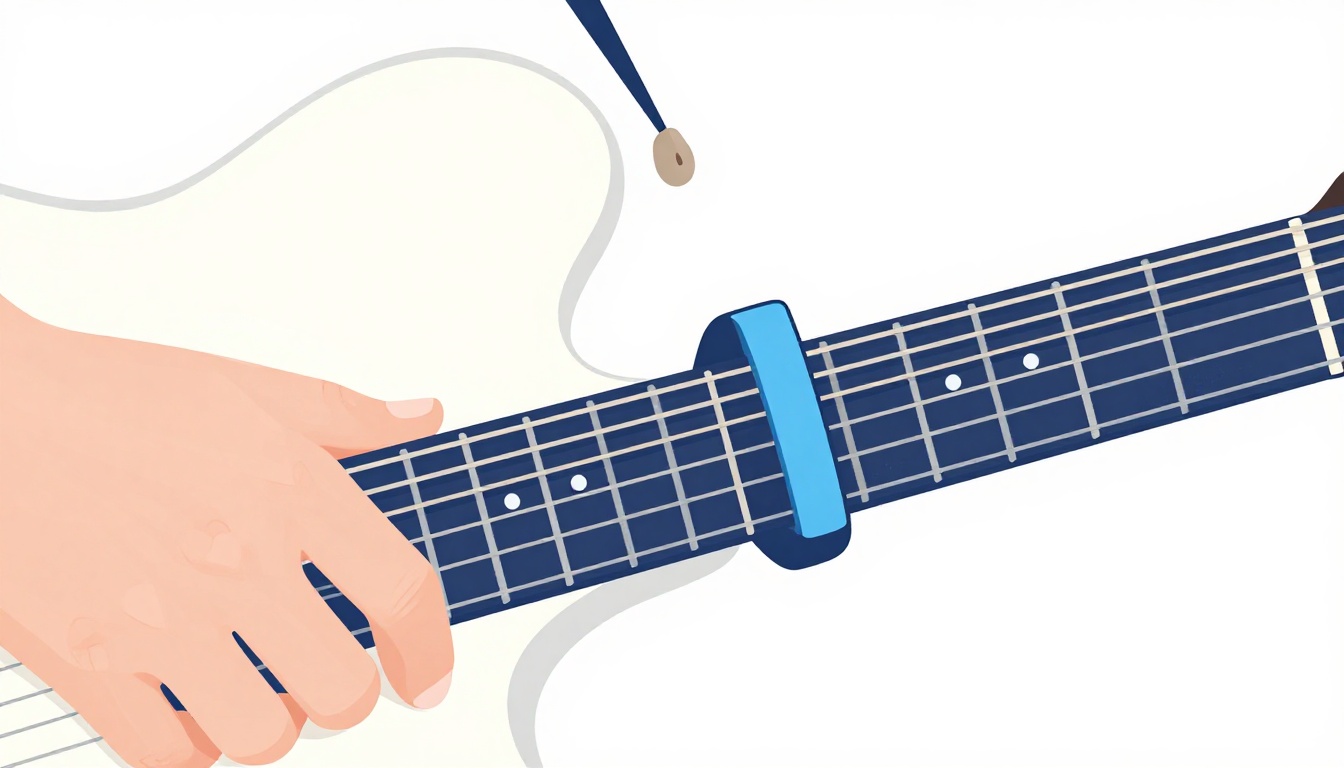
To play C#m7 on guitar, mute the low E string, lay your index finger flat across the 4th fret from the A string through to the high E string, press your ring finger on the 6th fret of the D string, and press your middle finger on the 5th fret of the B string. Strum the five strings from the A string down. There is no open-position version of this chord, but a capo at the 4th fret lets you play it with a familiar two-finger open shape instead of a barre, and that trick, along with the full barre version and a lighter alternative, is everything below.
String names, numbers, and standard tuning
Every fret number and finger placement in this post refers to the six strings by both name and number, so it helps to have those straight before anything else.
| String number | Name | Standard tuning |
|---|---|---|
| 6 | Low E | E |
| 5 | A | A |
| 4 | D | D |
| 3 | G | G |
| 2 | B | B |
| 1 | High E | E |
Strings are numbered thinnest to thickest, so the 1st string is the thinnest, the high E, and the 6th string is the thickest, the low E. Standard tuning, low to high, is E-A-D-G-B-E. Every shape in this post assumes standard tuning, so if your open strings are not producing those exact notes, none of the fret numbers below will land where they should. Check your tuning with a tuner before troubleshooting a chord that will not ring clean, since a chord that is out of tune will buzz and sound wrong no matter how well you fret it.
Finger numbering follows the usual convention too: 1 is your index finger, 2 is your middle finger, 3 is your ring finger, 4 is your pinky. The thumb is written as T when it comes up, which it does once in this post.
What notes make up C#m7
C#m7 is built from four notes: C# (the root), E (the minor third), G# (the perfect fifth), and B (the minor seventh). In interval terms, that formula is 1, flat 3, 5, flat 7, the same formula behind every minor seventh chord on the instrument, whether it is Am7, Em7 or C#m7.
| Note | Interval | Role |
|---|---|---|
| C# | 1 (root) | Names the chord |
| E | Flat 3 | Makes it minor |
| G# | 5 | Perfect fifth, the stable middle |
| B | Flat 7 | The note that turns C#m into C#m7 |
That last note is the one doing the actual work. Take it away and you are left with a plain C#m triad, C#, E and G#. Add it back and the chord gets the softer, jazzier color that minor seventh chords are known for, less final-sounding than a plain minor triad, which is part of why C#m7 shows up so often as a passing or connecting chord rather than a chord a song ends on.
This same formula works for any minor seventh chord, which is useful to know once C#m7 stops being a one-off shape you memorized and starts being a pattern you understand. Take the root of any minor chord, count up a flat third, a perfect fifth and a flat seventh, and you have that chord's minor seventh version. The reason Am7, Em7, Dm7 and C#m7 all look and feel related on the fretboard, even in completely different positions, is that they are all built from exactly this same shape of intervals, just starting from a different note.
The main C#m7 shape, string by string
This is the shape most guitar chord charts show first for C#m7, and the one you will use most once your hand can hold it comfortably.
| String | Fret | Finger |
|---|---|---|
| 6 (low E) | Muted | - |
| 5 (A) | 4 | 1 (index, barre) |
| 4 (D) | 6 | 3 (ring) |
| 3 (G) | 4 | 1 (index, barre) |
| 2 (B) | 5 | 2 (middle) |
| 1 (high E) | 4 | 1 (index, barre) |
Build it in this order. Lay your index finger flat across the 4th fret, starting at the A string and running all the way to the high E string. That single finger is responsible for three of the five notes: the A, G and high E strings, all at the 4th fret. Then add your ring finger on the D string, 6th fret, and your middle finger on the B string, 5th fret. Both of those fingers land slightly further from the nut than your index finger's barre, on the same two strings your index finger is already touching, which is fine. The note that sounds on a string is always the one fretted closest to the bridge, so your ring and middle fingers simply take over on those two strings.
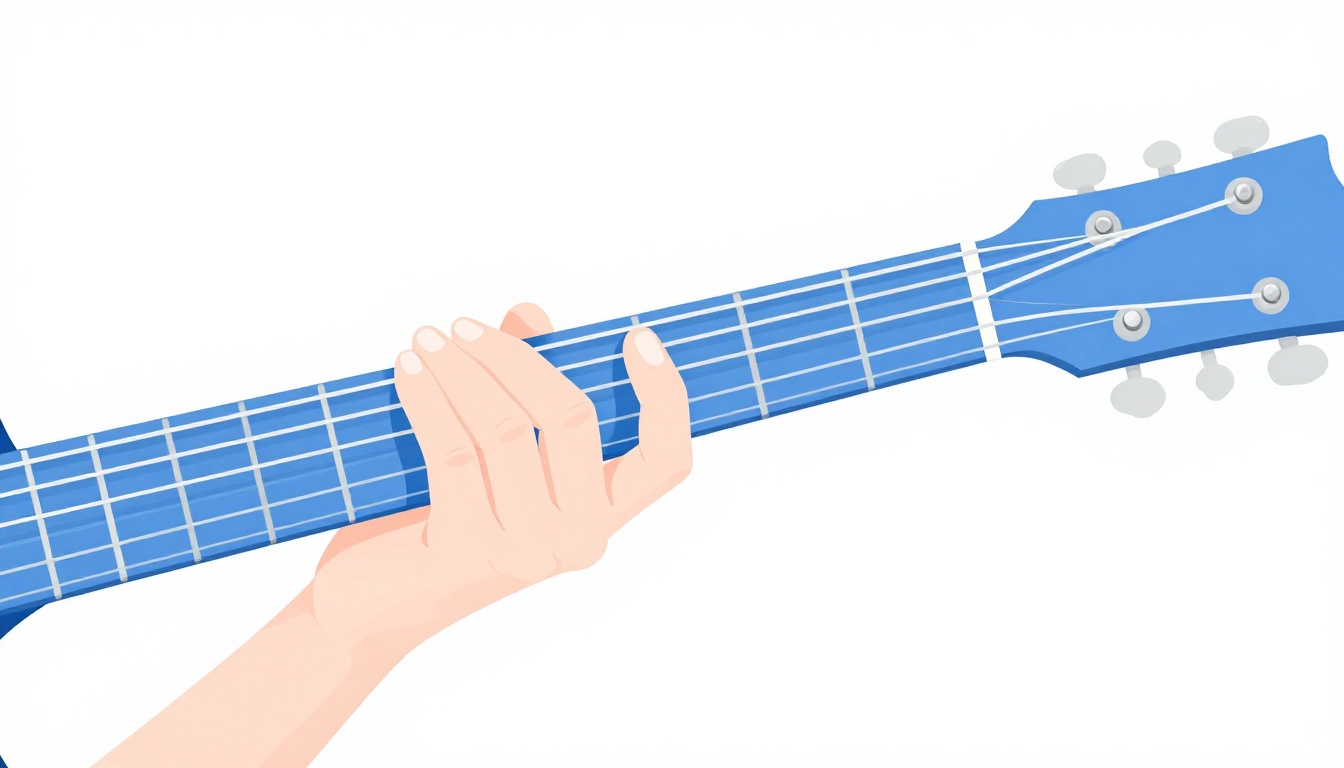
Mute the low E string with the side of your index finger or your thumb, and strum from the A string down through the high E string. Five strings, three fingers, one of them doing triple duty.
The capo trick that skips the barre entirely
If the barre above is not happening for you yet, there is a genuinely easier way to reach the exact same chord, not an approximation of it.
Clip a capo onto the 4th fret. Behind the capo, play the open Am7 shape: leave the A, G and high E strings open, press your index finger on the 1st fret of the B string, and press your middle finger on the 2nd fret of the D string. Mute the low E string. Strum from the A string down.
| String | Relative fret (behind capo) | Finger |
|---|---|---|
| 6 (low E) | Muted | - |
| 5 (A) | Open | - |
| 4 (D) | 2 | 2 (middle) |
| 3 (G) | Open | - |
| 2 (B) | 1 | 1 (index) |
| 1 (high E) | Open | - |
Because the capo does the job your index finger's barre was doing in the shape above, this produces the identical absolute frets, C#, G#, B, E, G# from the A string to the high E string. The only difference is that your fretting hand now only has to hold two fingers down instead of three, and neither of them has to barre anything. If you already know the Am7 chord shape, this trick is free: you already have the fingers, you are just moving them four frets up the neck with a capo doing the rest.
The tradeoff is honest: a capo changes where every other chord in the song sits too, so this only works cleanly if you are either playing C#m7 on its own, transposing an entire song to fit the capo, or you already planned to capo the song for another reason. It is not a substitute for eventually learning the barre, but it is a legitimate way to get the correct sound today while that barre is still building.
Why there is no open-position C#m7 shape
Guitars are tuned to E, A, D, G, B and E, and the handful of chords with easy open-string versions, C, G, D, A, E and their minor and seventh relatives, all happen to sit conveniently close to those six open notes. C# does not. The nearest open string to C# is either the low E, three semitones below, or the A string, four semitones above, and neither position lines up with enough of the other open strings to build a full C#m7 chord without fretting almost everything by hand.
This is not a beginner problem you will eventually solve with a different shape. Every real C#m7 voicing on the guitar involves either a barre, a capo standing in for a barre, or enough individually fretted notes that a barre would have been simpler. The honest goal is not to find the open C#m7 chord, because it does not exist, but to get comfortable with the barre or the capo trick above, both of which get you the correct sound.
This is also why C#m7 tends to show up later in a beginner's chord vocabulary than chords like Am7 or Em7, not because it is a fundamentally different kind of chord, but because the guitar itself was tuned around a specific set of keys, and C# major and its relatives simply were not among them. Every guitarist who plays in these keys regularly runs into the same wall and solves it the same way, with a barre, a capo, or both, so there is nothing unusual about needing longer to get comfortable here than you did with a chord that happened to fall on open strings.
A rootless four-string version for when the root is already covered
Once the main shape from earlier feels solid, you can lighten it by dropping the two lowest strings and playing only the D, G, B and high E strings.
| String | Fret | Finger |
|---|---|---|
| 6 (low E) | Not played | - |
| 5 (A) | Not played | - |
| 4 (D) | 6 | 3 (ring) |
| 3 (G) | 4 | 1 (index) |
| 2 (B) | 5 | 2 (middle) |
| 1 (high E) | 4 | 1 (index) |
This uses the same three fingers in the same positions as the main barre shape, so there is nothing new to learn, you are simply choosing not to strum the A string. What is left is G#, B, E and G#, the fifth, the seventh and the third, with no root note at all. That makes it a rootless voicing, which sounds slightly ambiguous on its own but works well the moment another instrument, a bassist, a keyboard player, or a second guitarist playing a fuller chord, is already supplying the C# underneath it. Rootless voicings like this one are a staple of jazz and R&B rhythm playing for exactly that reason: they leave more sonic space for whoever is covering the bottom end.
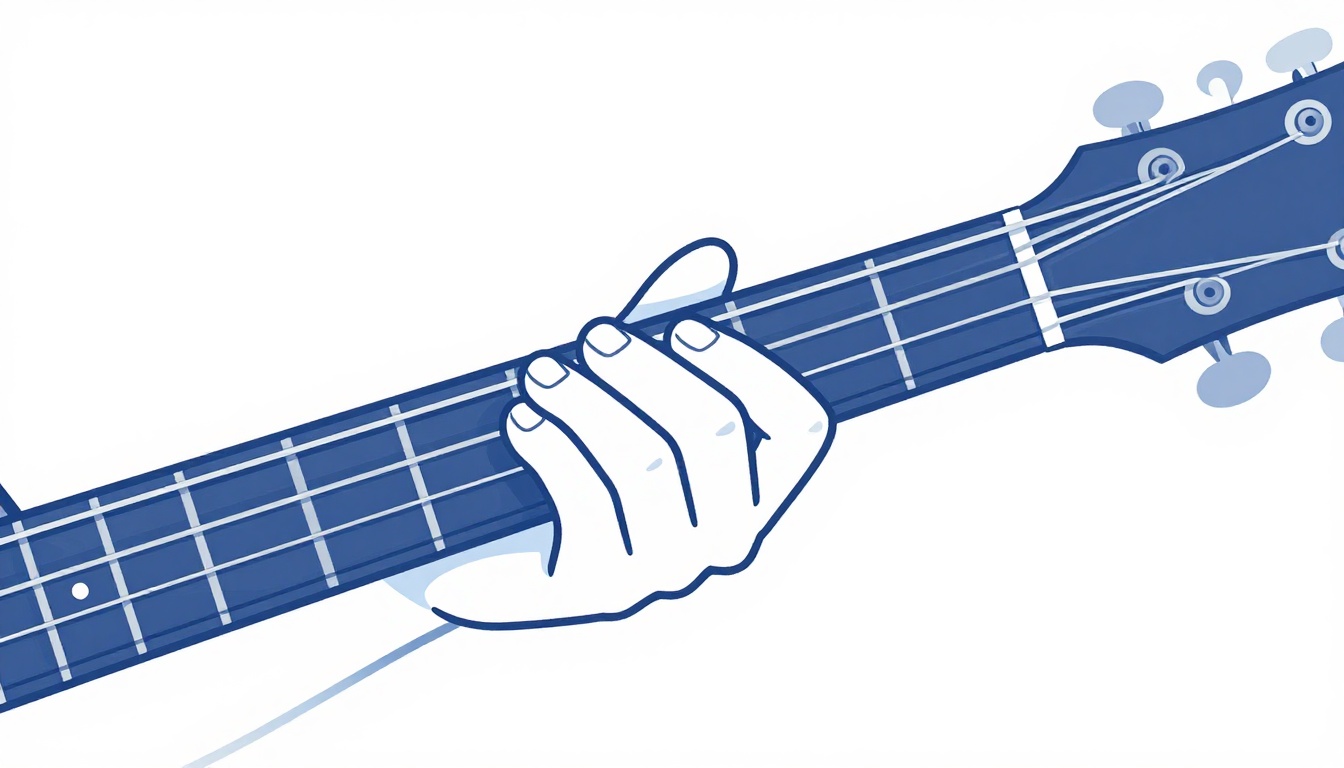
Played alone, without anything else supplying that root, it can sound like it is floating rather than landing, so treat this as a texture choice for ensemble playing, not a simpler replacement for the full chord when you are playing solo.
A three-note shell voicing for comping
Jazz and soul rhythm players often strip a seventh chord down even further than the rootless version above, keeping only the notes that define the chord's character: the root, the third, and the seventh. The fifth, which is the same in both major and minor versions of a chord, contributes the least to how a chord sounds, so it is usually the first note dropped when a guitarist wants a lighter, less cluttered voicing to comp with behind a singer or another soloist.
| String | Fret | Finger |
|---|---|---|
| 6 (low E) | Not played | - |
| 5 (A) | 4 | 3 (ring) |
| 4 (D) | 2 | 1 (index) |
| 3 (G) | 4 | 2 (middle) |
| 2 (B) | Not played | - |
| 1 (high E) | Not played | - |
No finger touches more than one string in this voicing, so there is no barre at all, just three fingers landing on three separate strings. The result is C#, E and B, the root, the flat third and the flat seventh, the three notes that unambiguously spell out a minor seventh chord even without the fifth present. This kind of three-note voicing is often called a shell voicing, and it is worth building even outside the context of this one chord, since the same root-third-seventh logic applies to every minor seventh and major seventh chord on the neck.
Because it uses only three adjacent strings and no barre, this shape is fast to grab and release, which makes it useful for songs that move through chords quickly, or for comping behind a soloist where you want short, punchy chord stabs rather than long, ringing strums.
The full six-string barre further up the neck
There is also a version of C#m7 with its root on the low E string instead of the A string, played at the 9th fret.
| String | Fret | Finger |
|---|---|---|
| 6 (low E) | 9 | 1 (index, barre) |
| 5 (A) | 11 | 3 (ring) |
| 4 (D) | 9 | 1 (index, barre) |
| 3 (G) | 9 | 1 (index, barre) |
| 2 (B) | 9 | 1 (index, barre) |
| 1 (high E) | 9 | 1 (index, barre) |
Lay your index finger flat across all six strings at the 9th fret, then add your ring finger on the A string, 11th fret, two frets higher than the barre. Strum all six strings. This is the same shape you would use for Em7 if you moved it up the neck, only here it lands on C#m7 because the barre sits at the 9th fret instead of open.
This version is rarely the first one anyone reaches for, since it sits high enough up the neck that the frets are closer together and less familiar territory for most players, but it matters for two reasons. First, it gives you a second option when the main shape falls in an awkward spot relative to whatever chord comes before or after it in a song. Second, if you already know the open Em7 chord well, one finger, low E string, A string 2nd fret, everything else open, clamping a capo at the 9th fret and playing that exact same one-finger shape lands you on this same voicing without a six-string barre at all.
Fingerpicking C#m7
Every shape above works just as well fingerpicked as strummed, and picking it apart note by note is also one of the fastest ways to hear what each finger is actually contributing to the chord. On the main barre shape, a standard fingerstyle assignment works cleanly: thumb (T) covers the A string, index (i) covers the D string, middle (m) covers the G string, and ring (a) covers the B string, with the high E string picked by whichever finger you have free, often the ring finger again or a light thumb brush.
A simple pattern to start with is thumb, index, middle, ring, played one note at a time from the A string up to the B string, then back down. Played slowly, this makes the barre's contribution obvious: mute the barre entirely for a moment, pressing everything else as normal, and the A, G and high E strings die out immediately while the D and B string notes, held by your ring and middle fingers, keep ringing. That is a fast, concrete way to feel exactly how much of the chord depends on the barre holding firm.
Because a fingerpicked chord sustains each note rather than cutting them off with a strum, fingerpicking C#m7 also makes buzzing far more obvious than strumming does, since a single dead or muted string in a slow arpeggio is much harder to miss than the same string lost inside a fast strum. If you suspect a string is not ringing cleanly but strumming has not made it obvious, slow down and pick the chord apart one string at a time before assuming the shape is fine.
Why your C#m7 is buzzing or sounds muted
A five or six string barre chord has more places to go wrong than an open chord, so work through these one at a time rather than guessing at the fix.
A gap under the barre finger
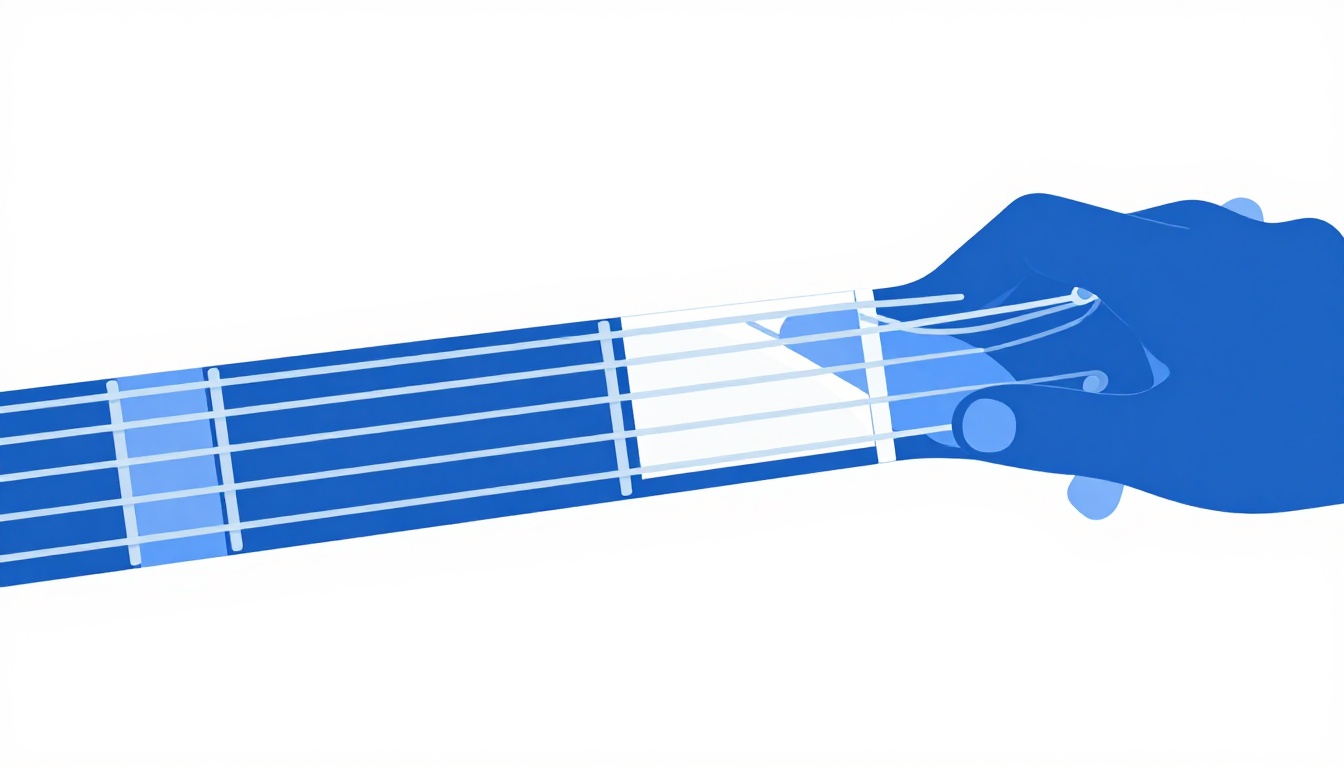
Your index finger's knuckles are not perfectly straight, which means a finger laid flat across the fretboard often presses hard enough on the outer strings while leaving a small gap over one of the strings in the middle, usually the D or G string. That gap is enough for the string to buzz or die out completely, even though every other string in the chord rings clean.
Fret the shape, then pick each string the barre covers one at a time, listening for the one that sounds wrong. Roll your index finger very slightly toward its outer edge, the side closer to the headstock, which straightens out the knuckle and often closes the gap without needing more overall pressure.
Your thumb has crept over the top
A thumb that climbs up and over the top edge of the neck pulls your whole hand out of position, flattening your fingers and reducing the leverage your index finger needs to hold a clean barre. This is one of the most common causes of a weak or buzzing barre chord, and it happens gradually enough that most players do not notice it happening in the moment.
Check your thumb position by feel: it should sit roughly behind your middle finger, on the back of the neck, pressing more or less straight across from where your index finger lands on the fretboard. If it has drifted up toward the top edge, bring it back down and re-fret the chord before adjusting anything else.
Not enough pressure on the barre
Even with good hand position, a barre needs more downward force than a single fretted note, since one finger is now doing the work that several fingers usually split between them in an open chord. New players often under-press the barre specifically, while the individually fretted notes from the ring and middle fingers ring out fine.
Pick each of the three strings under the barre, on their own, and listen for buzz. If one or more buzz while the ring and middle finger notes ring clean, the fix is more pressure from the index finger specifically, not a wholesale re-fretting of the chord.
Fingers colliding with each other
Because your ring finger and middle finger are both pressing down further from the nut than your index finger's barre, on strings the barre is also touching, it is easy for one of them to lean sideways and brush a neighboring string it should not be touching at all, muting a note that had nothing wrong with it.
Check your ring finger is coming down close to vertical on the D string alone, not leaning into the G string beside it, and that your middle finger is doing the same on the B string without touching the high E string next to it. A small adjustment in the angle of either finger usually clears this up without changing where the fingertip actually lands.
Weak barre strength, which is temporary
If every note buzzes evenly across the barre no matter how you adjust your hand, the most likely explanation is simply that the specific muscles a barre chord uses have not been trained yet. This is not a sign you are doing something fundamentally wrong, and it is not permanent. It responds to repetition faster than almost any other barre chord problem, because it is a strength issue, not a technique issue.
Fret the barre, strum, and hold it for a few seconds even after it starts to ache slightly, then release. A minute or two of this a day, alongside actual practice of the chord in context, builds the specific grip strength a clean barre needs within a few weeks for most players.
High string action, which is not your technique at all
If you have worked through every fix above, your hand position looks right, your pressure is even, and the chord still buzzes no matter what you try, the cause might not be your technique at all. String action is the height of the strings above the frets, and on a guitar with high action, even a well-fretted barre chord can buzz or take unusual effort to hold clean.
You can get a rough sense of your action by looking down the side of the neck from behind the headstock, sighting along the top of the frets toward the body. A large, obvious gap between the strings and the fretboard around the 12th fret usually means the action is higher than it needs to be. This is a setup issue, adjusted at the bridge or the nut, not something your fretting hand can practice its way around. If barre chords across the board feel unusually hard compared to what other players describe, and the causes above do not explain it, it is worth having the setup checked rather than assuming the problem is you.
C#m7 vs plain C#m
The plain C#m triad uses the same barre shape as the main C#m7 above, but with your ring finger also covering the 6th fret of the G string instead of leaving that job to your index finger's barre at the 4th fret. In practice, most players learn C#m as a full barre at the 4th fret with the ring finger, middle finger and pinky forming an A-shape triad on top, then drop the pinky to get C#m7.
If you already have C#m under your fingers, getting to C#m7 is a matter of subtraction rather than learning a new shape from scratch: take the standard C#m barre and lift whichever finger is fretting the G string at the 6th fret, letting your index finger's barre take over that string at the 4th fret instead. That single change, one finger lifted, turns the B note (the seventh) into what is sounding on the G string, and C#m becomes C#m7.
The two chords are worth learning to tell apart by ear, not just by shape, since a lot of songwriting decisions come down to which one a section actually wants. Play C#m, let it ring, then lift the pinky into C#m7 and let that ring too. The triad resolves more fully, it sounds finished on its own. The seventh chord sounds like it is leaning somewhere, unresolved, waiting for the next chord to arrive. That leaning quality is exactly why C#m7 shows up so often as a passing chord inside a progression and so rarely as the last chord of a song.
C#m7 vs C#maj7, and why the names get confused
C#m7 and C#maj7 share a root and a general "moody" character, which is part of why the names get mixed up, but they are built from different formulas and sound noticeably different side by side. C#m7 uses a flat third, giving it that minor color, while C#maj7 uses a natural third and a natural seventh, giving it the smoother, more consonant sound major seventh chords are known for in ballads and jazz standards.
| Chord | Formula | Notes |
|---|---|---|
| C#m7 | 1, flat 3, 5, flat 7 | C#, E, G#, B |
| C#maj7 | 1, 3, 5, 7 | C#, E#, G#, B# |
Note that C#maj7's third and seventh are written E# and B#, not F and C, even though each pair is the same pitch on a guitar. Chord spelling follows the underlying scale, and in C# major the third degree is spelled E# and the seventh degree is spelled B#, so a chord chart or a bandmate reading from notation may use those spellings even though your fretting hand does not care which name is used.
If a chord chart just says "C#7" with no "m" and no "maj", that is a third chord entirely, a dominant seventh built 1, 3, 5, flat 7, common in blues and as the V chord leading into a I chord in the key of F# major. Three chords, three different sounds, one shared root.
The clearest way to tell the two apart by ear rather than by name is to listen for how each one wants to resolve. C#m7, with its flat third and flat seventh, has a searching, unresolved quality that makes it feel like a stop along the way to somewhere else, which lines up with how it is actually used in the ii-V-i and I-V-vi-IV progressions covered later in this post. C#maj7 leans the opposite way, its natural seventh giving it a lush, settled quality that composers often reach for specifically because it can function as a resting point, a chord a phrase can land on without needing to keep moving. If you are looking at a chord chart with no way to check the notes and the song around it feels like it is drifting or searching, a minor seventh is the more likely read. If the same passage feels like it has arrived somewhere calm, a major seventh is more likely.
C#m7 and its twin, Dbm7
C# and Db are the same pitch, so C#m7 and Dbm7 are the same chord under two different names, played with identical shapes on the guitar. Which name shows up on a chart usually depends on the key signature of the song around it rather than any difference in the chord itself. A song in a key that uses sharps, like B major or E major, is more likely to spell it C#m7. A song built around flats, like the key of Ab major, is more likely to spell the same chord Dbm7. If you see either name on a chart, play the shapes in this post.
Other ways you will see this chord written
Chord charts are not fully standardized, so the same C#m7 chord turns up under a few different spellings depending on the source. C#min7 and C#mi7 are both common, especially in charts written for jazz players, and mean exactly the same chord as C#m7. C#-7, using a plain dash for minor, shows up in some jazz real books and lead sheets, a shorthand borrowed from horn and piano charts rather than guitar-specific notation. Since the "#" symbol does not exist on every keyboard or in every font, you will also occasionally see it typed out as Csm7 or C sharp m7 in text-only contexts, like a forum post or a plain text file, where the sharp sign was substituted with a letter instead. All of these point to the same four notes and the same shapes covered in this post.
Where C#m7 fits in a key
C#m7 turns up most often in two closely related keys. In the key of B major, it is the ii7 chord, the second step of the scale, and it commonly leads into F#7 and resolves to Bmaj7, a classic ii-V-I movement that shows up constantly in jazz standards and is worth knowing by ear as much as by name. In the key of E major, C#m7 is the vi7 chord, built on the relative minor of the key, and it often shows up as the third chord in a I-V-vi-IV progression, one of the most common chord sequences in pop and rock songwriting, here spelled Emaj7-B7-C#m7-Amaj7 in its seventh-chord form, or E-B-C#m-A with plain triads.
Recognizing which key a C#m7 is sitting in is useful beyond theory trivia, because it tells you what is likely to come next. A C#m7 following a Bmaj7 is very likely heading toward an F#7. A C#m7 following an Emaj7 and a B7 is very likely about to resolve to Amaj7. Neither is a rule you have to memorize outright, but the pattern repeats often enough across real songs that it starts to become predictable by ear.
A ii-V-i workout in B major
Because C#m7 is the ii chord in B major, the fastest way to make it feel useful rather than academic is to practice it inside the exact progression it was built for: ii, V, i. In B major that is C#m7, F#7, and Bmaj7.
| C#m7        | F#7         | Bmaj7       | Bmaj7       |
| (4th fret barre) | (2nd fret barre) | (2nd fret barre) | (2nd fret barre) |
Play each chord for a full bar at a slow, steady tempo, letting each one ring out completely before you move to the next. Notice how little your hand actually has to travel: C#m7 and F#7 both live around the 2nd to 4th frets, and Bmaj7 sits right next to them. This progression is a common building block in jazz and soul rhythm playing specifically because the chords sit so close together on the neck, which means smooth voice leading is available almost by accident once your hand knows the shapes.
Once the progression feels steady, try reversing the order, Bmaj7 to F#7 to C#m7, and notice that it sounds and feels entirely different even though it is the same three chords. A ii-V-i resolves forward, toward rest. Played backward, it never quite lands, which is a useful thing to hear once, even if you never play it that way in a real song.
Chords that move naturally into and out of C#m7
A handful of chords sit close to C#m7 on the fretboard, sharing either a finger position or a barre fret, which makes them natural neighbors to practice switching to and from.
F#m7 sits at the barre position right next to C#m7, using the same finger pattern moved down two frets, since C# and F# are a perfect fourth apart. Practicing the switch between them is really practicing keeping your hand's shape intact while your whole hand slides two frets, which builds the exact control barre chords rely on. If the barre itself is still the sticking point rather than the switch, the F#m chord post covers barre technique and a capo workaround in more depth than fits here.
B, the chord C#m7 most often resolves toward as ii heading to a V, sits as an open chord or a 2nd-fret barre depending on which version you use, giving you a chance to practice moving out of a barre and into either an open or differently-shaped barre chord.
G#m7, the iii chord in the key of E major, sits one barre fret above C#m7's main shape and uses an identical finger pattern, making it one of the more forgiving chords to alternate with while your hand gets used to holding the C#m7 shape under tension.
Emaj7, the I chord in the key that treats C#m7 as its vi, sits in open position with no barre at all, which makes the switch from C#m7 into Emaj7 a genuinely useful exercise in releasing a barre cleanly rather than dragging your fingers off the strings and killing the sustain of the chord you just played.
Practicing these as pairs, back and forth slowly with a metronome, does more for your ability to actually use C#m7 in a song than practicing the shape alone ever will, since the real test of a chord is not whether you can hold it in isolation but whether you can arrive at it and leave it on time.
Small hands and limited stretch
The main C#m7 shape does not ask for a wide stretch, since your ring and middle fingers are both landing close to your index finger's barre rather than far up the neck from it, which makes it more forgiving on small hands than a lot of other barre chords. The part that actually challenges smaller or less flexible hands is the barre itself, the flat index finger pressing across several strings at once, and that is a strength and technique issue rather than a size issue.
If the barre genuinely is not happening yet regardless of technique, the capo trick from earlier is the honest answer, not a smaller or cramped version of the shape. It gets you the identical chord, correctly voiced, while your hand builds the barre strength it needs over the coming weeks.
Guitar neck width and shape also play a real role that has nothing to do with hand size on its own. A wider, flatter neck, common on many classical and some acoustic guitars, gives a barre finger more surface area to press across but also asks the thumb to work harder for leverage. A narrower, more rounded neck, common on many electric guitars, is often easier to barre on precisely because there is less string to cover, which is part of why some players find barre chords noticeably easier on an electric guitar than on the acoustic they learned on. If barre chords feel unusually difficult on one guitar but manageable on another, the instrument's neck shape is a more likely explanation than anything about your hand.
Common mistakes beyond buzzing
A handful of habits show up often enough with this chord specifically that they are worth naming even though they are not, strictly speaking, buzzing problems.
Releasing the barre too early is the most common one. Because the index finger is doing the most work in this shape, it is also the first finger to fatigue, and tired fingers tend to ease off pressure a fraction of a second before a strum finishes, which cuts the chord short in a way that is easy to hear but hard to diagnose by feel alone. If a chord sounds like it is fading out mid-strum rather than ringing through it, check whether your barre is holding for the full duration of the chord or letting go early.
Tensing your picking hand to match the effort in your fretting hand is another common one. A barre chord takes real effort from your fretting hand, and it is natural for that tension to spread to your picking or strumming hand without you noticing, producing a stiff, choppy strum that has nothing to do with the chord shape itself. Periodically check that your strumming wrist stays loose regardless of how hard your fretting hand is working.
Rushing the change into the chord to compensate for how long the shape takes to form is a third one. It is tempting to speed up the beat right before a hard chord change so the gap feels shorter, but this usually just makes the timing worse, not better. Slowing the whole passage down until the change is clean, then building the tempo back up gradually, almost always gets you to full speed faster than trying to muscle through it at tempo from the start.
A practice routine for this chord
Five minutes, done consistently, moves this chord from effortful to automatic faster than a longer session done once a week, and it helps to build the shape in stages rather than trying to land all three fingers at once from day one.
Start with the barre alone, no other fingers added. Fret just the 4th fret barre across the five strings from the A string to the high E string, strum, and listen for buzz on the A, G and high E strings specifically, since those are the only three the bare index finger is responsible for at this stage.
Once that is ringing clean on its own, add your ring finger on the D string, 6th fret, and check that string alone. Then add your middle finger on the B string, 5th fret, and check that one too. Building the shape in this order, rather than slamming all three fingers down at once, makes it much easier to isolate which specific finger is causing a buzz when one shows up.
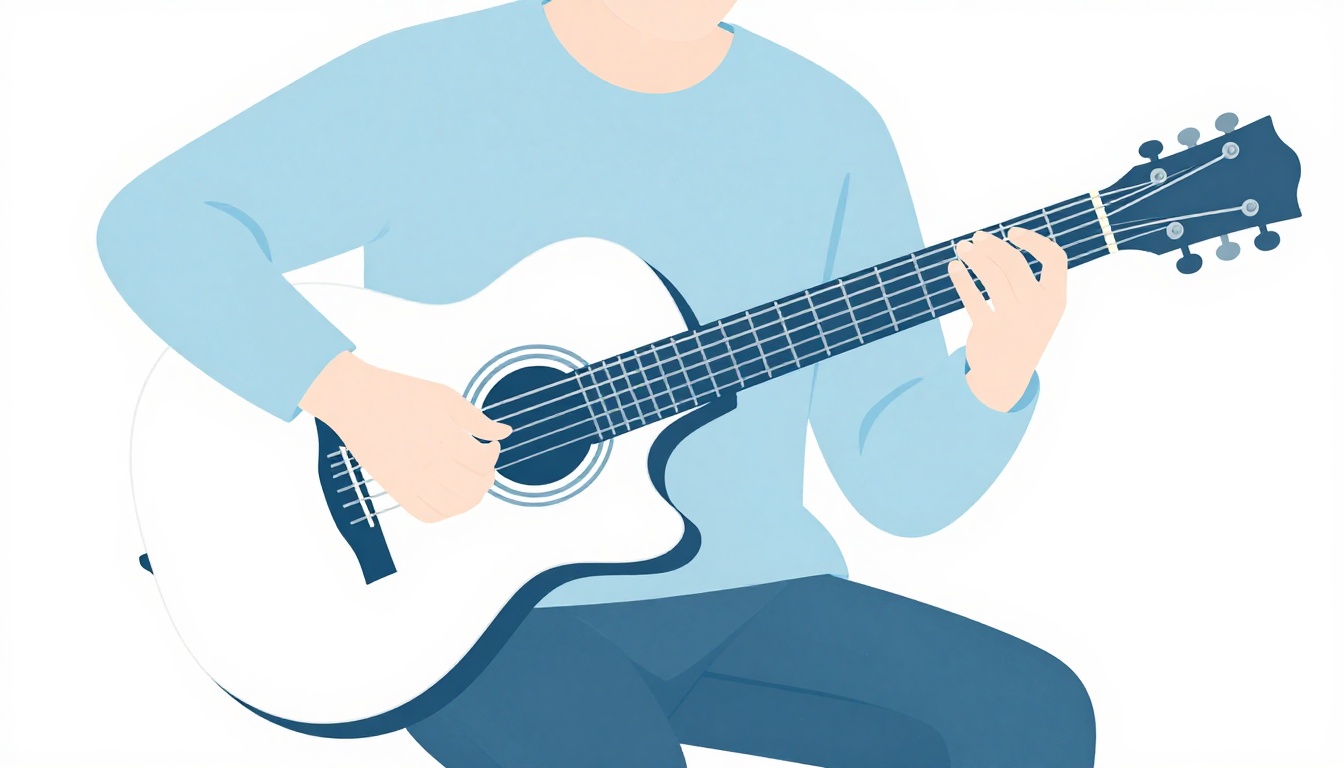
Across the first week, a simple progression works well. On the first couple of days, focus entirely on fretting and unfretting the shape cleanly, with no strumming rhythm to worry about yet, just placing the fingers, checking each string, releasing, and repeating. Once the shape itself feels reliable, add a slow, steady strum, still with no chord changes, just holding C#m7 for several bars at a time so your hand learns to sustain the tension without gripping harder than it needs to. Only once that feels comfortable should you bring in the switch to and from a neighboring chord, starting with whichever one actually shows up next to C#m7 in the song you are learning, or the F#m7 to Bmaj7 pair from the ii-V-i workout above if you are practicing the shape on its own.
Finish each session by practicing the switch into and out of C#m7 from whatever chord actually precedes and follows it in the song you are learning, slowly at first, with a metronome if you have one. Holding a chord cleanly and arriving at it on time during a real song are two different skills, and the second one only gets built by practicing the transition itself, not the shape in isolation.
Frequently asked questions
Is C#m7 a hard chord for beginners?
It is harder than an open chord because there is no open-position version of it, but the main shape only asks for a barre plus two fingers close by, no wide stretch. Most players find it comparable in difficulty to other movable barre chords like F or Bm, and the capo trick earlier in this post is a genuine way to play the correct chord before your barre strength is fully there.
What is the easiest way to play C#m7?
Clip a capo on the 4th fret and play the open Am7 shape behind it: index finger on the 1st fret of the B string, middle finger on the 2nd fret of the D string, everything else open except a muted low E string. It produces the exact same notes as the full barre version with none of the barre.
Is C#m7 the same as Dbm7?
Yes. C# and Db are the same pitch, so C#m7 and Dbm7 are the same chord with two different names. Which spelling shows up on a chart usually depends on whether the song is built around sharps or flats.
What notes are in a C#m7 chord?
C#, E, G# and B, which is the root, minor third, perfect fifth and minor seventh. Removing the B leaves a plain C#m triad.
What is the difference between C#m and C#m7?
C#m is a three-note triad, C#, E and G#. C#m7 adds a fourth note, B, the flat seventh, which softens the chord and gives it a less final, more suspended sound than the plain minor triad.
Why does my C#m7 sound muted on one string even though I am pressing hard?
Check the finger nearest that string first. A ring or middle finger leaning sideways into a neighboring string is a far more common cause of a single dead string than weak barre pressure, especially if the rest of the chord is ringing clean.
Can I play C#m7 without a barre at all?
The capo trick lets you avoid a barre completely while still playing the correct, fully voiced chord. Without a capo, every real C#m7 shape on the guitar involves fretting enough notes by hand that a barre ends up being the simplest option, not an optional one.
What key is C#m7 usually found in?
Most often B major, where it is the ii7 chord, or E major, where it is the vi7 chord built on the relative minor. In both cases it tends to move toward a specific next chord, F#7 in the first case and Amaj7 in the second, which is useful to listen for when you are working out a song by ear.
Can C#m7 replace a plain C#m chord in a song?
Often, yes. Because C#m7 contains every note of the plain C#m triad plus one extra, it can usually substitute for C#m without clashing against a melody or bassline, softening the sound slightly in the process. The reverse is not always true: a melody or bass part that specifically leans on the flat seventh will sound incomplete if you play the plain triad instead, so treat the substitution as safe in one direction more than the other.
How do I build a minor seventh chord shape for any root note, not just C#?
Once you know one movable minor seventh barre shape, you can find its root by checking which note the barre lands on along either the low E string or the A string, then sliding the whole shape to whichever fret has the root you need. The C#m7 shape in this post has its root on the A string at the 4th fret, so the identical shape played two frets lower, at the 2nd fret, becomes Bm7, and played four frets higher, at the 8th fret, becomes Fm7. The finger pattern never changes, only the fret it starts on.
GuitarLowKey
Ready for fifteen focused minutes?
Open the web app and train the change that is blocking your song.