
How to Play the C9 Guitar Chord (Every Shape, No Buzzing)
The standard C9 shape at the 3rd fret, an easier version for small hands, a rootless jazz voicing, and how C9 differs from C7, Cadd9, and Cmaj7.

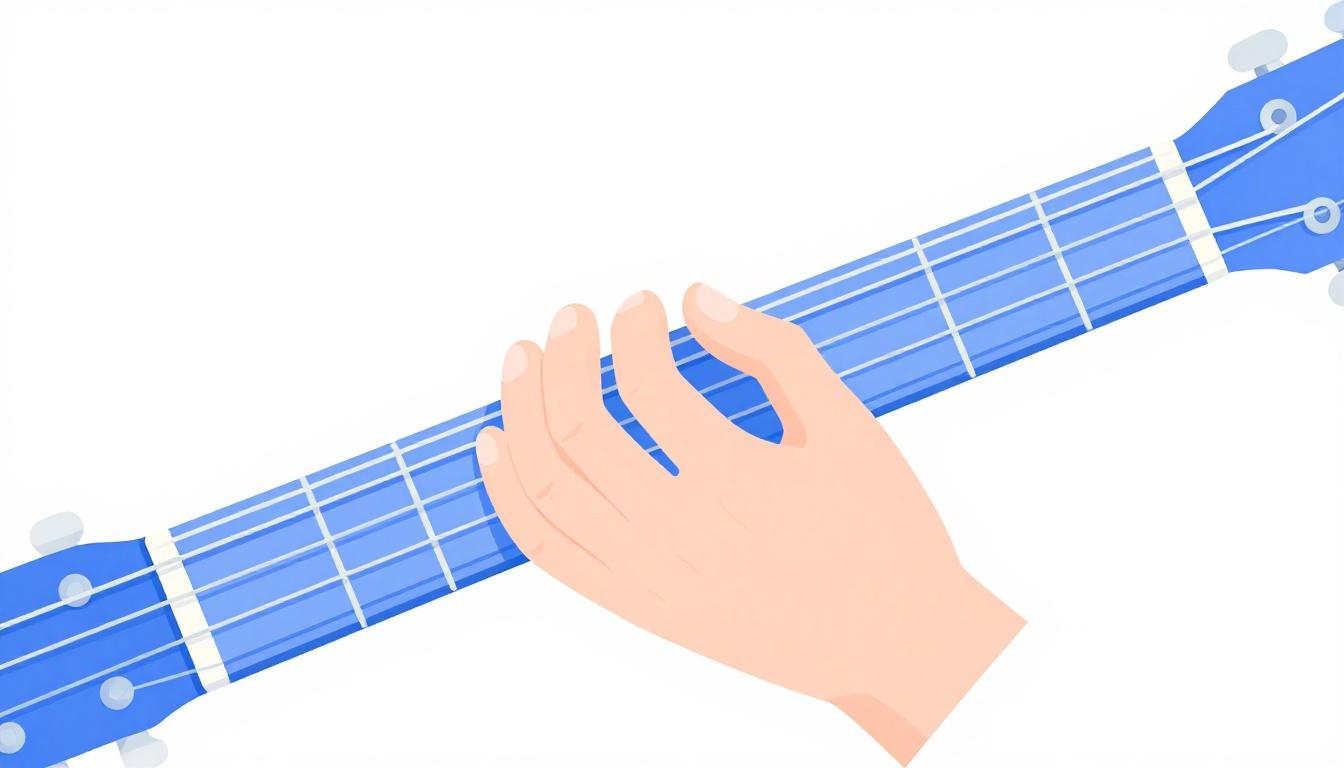
To play a C9 chord on guitar, mute the low E string, place your index finger on the 2nd fret of the D string, your middle finger on the 3rd fret of the A string, and lay your ring finger flat across the 3rd fret of the G, B, and high E strings as a small barre. Strum from the A string down through the high E string. That gives you all five notes of a C9, C, E, G, Bb, and D, in one compact shape. Everything below covers the easier versions, why this one buzzes, and how it actually differs from C7, Cadd9, and Cmaj7, which get mixed up constantly.
The C9 chord, string by string
Here is the full shape as a table. "Finger" uses standard numbering: 1 is your index finger, 2 is your middle finger, 3 is your ring finger, 4 is your pinky.
| String | Fret | Finger |
|---|---|---|
| 6 (low E) | Muted, do not play | - |
| 5 (A) | 3 | 2 (middle) |
| 4 (D) | 2 | 1 (index) |
| 3 (G) | 3 | 3 (ring, mini-barre) |
| 2 (B) | 3 | 3 (ring, mini-barre) |
| 1 (high E) | 3 | 3 (ring, mini-barre) |
The ring finger's job is the part that trips people up. It is not fretting three separate notes, it is laying flat across three strings at the same fret, the same movement a full barre chord asks of your index finger, just on three strings instead of six. The middle finger and index finger each hold a single note on their own string, below and beside that mini-barre.
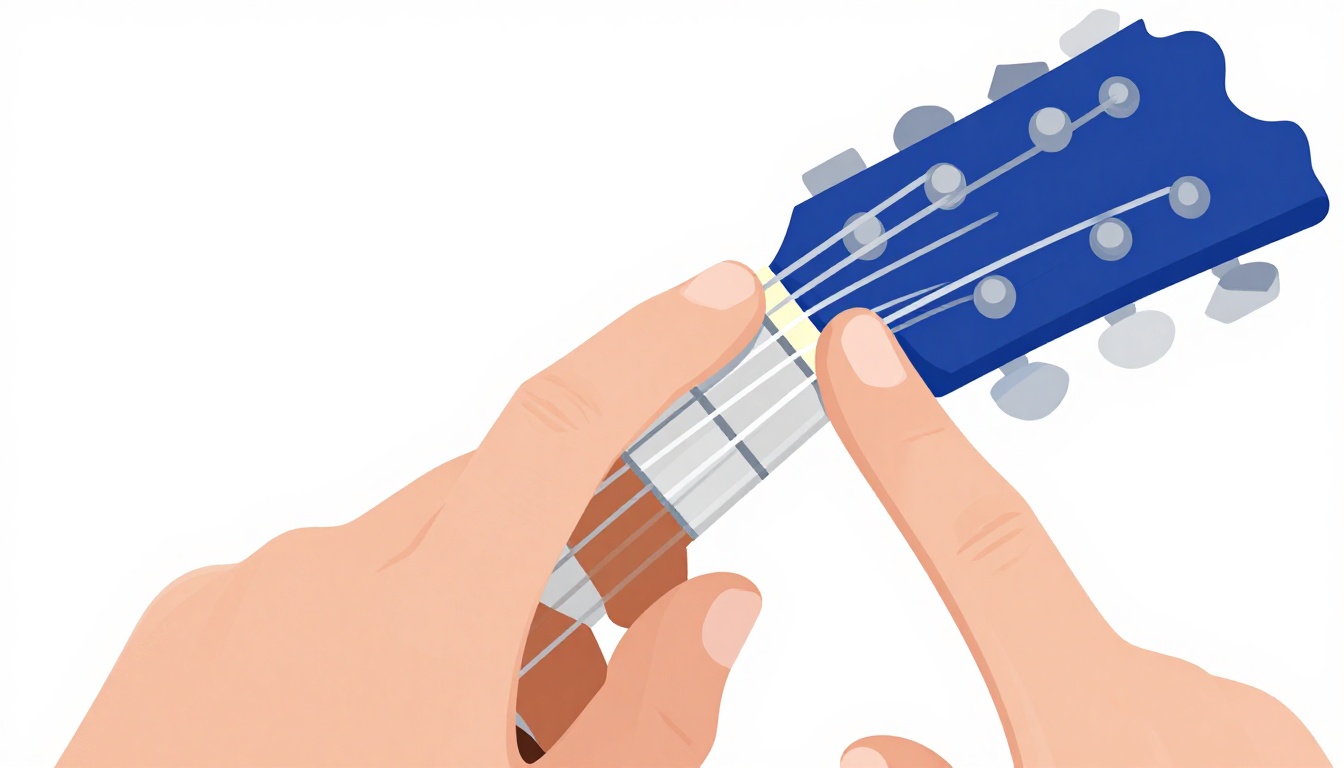
If a mini-barre with your ring finger genuinely will not settle, some players swap it for the pinky instead, keeping the ring finger free on the A string beside the middle finger for extra stability. The notes and the sound are identical either way. Which finger does the barring is a matter of which hand shape feels more stable to you, not a right or wrong choice.
What notes are in a C9 chord
A C9 chord is built from five notes: C (the root), E (the major 3rd), G (the perfect 5th), Bb (the flattened 7th), and D (the 9th). That flattened 7th is what separates a 9 chord from an add9 chord, and it is also what gives C9 its restless, bluesy pull rather than the brighter, more settled sound of a plain major chord.
| Note | Role | Where it sits in the shape above |
|---|---|---|
| C | Root | 5th string, 3rd fret |
| E | Major 3rd | 4th string, 2nd fret |
| G | Perfect 5th | 1st string, 3rd fret |
| Bb | Flattened 7th | 3rd string, 3rd fret |
| D | 9th | 2nd string, 3rd fret |
Counting a scale past its own octave is where the "9" comes from. The C major scale runs C (1), D (2), E (3), F (4), G (5), A (6), B (7), then starts over at C (8). Keep counting and D becomes 9, a full octave above where it sat as the 2nd note. The 9th and the 2nd are the same note, D, just thought of as continuing the stack of thirds upward rather than sitting underneath the root.
Other ways charts write this chord
Chord charts are not perfectly consistent about how they label a dominant 9, and it is worth recognizing the common variants so a different-looking symbol does not read as a different chord.
| Symbol on a chart | What it means |
|---|---|
| C9 | Standard notation for a dominant 9 chord |
| Cdom9 | The same chord, spelled out to avoid confusion with Cmaj9 |
| C7(9) | The 7th written first, with the added 9th shown in brackets |
| C79 | An older, compressed way of writing the same C7(9) |
All four of these point at the exact same five notes, C, E, G, Bb, and D. The variation is purely in how different publishers or software format the symbol, not in the chord itself. What to actually watch for is "Cmaj9" or "Cadd9", both of which are genuinely different chords covered above, not alternate spellings of C9.
Listening for the 9th before you play it
Before working on the shape itself, it helps to know what you are listening for. Play an open C major chord, then a plain C7, then the full C9 shape, one after another, and pay attention to how each one feels rather than only how it sounds.
Plain C major feels settled and complete on its own. C7 introduces a slight pull, a sense that the chord wants to move somewhere rather than sit still, coming entirely from the flattened 7th. C9 keeps that same pull and adds a layer of color on top of it, a fuller, slightly denser quality that comes specifically from the 9th sitting a whole step above the octave. Many new players describe the difference between C7 and C9 as C7 sounding "bluesy" and C9 sounding "bluesy and rich" or "bluesy and busy," which is a reasonable way to hear it before the theory behind the difference clicks.
Isolating the 9th itself is worth doing once the full shape rings cleanly. Play the D string's 2nd fret and the B string's 3rd fret together, on their own, away from the rest of the chord. Those two notes, E and D, are the 3rd and the 9th, and hearing that specific interval by itself makes it easier to recognize the same color the next time it shows up in a chart or a recording.
C9 vs C7, Cadd9, and Cmaj7
These four chords get confused constantly because their names look similar and a couple of them share fingers on the fretboard, but each one is built from a different set of notes.
| Chord | Notes | 7th present | 9th present | Character |
|---|---|---|---|---|
| C7 | C, E, G, Bb | Flattened (Bb) | No | Bluesy, wants to resolve |
| C9 | C, E, G, Bb, D | Flattened (Bb) | Yes (D) | Bluesy, richer, funkier |
| Cadd9 | C, E, G, D | No | Yes (D) | Bright, resolved, shimmery |
| Cmaj7 | C, E, G, B | Major (B) | No | Soft, jazzy, still resolved |
C9 is best understood as C7 with a D stacked on top, not as a relative of Cadd9. Cadd9 deliberately leaves the 7th out, which is exactly why guitarists write "add9" instead of a bare "9", to make clear no 7th is involved. If a chart just says "C9," it is calling for the flattened 7th and the 9th together, a genuinely different, more dominant-sounding chord than either Cadd9 or Cmaj7.
An easier version for a stiff first week
The full mini-barre above asks your ring finger to flatten across three strings evenly, which takes some hands longer to settle into than others. A simpler version exists that only asks the ring finger to cover two strings instead of three, leaving the high E string open.
| String | Fret | Finger |
|---|---|---|
| 6 (low E) | Muted, do not play | - |
| 5 (A) | 3 | 2 (middle) |
| 4 (D) | 2 | 1 (index) |
| 3 (G) | 3 | 3 (ring, mini-barre) |
| 2 (B) | 3 | 3 (ring, mini-barre) |
| 1 (high E) | Open | - |
The open high E string rings out an E, which is already the major 3rd of the chord, so nothing foreign slips in, you are simply doubling a note the chord already has. This version is a genuine, complete C9, not a simplification that changes the sound, and it is worth using any time the full three-string barre is fighting you.
A rootless version for jazz comping
Jazz players frequently drop the root and the 5th from a 9 chord entirely, since a bass player or another instrument usually supplies the root, and the remaining notes still spell out the chord's essential color. On guitar this gives you a genuinely easy, no-barre C9 that needs only two fretted notes.
| String | Fret | Finger |
|---|---|---|
| 6 (low E) | Muted, do not play | - |
| 5 (A) | Muted, do not play | - |
| 4 (D) | 2 | 1 (index) |
| 3 (G) | 3 | 2 (middle) |
| 2 (B) | 3 | 3 (ring) |
| 1 (high E) | Muted, do not play | - |
This voicing plays only E, Bb, and D, the 3rd, the flattened 7th, and the 9th. Those three notes are enough for the chord to read clearly as a dominant 9 in a band setting, since the root is implied by whatever else is playing underneath. It will sound thin played completely alone, with nothing else supplying a low C, so treat it as a comping tool for playing along with a bassist or a backing track, not a replacement for the full shape when you are the only instrument.
A movable barre shape further up the neck
Once the open-position shape feels comfortable, it is worth knowing that shape is already movable, since every note in it comes from a fretted finger rather than an open string, other than the muted low E. Slide the whole shape up or down the neck and the root moves with it.
| Chord | 6 (low E) | 5 (A) | 4 (D) | 3, 2, 1 (mini-barre) |
|---|---|---|---|---|
| C9 | Muted | 3rd fret | 2nd fret | 3rd fret |
| D9 | Muted | 5th fret | 4th fret | 5th fret |
| G9 | Muted | 10th fret | 9th fret | 10th fret |
Whatever fret your middle finger lands on the A string becomes the new root, and every other finger shifts by the same number of frets. This is the same shape covered above, just relocated, which means you do not need to learn a separate fingering for every 9 chord you meet, only where to place the one shape you already know.
There is also a distinct barre voicing higher up the neck that some players prefer, with the barre itself landing on the 5th fret of the middle four strings and a single extra finger on top.
| String | Fret | Finger |
|---|---|---|
| 6 (low E) | Muted, do not play | - |
| 5 (A) | 5 | 1 (index, barre) |
| 4 (D) | 5 | 1 (index, barre) |
| 3 (G) | 5 | 1 (index, barre) |
| 2 (B) | 5 | 1 (index, barre) |
| 1 (high E) | 6 | 2 (middle) |
Here the root, C, lands on the G string rather than the A string, which can feel disorienting the first time you meet it, since most movable chords a new player learns put the root on the low E or A string. It is worth knowing this shape exists mainly so a chord chart or a video lesson using it does not look like a completely different chord.
C9 with a capo
A capo lets you keep the exact open-string ring and mini-barre feel of the shapes above while shifting the whole chord to a different pitch, rather than trading it for a barre chord in an unfamiliar spot on the neck.
| Capo position | Shape you play | What it sounds like |
|---|---|---|
| 2nd fret | Open C9 shape (x-3-2-3-3-3) | D9 |
| 3rd fret | Open C9 shape (x-3-2-3-3-3) | D#9 / Eb9 |
| 5th fret | Open C9 shape (x-3-2-3-3-3) | F9 |
Clamp a capo across the 2nd fret and play the identical shape covered at the top of this article, and the chord ringing out is D9, not C9, because the capo raises every fretted note by two half steps. This matters most in the blues and funk contexts covered later in this article, where a singer or band may need a 9 chord in a key like D or F, and a capo preserves the exact fingering you already know rather than asking you to relearn the mini-barre somewhere unfamiliar on the neck.
None of this changes what C9 itself is. You are moving the same shape to a different pitch, not altering the chord's internal fingering or the relationships between its notes.
C9sus4: the other common ninth chord
C9sus4 replaces the major 3rd (E) with the 4th (F), the same substitution a plain sus4 chord makes to a plain major chord, giving a suspended, unresolved version of C9.
| Chord | Notes | Note replaced |
|---|---|---|
| C9 | C, E, G, Bb, D | None, standard dominant 9 |
| C9sus4 | C, F, G, Bb, D | 3rd (E) replaced by 4th (F) |
The easiest way to play it is a single, full barre, no mini-barre and no separate finger placements needed.
| String | Fret | Finger |
|---|---|---|
| 6 (low E) | Muted, do not play | - |
| 5 (A) | 3 | 1 (barre) |
| 4 (D) | 3 | 1 (barre) |
| 3 (G) | 3 | 1 (barre) |
| 2 (B) | 3 | 1 (barre) |
| 1 (high E) | Muted, do not play | - |
Lay your index finger flat across the A, D, G, and B strings at the 3rd fret, mute the low E and high E strings, and strum the middle four. Because the major 3rd is gone entirely, this chord has none of C9's usual "major versus minor" identity, which is exactly what gives sus chords their open, hanging quality. Guitarists usually resolve a 9sus4 chord back to the plain 9 chord it is built from, often just by lifting the barre's grip on the D string and letting the 2nd fret ring in its place, the same E-for-F swap that separates the two chords.
How C9 relates to C11 and C13
C9 is part of a family of extended dominant chords built by continuing to stack notes a third apart on top of a basic dominant 7. C11 adds an 11th (F) on top of what C9 already has, and C13 adds a 13th (A) on top of that, though in practice guitarists usually drop one or two of the lower extensions from an 11 or 13 chord voicing, since fitting every note across six strings is not physically possible.
| Chord | Adds on top of C7 |
|---|---|
| C9 | 9th (D) |
| C11 | 9th (D) and 11th (F) |
| C13 | 9th (D), and usually the 13th (A), often without the 11th |
You will not need C11 or C13 shapes to play C9 itself, but recognizing the family helps when a chart moves between them within the same song, since a C13 chord in one bar and a C9 in the next are close relatives built by the same stacking logic, not unrelated chords that happen to share a letter name.
Which strings to strum
For the open-position shape and its easier variant, strum from the 5th string (A) down through the 1st string (high E), leaving the 6th string (low E) out entirely. For the rootless jazz voicing, strum or pick only the 4th, 3rd, and 2nd strings.
The reason is the same in every case: an open low E string rings at E, which is not one of C9's five notes, and letting it sound underneath the chord adds a note that has nothing to do with the shape your fretting hand is holding. On a chord this color-dependent, an out-of-key bass note is more noticeable than it would be on a plain major chord, since 9 chords already rely on a slightly ambiguous, tension-filled sound that a wrong low note muddies further.
Why your C9 is buzzing or sounds dead
The mini-barre is where nearly every problem with this chord starts. Work through these one at a time.
The mini-barre is not flat enough
If your ring finger is arched instead of flattened across the G, B, and high E strings, one or two of those three strings will buzz or go dead while the others ring fine. Roll your ring finger slightly toward its outer edge, the side away from your thumb, until all three strings ring clearly when picked one at a time.
The mini-barre is too far from the fret wire
A fret number describes the space between two metal wires, not the wire itself. Pressing closer to the fret wire nearer the guitar's body takes noticeably less force than pressing in the middle of that space. If your ring finger sits in the middle of the "3rd fret" space rather than hugging the wire, you will need more pressure than the shape actually requires, and your hand will tire faster.
Uneven pressure across the barre
Because a finger is not perfectly flat along its whole length, one string under the mini-barre often gets less pressure than the others by default, usually whichever string sits closest to the fingertip or closest to the first knuckle. Pick the G, B, and high E strings one at a time while holding the chord and listen for which one is weakest, then focus added pressure specifically over that string rather than pressing harder everywhere at once.

The index or middle finger is leaning into a neighboring string
Your index finger on the D string and your middle finger on the A string are working in a tight cluster with the muted low E string right next to the middle finger. If either finger leans or flattens more than it needs to, it can mute a string it is not supposed to touch. Curl both fingers so they contact their string near the fingertip, coming down close to vertical rather than at a shallow angle.
The low E string is sneaking into the strum
This is not a fretting problem, it is a strumming habit, and it is covered in the strumming section above. If every note in the chord rings clean when picked individually but the strummed chord sounds muddy, the low E string getting struck by accident is the most likely cause, not anything in your left hand.
The thumb is creeping over the top of the neck
A thumb that climbs up and over the top of the neck pulls the rest of your hand down flatter to compensate, which works directly against the vertical finger angle the mini-barre needs. Keep your thumb roughly behind your middle finger, on the back of the neck, rather than hooking over the top.
The guitar itself is working against you
If every other cause has been ruled out and the mini-barre still buzzes no matter how it is placed, the instrument's setup may be part of the problem rather than technique. Strings sitting unusually high above the frets, a common issue on guitars that have not been set up in a while, ask for noticeably more finger pressure on any barre than a well-adjusted guitar would need. This is worth ruling out on an older or unfamiliar instrument before assuming the fault is entirely in your hand.
Changing from C9 to C7
C7 and C9 share three fingers in the exact same spots, which makes this one of the smoothest changes on this list once you know where to look.
| Chord | 6 (low E) | 5 (A) | 4 (D) | 3 (G) | 2 (B) | 1 (high E) |
|---|---|---|---|---|---|---|
| C9 | Muted | 3 (middle) | 2 (index) | 3 (ring) | 3 (ring) | 3 (ring) |
| C7 | Muted | 3 (ring) | 2 (middle) | 3 (index) | Open | 3 (ring) |
Different common fingerings exist for open C7, so treat this as one useful path rather than the only one: the fastest route is to lift the mini-barre off the B string only, letting it ring open, while keeping the rest of the shape close to where it already sits. Practice releasing just that one string first, since it is the single change that turns a C9 into the simpler, more consonant sound of C7.
Changing from C9 to F
C9 leans heavily on the IV chord in blues progressions, and F is the most common destination from it.
| Chord | 6 (low E) | 5 (A) | 4 (D) | 3 (G) | 2 (B) | 1 (high E) |
|---|---|---|---|---|---|---|
| C9 | Muted | 3 (middle) | 2 (index) | 3 (ring, barre) | 3 (ring, barre) | 3 (ring, barre) |
| F (mini, small barre) | Do not play | Do not play | 3 (ring) | 2 (middle) | 1 (barre) | 1 (barre) |
Both chords use a small barre, just at different frets and on different strings, so the physical skill transfers directly even though every finger reassigns to a new spot. Practice lifting the whole C9 shape as one motion and dropping the F shape as one motion, rather than moving finger by finger, since one-at-a-time habits are what make chord changes feel slow long after the shapes themselves are memorized.
Changing from C9 to G9
Staying inside the same family of 9 chords is often smoother than jumping to a plain triad, since your hand keeps the same general shape and only shifts position.
| Chord | 6 (low E) | 5 (A) | 4 (D) | 3, 2, 1 (mini-barre) |
|---|---|---|---|---|
| C9 | Muted | 3 (middle) | 2 (index) | 3rd fret |
| G9 | Muted | 10 (middle) | 9 (index) | 10th fret |
Because this is the same movable shape covered earlier, just relocated seven frets higher, your hand does not need to learn a new grip, only a new position on the neck. Sliding the entire shape as one block, keeping the fingers in their same relative spots, is far more reliable than trying to reposition each finger independently mid-slide.
C9 in a 12-bar blues turnaround
Dominant 9 chords are a common substitute for plain dominant 7 chords in blues, since the extra note thickens the sound without changing which chord is functioning as the I, IV, or V. A typical 12-bar blues in the key of C, played with 9 chords instead of plain 7s, uses C9 as the I chord, F9 as the IV chord, and G9 as the V chord.
| Bar | Chord | Roman numeral |
|---|---|---|
| 1 to 4 | C9 | I9 |
| 5 to 6 | F9 | IV9 |
| 7 to 8 | C9 | I9 |
| 9 | G9 | V9 |
| 10 | F9 | IV9 |
| 11 to 12 | C9 | I9, then turnaround |
This substitution works because a 9 chord shares its root, 3rd, 5th, and flattened 7th with the plain dominant 7 chord it is replacing, adding only the 9th on top. The underlying blues form and its resolution points do not change, only the color and thickness of each chord.
A common variation on this same form is the "quick change" blues, which moves to the IV chord in the second bar instead of staying on the I chord for the first four bars.
| Bar | Standard turnaround | Quick change |
|---|---|---|
| 1 | C9 | C9 |
| 2 | C9 | F9 |
| 3 to 4 | C9 | C9 |
Everything else in the form stays the same. The quick change simply adds one extra bar of movement near the start, which is common enough in real blues playing that it is worth recognizing by ear rather than assuming a bandleader has made a mistake the first time you hear it.
Strumming C9 in a shuffle feel
Slow blues in this style is usually felt in a shuffle rhythm, where each beat splits unevenly into a long note followed by a short one rather than two even eighth notes. Rather than strumming the full C9 chord on every one of those subdivisions, many players hold the shape and let the shuffle come from a steady down-up picking motion low on the strings, brushing lightly on the upstroke and digging in slightly more on the downstroke.
Practicing the shuffle feel separately from the chord itself, tapping or clapping the long-short pattern until it feels natural, before adding the C9 shape on top, keeps the two skills from competing for your attention at the same time. Once the feel is steady, the chord change points in the turnaround above land on the strong beats of the shuffle, which is where a listener's ear expects the harmony to move.
C9 in a jazz ii-V-I progression
In jazz harmony, a dominant 9 chord frequently fills the V slot of a ii-V-I progression, the three-chord movement that resolves a huge share of jazz standards back to their home key. In the key of F major, that progression runs Gm7 (ii), C9 (V), Fmaj7 (I).
| Chord | Roman numeral | Notes |
|---|---|---|
| Gm7 | ii | G, Bb, D, F |
| C9 | V | C, E, G, Bb, D |
| Fmaj7 | I | F, A, C, E |
Notice that C9 shares its Bb and D with the Gm7 chord just before it, and its E and C with the Fmaj7 chord just after it, which is exactly why the progression sounds so smooth even though the chord names look unrelated on paper. Practicing this three-chord move on its own, slowly, is one of the more useful things a guitarist learning C9 can do with it, since the shape shows up constantly in jazz, soul, and pop songs built around this same resolution.
Reading slash chords like C9/E or C9/Bb
A slash chord tells you which note to put in the bass, separate from the chord itself. C9/E means play a C9 chord, whatever voicing you choose, but make sure an E, the chord's major 3rd, is the lowest note sounding. C9/Bb does the same with the flattened 7th in the bass instead.
| Chord symbol | Chord | Bass note | What that note is in the chord |
|---|---|---|---|
| C9 | C9 | C | Root |
| C9/E | C9 | E | Major 3rd |
| C9/Bb | C9 | Bb | Flattened 7th |
On guitar, the easiest way to satisfy a slash chord is often to fret the bass note on the low E or A string, then add whatever portion of the chord's upper notes is comfortable above it, rather than trying to force a single fixed shape to cover both requirements at once. If a chart hands you a slash chord you have not met before, start by finding just the bass note and confirming it against the table above, since the letter after the slash is always a plain note name, never a second chord.
C9 in funk rhythm guitar
Dominant 9 chords, C9 among them, are a genuine staple of funk rhythm guitar, most often played in short, muted, percussive strokes rather than held and let ring. A common funk-style movement shifts between a 9 chord and the 13th chord built on the same root, keeping the hand in roughly the same position while adding motion.
The technique that makes this style work is as much about the right hand as the left: strum, mute the strings immediately with the side of your fretting hand or the heel of your picking hand, strum again, mute again, building a tight, syncopated pattern rather than a sustained chord. A common starting pattern counts in straight sixteenth notes, striking the chord on the first and third sixteenth of each beat and choking the strings silent on the second and fourth, so the rhythm reads as a clipped, percussive pulse rather than a sustained wash of sound.
Practicing the C9 shape purely as a muted, percussive stroke, with no sustain at all, is a useful exercise on its own before trying to combine it with a full song. Once the muted stroke feels steady on its own, try letting one strum in every four ring out fully while the rest stay clipped, which is closer to how the pattern actually gets used against a full band.
Fingerpicking a C9 chord
The C9 shape also works picked one string at a time rather than strummed, which is a useful way to hear all five of its notes individually before combining them into a full chord.
| Finger | String | Note |
|---|---|---|
| Thumb | 5 (A) | C |
| Index | 4 (D) | E |
| Middle | 3 (G) | Bb |
| Ring | 2 (B) | D |
A simple pattern: thumb plays the A string, then index, middle, and ring pluck the D, G, and B strings in sequence, letting the high E ring as part of the chord's overall color rather than a note in the pattern itself. Practicing this slowly, naming each note out loud as it plays, is a good way to actually hear the flattened 7th and the 9th separately rather than only hearing them blend into the chord as a whole.
Where C9 sits in a key
C9 functions as a dominant chord, which means it wants to resolve, most naturally down to an F chord (its own IV, treating C9 as a I in a blues sense) or, in the key of F major, as the V chord resolving to F itself. That restless, unresolved quality is a direct result of the flattened 7th it shares with plain C7, sharpened further by the added 9th on top.
| Chord | Roman numeral (in F major) |
|---|---|
| F | I |
| Gm | ii |
| Am | iii |
| Bb | IV |
| C / C9 | V |
| Dm | vi |
Recognizing C9 as a V chord in the key of F, rather than as a chord centered on itself, explains why it so rarely sits as a song's final chord. A dominant chord's whole function is forward motion toward home, not resting as home itself, and the 9th only adds to that pull rather than resolving it.
Common mistakes beyond buzzing
A handful of habits show up again and again with this chord specifically, separate from the fretting issues already covered.
Confusing C9 with Cadd9 on a chart
As covered earlier, these are different chords, one with a flattened 7th baked in and one without. If a chart calls for C9 and you play Cadd9, or the reverse, the chord will sound noticeably different even though your fingers landed confidently. When a chart just says "9" with no "add" in front of it, it means the 7th is included.
Letting the chord ring when the style calls for muting
Especially in funk contexts, holding a C9 fully open when the part calls for short, muted strokes changes the entire feel of the rhythm part, not just its tone. If a groove sounds "right" harmonically but "wrong" rhythmically, check whether the part actually wants the strings choked off between strums rather than left ringing.
Treating the rootless voicing as a complete chord when playing alone
The rootless jazz version covered earlier sounds thin without a bass note underneath it. It is a real, useful voicing in a band setting, not a mistake to avoid, but using it as your only chord while playing solo will leave the harmony sounding incomplete, since nothing in the room is supplying the root it deliberately leaves out.
Assuming every 9 chord uses the same shape as C9
The shape covered at the top of this article is movable and works for any dominant 9 chord once you find the right root fret, but not every 9 chord voicing you meet in a chart or a video lesson will use this exact fingering. Barre position, rootless voicings, and voicings with the root on a different string all sound like valid 9 chords and are not wrong just because they differ from the specific shape taught here.
Does C9 feel different on electric, acoustic, or nylon-string guitar?
Yes, mainly because of string tension and neck width rather than anything about the chord itself. Electric guitars typically carry lighter gauge strings under lower tension, so the mini-barre needed for C9 usually takes less force to ring cleanly than the same shape on a steel-string acoustic. Electric necks also tend to be narrower, which can make the tight cluster of index and middle fingers near the muted low E string feel more cramped rather than less, since there is simply less room between strings.
A nylon-string classical guitar pulls in the opposite direction on both counts. Nylon strings sit under noticeably lower tension than steel, so once your ring finger is correctly flattened, less force is needed to stop the mini-barre from buzzing, which helps while your fingertips are still building calluses. Classical necks are also usually wider than a steel-string acoustic's, giving the G, B, and high E strings more room to ring clearly without a neighboring finger brushing them, but that same width asks for a slightly bigger stretch between your index and middle fingers to reach their notes.
Because funk and blues, the two styles where C9 shows up most, are both played on electric guitar constantly, it is worth expecting the shape to feel different, generally easier under the fretting hand, on an electric instrument than on either an acoustic or a nylon-string guitar, rather than assuming something is wrong with your technique if one of them feels stiffer than another.
Warm-ups that make the mini-barre easier
The mini-barre is the one part of this chord that benefits most from a short warm-up before a focused session.
- Three-string press. Lay your ring finger flat across the top three strings at any comfortable fret, without the rest of the chord, and press down until all three ring cleanly when picked one at a time. Release and repeat five times.
- Barre roll. With the same three-string barre held, slowly roll your finger toward its outer edge and back toward the pad, listening for the point where all three strings ring most clearly. This builds a physical sense of exactly where your finger needs to sit.
- Finger independence. Rest your index and middle fingers on the D and A strings as they sit in the full C9 shape, then bring the ring finger down to complete the mini-barre without letting the first two fingers shift position. This is the coordination the full chord actually asks for.
None of this needs more than a minute or two, and it pays off directly the first time you try to land the full shape cleanly rather than needing several attempts.
Changing between chords is still the real skill
Every voicing and every chord change above eventually comes back to the same point: the C9 shape itself is not the hard part once the mini-barre settles in. What takes practice is landing it cleanly at tempo, inside a blues turnaround or a funk groove, without your hand hesitating or the rhythm dropping out while your fingers find their spot. Treat each chord change above as its own small drill, done slowly and away from a full strum or a full groove, before asking it to survive inside real playing at speed.
A practice routine for today
Fifteen focused minutes is enough to make real progress on this chord, in keeping with the idea behind practicing guitar in short daily sessions rather than occasional long ones.
- Two minutes: form the C9 shape from nothing, five separate times, resetting your hand fully between each one. Check the mini-barre first, the sound second.
- Three minutes: strum the chord slowly, five strings only, and pick the G, B, and high E strings one at a time if anything sounds muted, using the troubleshooting section above to diagnose it.
- Five minutes: practice one chord change, C9 to C7 first since it shares the most fingers, or C9 to F once C7 feels solid. Change on a slow, steady four-count, no strumming in between, just the new shape landing cleanly on the beat.
- Five minutes: loop the 12-bar blues turnaround above at a slow tempo, C9 to F9 to G9 and back, focusing only on landing each mini-barre cleanly rather than on speed.
Repeat this most days rather than saving it for one long weekly session. The mini-barre is a physical position your hand is learning, not a fact to memorize, and it responds to frequent short repetition far better than occasional long ones.
FAQ
What notes are in a C9 chord? C, E, G, Bb, and D. C is the root, E is the major 3rd, G is the perfect 5th, Bb is the flattened 7th, and D is the 9th, the note stacked on top that gives the chord its fuller, jazzier color.
Is C9 the same as Cadd9? No. C9 includes a flattened 7th (Bb) alongside the 9th, giving it a bluesy, dominant quality. Cadd9 skips the 7th entirely, keeping the bright, resolved character of plain C major while adding only the 9th.
Is C9 harder to play than C7? Slightly, mainly because of the three-string mini-barre the standard C9 shape asks for. Once that barre settles in, the two chords share nearly identical hand positions, and moving between them is one of the smoother changes covered above.
Do I need to barre three strings, or is there an easier way? The easier version covered above only asks for a two-string mini-barre, leaving the high E string open, and it is a complete, correct C9 on its own, not a simplification that changes the sound.
Why does a chart just say "C9" instead of "Cadd9"? Because they are different chords. "C9" always includes the flattened 7th along with the 9th. Writers use "add9" specifically to signal that the 7th is left out, so the two names are never meant to be interchangeable.
Where does C9 show up most in real playing? Blues turnarounds, where it substitutes for a plain C7 as the I chord, and funk rhythm guitar, where 9 chords are a genuine staple, usually played as short, muted, percussive strokes rather than sustained chords.
Can I play C9 without a barre at all? Yes, using the rootless jazz voicing covered above, which needs only two fretted notes on the D and G strings, plus a third on the B string. It sounds thin without a bass note underneath, so it works best in a band setting rather than as a standalone chord.
Is C9 always a V chord? Not always. Treated as a I chord in the key of C, it functions as the tonic of a dominant-flavored blues. Treated as a V chord in the key of F, it pulls strongly toward resolving down to F. Which role it is playing depends on the surrounding progression, not on anything inherent to the shape itself.
What is the difference between C9 and C9sus4? C9sus4 replaces the major 3rd with the 4th, removing the chord's major quality entirely and giving it an open, unresolved sound. It is also easier to play, since it uses a single full barre across four strings rather than the mini-barre and separate finger placements C9 needs.
What does it mean if a chart writes C9/E or C9/Bb? The letter after the slash names the note that belongs in the bass, separate from the chord itself. C9/E puts the major 3rd in the bass, and C9/Bb puts the flattened 7th there, while the chord above the slash stays a plain C9 either way.
Is C9 a good chord for a beginner to learn? It is more demanding than a first-month open chord like C or G, mainly because of the mini-barre, but it is well within reach once basic open chords feel comfortable. Starting with the easier two-string version covered above, then building up to the full three-string mini-barre, is a reasonable path rather than tackling the full shape cold.
GuitarLowKey
Ready for fifteen focused minutes?
Open the web app and train the change that is blocking your song.