
How to Write a Catchy Guitar Lick You'll Actually Remember
Five ready-to-play pentatonic licks, the three-note formula behind every catchy guitar lick, and the real reasons yours still sounds forgettable.

A catchy guitar lick is a short, repeatable phrase, usually four to eight notes, built from two or three notes that ring clearly against the chord underneath it, played with a rhythm that leaves some space instead of an even stream of notes. Below are five ready-to-play licks in A minor and A major pentatonic, the exact process for writing your own over any chord progression, and the specific reasons a lick that sounded good in your head comes out flat once you actually play it.
What Makes a Guitar Lick "Catchy"
"Catchy" is not a vague compliment, it is a description of three things happening at once: a small set of notes, a rhythm with a clear shape, and enough repetition that a listener can predict where the phrase is going before it gets there. Take away any one of those and the lick stops being catchy, even if every note in it is technically correct.
The note count matters more than most players expect. A lick built from two or three core pitches, repeated and rearranged, sticks in a listener's ear far faster than a six-note run that never repeats a pitch. This is why so many famous licks look almost too simple written down. The simplicity is not a limitation, it is the point. A listener needs to hear a shape twice before they recognize it as a shape at all, and a phrase with eight different notes gives them nothing to latch onto the first time through.
Rhythm does more work than melody in making a lick memorable. The same three notes played as a flat, even run barely register. Delay the first note by half a beat, rush the middle two together, and land hard on the last one, and suddenly the phrase has a silhouette a listener can hum back without knowing a single note name. If you can hum a lick after hearing it once, the rhythm is doing that, not the pitches.
Repetition is what turns a phrase into a motif. Play a shape once and it is a passing idea. Play it twice, even with a small variation the second time, and a listener's brain files it as "the thing this lick does." That filing process is what catchiness actually is, and it happens in the listener's head, not in the guitar.
Context is the part every isolated exercise lick skips. A phrase that sounds strong on its own can sound wrong the moment you drop it over an actual chord progression, because the notes that made it interesting in isolation clash with a chord tone it never had to answer to before. Every technique in this post assumes you are writing to a chord or a progression, not to silence.
Lick, Riff, or Fill: Which One Are You Actually Trying to Write
These three words get used interchangeably, and that causes real confusion when you are searching for how to write one.
A lick is a short, usually single-note melodic phrase, typically one to two bars long, that can be dropped into a solo, a turnaround, or the space between vocal lines. It is the vocabulary word, not the sentence. Most of what a lead guitarist plays during an improvised solo is a string of licks stitched together, some memorized, some invented in the moment.
A riff is a repeating pattern, often chord-based or built on the lower strings, that functions as a song's main hook or its rhythmic backbone. A riff usually repeats through an entire verse or chorus without much variation. Where a lick is vocabulary, a riff is closer to a chorus melody: it is meant to be heard the same way every time.
A fill is a short phrase that lives in a gap, most often between the end of one vocal line and the start of the next. A fill borrows techniques from lick-writing but has a narrower job: it has to start and end inside a specific, usually short window of silence without stepping on the vocal.
When someone searches for a catchy guitar lick, they almost always mean the first definition: a short single-note phrase they can learn today and drop into a solo or a song idea. That is the focus of everything below, though the same principles of target notes, rhythm, and repetition apply if what you actually need is a riff or a fill.
The Two Scales Almost Every Catchy Lick Comes From
Nearly every beginner-friendly catchy lick, in blues, rock, country, or pop, comes from one of two five-note scales: minor pentatonic or major pentatonic. Both remove the two notes most likely to clash against the underlying chord, which is exactly why they are forgiving to improvise with.
| Scale | Notes (root A) | Character |
|---|---|---|
| A minor pentatonic | A, C, D, E, G | Bluesy, moody, works over minor and dominant chords |
| A major pentatonic | A, B, C#, E, F# | Bright, open, works over major chords |
Minor pentatonic is the scale behind almost every blues and rock lick you have ever heard, and it is usually the first scale a guitarist learns to solo with, because five notes leave far fewer chances to land somewhere that sounds wrong. Major pentatonic uses the same shape moved to a different root and gives you a brighter, more pop or country-leaning sound over major chords.
If you have not yet spent time with the scale itself, the pentatonic scale explained in full covers why these five notes exist and how the minor and major versions relate to each other, and every A minor pentatonic box shape covers the other four positions once the one below feels automatic. Everything in this post stays inside a single box in each scale on purpose, because one position played with good rhythm and phrasing beats five positions played evenly and forgettably.
Three Ready-to-Play Licks in A Minor Pentatonic
All three licks below live inside one box shape: root on the 5th fret of the 6th string (low E), the most commonly taught minor pentatonic position on the guitar.
| String | Lower fret | Upper fret |
|---|---|---|
| 6 (low E) | 5 (A, root) | 8 (C) |
| 5 (A) | 5 (D) | 7 (E) |
| 4 (D) | 5 (G) | 7 (A) |
| 3 (G) | 5 (C) | 7 (D) |
| 2 (B) | 5 (E) | 8 (G) |
| 1 (high E) | 5 (A, root) | 8 (C) |
Play through that shape slowly first, one note at a time, so your fretting hand knows where every note lives before you try to make any of them catchy.
Lick 1: The Pull-Off Opener
A two-string pull-off pattern that works as an opening phrase, since it starts on a stable note and ends hanging on a tone that wants to resolve.
G|--5h7p5-----------|
B|----------5h8p5---|
Hammer from the 5th to the 7th fret on the G string, pull back off to the 5th, then move to the B string and do the same shape a fret higher: hammer 5 to 8, pull off back to 5. Play it slowly at first. The pull-off should sound as loud as the picked note, which means snapping the fretting finger off the string rather than just lifting it.
Lick 2: The Bend and Release
A single bend that resolves to the root, the most direct way to make three notes sound like a complete musical statement.
B|--5--8b(10)-------|
e|-------------5----|
Pick the B string 5th fret, then the 8th fret, and bend that 8th-fret note up a full step until it matches the pitch of the 10th fret before releasing it back down. Land on the 5th fret of the high E string, which is the root note A. That bend is taking the scale's flat seventh (G) up to the root (A), which is why the resolution feels finished rather than random.
Lick 3: The Blues Turn
A slide into a pull-off pattern, the kind of phrase that works well as a short answer to a vocal line or as a turnaround at the end of a solo.
D|--5/7-------------|
G|-------5p7p5------|
Slide from the 5th to the 7th fret on the D string, then move to the G string and play a descending pull-off run: pick the 7th fret, pull off to the 5th, and let the phrase settle there. Keep the slide smooth and connected rather than two separate picked notes.
Two Ready-to-Play Licks in A Major Pentatonic
Major pentatonic uses the same five-notes-per-octave logic as minor pentatonic, built from A, B, C#, E, and F#. It trades the moody, bluesy color of the minor version for something brighter, closer to what you hear in country, pop, and upbeat rock playing.
Lick 4: The Skip
A string-skipping pattern that alternates between two strings instead of moving straight up or down, which is what gives major pentatonic licks their bouncy, bright character.
e|--5-----------7-----5--|
B|------5-----7-----------|
Play the 5th fret on the high E string (the root, A), skip down to the 5th fret on the B string (E), back up to the 7th fret on the high E string (B), then the 7th fret on the B string (F#), and resolve back to the root. The skip between strings, rather than a straight run, is what makes this feel different from a minor pentatonic lick even though the shape is similarly compact.
Lick 5: The Slide Up
A single-string slide that works well as a short fill or a bright ending to a phrase.
G|--2/4/6-4-2------|
Slide from the 2nd fret (A, the root) up to the 4th fret (B) and on to the 6th fret (C#), then walk back down. One string, one continuous motion, minimal picking. This is the kind of lick that works as well on an acoustic as it does through a clean electric tone.
The Three-Note Rule: Picking Notes That Actually Stick
Before you can write your own catchy lick over a real song instead of playing one of the five above, you need a way to choose which notes to use, because a scale gives you five options and only two or three of them will actually sound intentional against any given chord.
The rule is simple: identify the chord you are playing over, then treat its chord tones as your home base. For a chord like E major, that means E, G#, and B. Play the scale that fits the chord (E major pentatonic, in this case), but land on one of those three chord tones on the strong beats of the bar, the first and third beat in a typical 4/4 phrase. The other scale notes become connective tissue between those landing points, not destinations in their own right.
This is the difference between a lick that sounds like it belongs and one that sounds like a scale exercise that happened to be played over a song. A scale exercise treats every note as equally important. A lick treats two or three notes as the point and everything else as the path between them.
To find those notes without guessing, play the underlying chord, let it ring, and then try single notes from the matching scale against it one at a time. The ones that sound settled, that seem to lock into the chord rather than sit slightly outside it, are your chord tones. The ones that sound like they want to move somewhere else are passing tones, useful for connecting phrases but wrong to end a lick on.
Rhythm Is What Makes a Lick Catchy, Not the Notes
Take any of the five licks above and play every note as a plain, even eighth note, no bends, no space, no accents. It stops being catchy. The pitches are identical to what is written, and the phrase still falls flat, because rhythm is doing more of the memorability than melody ever does.
Three specific rhythmic moves separate a flat run of notes from a lick with a shape:
Syncopation. Start the phrase slightly off the beat instead of squarely on it. A lick that begins on the "and" of beat one, rather than beat one itself, immediately sounds more like a musical idea and less like an exercise, because it creates a small moment of anticipation before the first note lands.
Space. Leave a rest somewhere in the phrase, even a short one. A three-note lick with a rest after the second note reads as a question. The same three notes played back to back with no gap reads as nothing in particular. Silence is doing real work here, not wasting time.
A held note. End on a note that rings longer than the notes before it, rather than cutting every note to the same short length. A lick that rushes through four quick notes and then holds the fifth gives a listener something to focus on right as the phrase resolves.
Try this with Lick 2 above: play the bend and release exactly as written, then play it again but rush the first two notes together and hold the bend an extra beat before releasing. Same three notes, same fretboard positions, noticeably more memorable phrase, purely from the rhythm change.
Call and Response: Building a Lick Around Silence
One of the most reliable structures for a catchy lick borrows directly from how vocal melodies work: play a short phrase, leave a gap, then answer it with a second short phrase that either repeats the first or resolves it.
This is why so many famous licks are really two two-note ideas rather than one continuous eight-note run. The first half asks a question, usually by ending on a note that feels unresolved, a scale tone other than the root. The gap is not empty space, it is the moment a listener's ear expects a response. The second half answers it, usually by landing on the root or another strongly stable chord tone.
You can build this structure directly on top of Lick 1 or Lick 3 above. Play only the first bar of either lick, stop, count two full beats of silence, then play the second bar as the answer. The exact same notes that felt like one continuous phrase suddenly read as a conversation, and a listener who has never heard the lick before can often predict roughly where the answer is going to land, which is the definition of catchy taking hold in real time.
Call and response also solves a common beginner problem: licks that never seem to end, that keep running until the guitarist simply stops playing. Building in a deliberate question-and-answer shape forces a clear stopping point into the phrase itself.
Repetition, and the One Variation Rule
Repetition is the single most underused tool in lick writing, mostly because repeating yourself feels like you are not being creative enough. The opposite is closer to true. A listener needs to hear a shape at least twice to recognize it as a shape, and licks that never repeat a rhythmic or melodic idea tend to feel like meandering rather than composition, no matter how technically impressive the notes are.
The practical version of this is what's sometimes called the one variation rule: play an idea, then play it again with exactly one thing changed, rather than either repeating it identically or changing everything the second time. Change the ending note, or move the whole shape up a string, or add a bend the second time through that was not there the first time. One change is enough to keep a repeated idea from sounding lazy. Three or four changes and it stops sounding like a repetition at all, which defeats the purpose.
Try it on Lick 5 above. Play the slide up exactly as written, then play it again but end a whole step higher, sliding to the 7th fret instead of stopping at the 6th. The first half of the phrase is identical both times, giving a listener the repetition their ear wants, and the small change at the end keeps the second pass from being a dull copy of the first.
Too much unbroken repetition does become monotonous, especially past three or four repeats without any change at all, so treat this as a two-to-one ratio: for every exact repeat, plan on at least one small variation somewhere nearby.
Learning a Lick by Ear From a Recording
Everything above assumes you are writing a lick from nothing. Just as often, you already have one in your head, from a song you heard, and the job is figuring out what you are actually hearing rather than inventing it.
Start by finding the key. Play the recording and, on your guitar, try the open low E, A, and D strings against it until one of them sounds like it belongs, like the note the whole passage is resting on rather than pulling away from. That note is very often the root of the key, and it narrows your search from all twelve notes down to the five or seven that actually fit.
With the key in hand, loop a short section, five or ten seconds, and hum or sing the lick back to yourself away from the guitar first. This matters more than it sounds like it should. Humming a phrase forces you to actually hear its shape, high notes versus low notes, long notes versus short ones, before you start hunting for it on the fretboard, and it stops you from settling for the first note that is merely close enough.
Next, find two or three notes that ring out clearly and repeat, the ones that sound like the anchor points of the phrase rather than the connective material between them. Chord tones are the right place to start looking, so if the section is in E major, try E, G#, and B first. Once you have those two or three notes located on the fretboard, the rest of the phrase is usually just a scale run connecting them, and you can work outward from the anchors rather than transcribing note by note from the start.
Finally, nail down the rhythm separately from the pitches. Play the recording again and tap the rhythm of the lick on your leg or the guitar body without fretting anything, counting along in your head. A lick with the right notes but the wrong rhythm still sounds wrong, often more wrong than a lick with one incorrect note and the right rhythm, which is exactly why rhythm gets its own pass instead of being guessed at alongside the pitches.
The Blue Note and Other Passing Tones: Going Outside the Scale on Purpose
Every lick so far has stayed strictly inside a five-note scale. Real blues and rock playing regularly steps outside that scale on purpose, for a single note at a time, and knowing when that is a deliberate color rather than a mistake is worth understanding even as a beginner.
The most common of these is the blue note, the flat fifth, sitting exactly halfway between the fourth and fifth degrees of the minor pentatonic scale. In A minor pentatonic, that note is Eb, sitting one fret above the D (the fourth) and one fret below the E (the fifth). It is not one of the five official scale tones, and played as a target note on a strong beat it usually sounds wrong. Used as a quick passing tone, slid or hammered through on the way from one scale note to the next, it is the single note most responsible for the "blues" in blues guitar.
A|--5/6/7------|
Slide from the 5th fret of the A string (D) through the 6th fret (Eb, the blue note) to the 7th fret (E). Played slowly, the middle note sounds like a mistake sitting between two correct ones. Played as a fast, connected slide, it sounds like the phrase leaning into the fifth rather than jumping straight to it, which is the entire effect blues phrasing is built around.
Chromatic passing tones work the same way outside of blues specifically: any note not in your working scale, used briefly and only to connect two scale tones a whole step apart, tends to sound intentional rather than wrong, provided it lands on a weak beat and keeps moving rather than stopping to be heard on its own. The rule of thumb is short and directional. A note outside the scale that passes through in less than a full beat and keeps traveling toward a real scale tone reads as color. The same note held or landed on reads as a wrong note.
The Techniques That Make a Lick Sound Alive
Chord tones, rhythm, and repetition give a lick its bones. These techniques are what put a voice on top of it, and they are the reason a recorded lick sounds expressive instead of mechanical even when the underlying notes are simple.
Bends
A bend pushes a string up in pitch by fretting a note and pushing or pulling the string sideways across the neck until it reaches a target pitch, most commonly a half step or a full step above the fretted note. Bends are how a guitar imitates the pitch slides a human voice makes naturally, and a well-placed bend into a chord tone is often the single most expressive move in an entire lick. Bend slowly at first and check the target pitch against the actual fret you are bending toward, played as a reference note, until your ear and your fingers agree on how far "a full step" actually feels.
G|--5b(6)------|
Fret the 5th fret of the G string (C) and bend it up a half step until it matches the pitch of the 6th fret (C#). Play the 6th fret unbent first as a reference, then try to match that exact pitch with the bend. This is the whole skill in isolation, with nothing else going on to distract from it.
Slides
A slide connects two notes on the same string by keeping the fretting finger pressed down and sliding it from one fret to another, letting the pitch glide between them instead of picking each note separately. Slides work best moving into a strong beat, landing the destination note exactly where the ear expects the next downbeat to fall.
D|--5/7--------|
Pick the 5th fret of the D string (G) and slide up to the 7th fret (A) without picking again. Keep even pressure on the string the whole way so the pitch glides smoothly instead of buzzing or cutting out partway through the slide.
Hammer-ons and Pull-offs
A hammer-on sounds a higher note by tapping a fretting finger down onto the string without picking again, using the impact of the finger to make the string ring. A pull-off does the reverse: with two fingers already fretted, the higher finger lifts off with a slight downward flick, sounding the lower note underneath it without a new pick stroke. Both techniques let you play more notes than your picking hand alone could manage at a given tempo, and they smooth out a lick's phrasing by removing the slight attack of a pick stroke on every note.
G|--5h7p5------|
Pick the 5th fret of the G string (C), hammer on to the 7th fret (D) without picking again, then pull off back to the 5th fret. All three notes should sound roughly the same volume. If the hammered or pulled note is noticeably quieter than the picked one, the finger movement needs more speed and a firmer landing, not more force overall.
Vibrato
Vibrato is a small, repeated pitch wobble applied to a note that is already ringing, usually the last note of a phrase, made by rocking the fretting finger back and forth slightly while keeping the string pressed to the fret. A held note with no vibrato at all tends to sound static and a little dead by comparison, while the same note with a slow, controlled wobble sounds sustained and intentional. Save vibrato for notes you are holding for at least a full beat. Applying it to every note in a fast run just sounds unsteady rather than expressive.
e|--5~~~~------|
Fret the 5th fret of the high E string (A), pick it once, and let the note ring while rocking your fretting finger slightly up and down the string. Start slow. A vibrato that wobbles too fast tends to sound nervous rather than expressive, and a slower, wider wobble almost always reads as more confident than a fast, narrow one.
Double Stops: The Fastest Way to Make a Simple Lick Sound Bigger
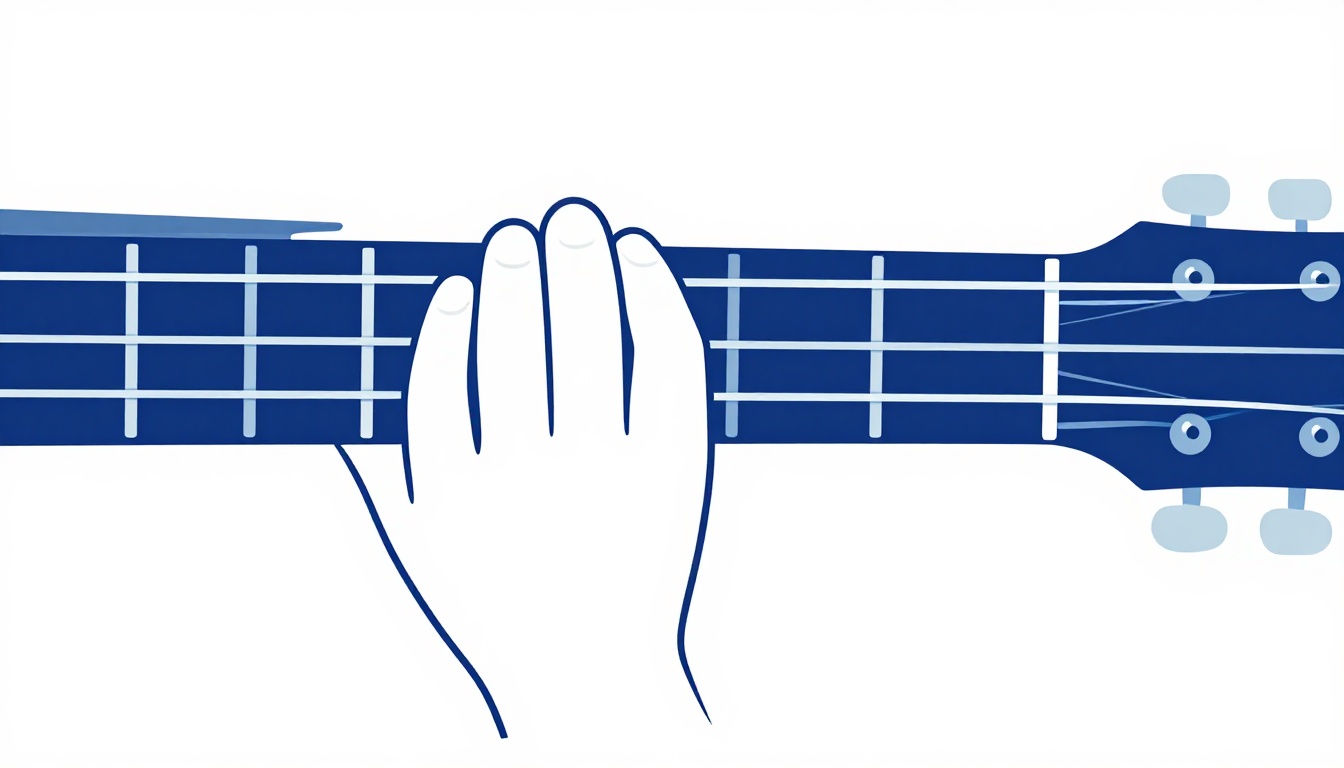
A double stop is two notes played at the same time on adjacent strings, and it is one of the fastest ways to make a plain single-note lick sound fuller without adding any new technique to learn. Instead of fretting one note per beat, you fret two notes on neighboring strings and pick or strum across both of them together.
The simplest double stops come from playing two notes of a chord shape you already know at the same time, rather than one at a time. Take the A minor pentatonic box from earlier and, instead of picking the 5th fret G string and 5th fret B string separately, fret both at once and strike them together. The result is a thicker, more percussive sound than either note played alone, and it reads as more deliberate than a single note in the same rhythmic spot.
e|--5-|
B|--5-|
Fret the 5th fret on both the B string (E) and the high E string (A) at the same time, using two fingers, and pick both strings in a single downstroke. That two-note stack is the entire technique. Everything else is choosing which two adjacent strings and which frets to stack together.
Double stops are especially common in Chuck Berry-style rock and roll licks and in country lead playing, where two strings bent or picked together give a lick a twangy, vocal quality that a single string cannot produce on its own. They also work as a simple way to add weight to the strongest beat of a phrase: play the rest of a lick as single notes, then hit a double stop on the final, landing note to make the resolution feel more definite.
Why Your Lick Sounds Muddy, Flat, or Off
You have the right notes and you are using real technique, and the lick still does not sound like the ones you are trying to write. It is almost always one of these five causes, and it is worth checking each one individually rather than guessing.
The Wrong Scale Over the Chord
Minor pentatonic over a major chord, or the reverse, is the single most common cause of a lick that sounds subtly wrong without an obvious mistake. Check the chord quality first: minor chords and dominant seventh chords generally want minor pentatonic, straightforward major chords generally want major pentatonic. If a lick sounds bluesy when the song calls for bright and upbeat, or thin and major when the song is dark and minor, this is usually why.
No Target Note on the Strong Beat
If every note in the phrase gets equal weight, nothing in it sounds like the point of the phrase. Go back to the three-note rule: pick one chord tone and make sure it lands squarely on beat one or beat three, not buried in the middle of a run of even eighth notes.
Rushing or Dragging the Rhythm
A lick that speeds up through its middle notes and slows back down at the end will sound uneven even if every pitch is correct, and this is one of the hardest problems to hear in yourself without a metronome. Record yourself against a click and listen back. The unevenness is usually much more obvious on playback than it was while playing.
No Space Between Phrases
A lick played back to back with the next idea, with zero silence between them, tends to blur into a single, forgettable run. Go back and physically stop the string from ringing (mute it with your fretting hand or a light touch from your picking hand) between phrases, so the gap you intended is actually silent rather than filled with ringing overtones.
Unwanted Noise From Neighboring Strings
Adjacent strings ringing sympathetically or getting caught by the pick add a low hum or buzz underneath a lick that is supposed to sound like one clean note at a time. Rest the side of your picking hand lightly across the strings you are not using, and use your fretting fingers to lightly touch, not press, strings you have just finished playing. This single habit, more than anything else on this list, is what separates a clean-sounding recording from a muddy one.
Getting In and Out of a Lick Without Losing the Groove
A lick that sounds great in isolation can still trip you up in real playing if you cannot get into it or out of it without stumbling. The entry and the exit matter as much as the notes in the middle.
Getting in cleanly usually means starting from a note you were already near. If your last chord voicing had your fretting hand around the 5th fret, do not open a lick at the 12th fret and expect a smooth transition. Look at where your hand already is at the end of the previous chord or phrase, and choose the closest available entry point into the lick's shape from there, even if that means starting the lick on its second or third note rather than its first.
Getting out cleanly means deciding in advance where the lick needs to land relative to the beat. If the next chord change happens on beat one of the following bar, the last note of your lick needs to either land exactly on that beat one, or resolve just before it with enough space to let the new chord speak clearly. A lick that spills half a beat into the next chord change tends to sound like a mistake rather than a stylistic choice, even when it was intentional.
The most reliable fix for both problems is the same: practice the lick starting one beat later and one beat earlier than written, not just at the timing you first learned it. That gives you the flexibility to drop it in wherever the actual moment in the song calls for it, instead of only being able to play it the one way you practiced.
Writing a Lick to a Chord Progression: A Worked Example
Take a common progression in A minor: Am, F, C, G, one chord per bar. Rather than picking one scale and running it over all four chords, treat each bar as its own short question of which notes to target.
| Chord | Chord tones | Strong target notes from A minor pentatonic |
|---|---|---|
| Am | A, C, E | A (root), C (minor third) |
| F | F, A, C | A, C (both already inside the scale) |
| C | C, E, G | C, E |
| G | G, B, D | G, D |
Notice that A minor pentatonic (A, C, D, E, G) covers strong target notes for all four chords without needing to change scale, because every one of those chords is diatonic to A minor and shares tones with the scale. This is the practical payoff of the three-note rule: rather than memorizing a different scale for every chord change, you keep one scale and simply shift which of its five notes you are landing on as the chord underneath you changes.
A simple worked phrase: over the Am bar, play Lick 1 from earlier and let it resolve on the low E string's 5th fret (A). As the chord changes to F, slide into the 8th fret on that same string (C), which is both inside the scale and a chord tone of F. Over the C bar, use the B string's 5th fret (E), a chord tone of C that is also inside the scale. Over the G bar, resolve down to the D string's 5th fret (G), the root of the G chord.
      Am              F               C               G
E|--5---8---------------------------------------------|
B|-----------------------------5-----------------------|
D|------------------------------------------5----------|
Read straight across: the low E string carries the phrase through the first two bars, sliding from the Am target to the F target, then the phrase hops up to the B string for the C bar and finishes on the D string for the G bar. Four bars, four chords, one scale shape, and four separate decisions about which single note gets the weight.
Nothing about the shape or the scale changed across all four chords. What changed was which single note inside that shape got the weight, and that one adjustment is what makes the lick track the chord progression instead of sounding like the same idea repeated over four unrelated chords.
Adapting Your Lick Across Genres
The same lick-writing tools produce noticeably different results depending on genre, mostly because of which techniques get emphasized and how much space is left in the phrasing.
Blues
Blues licks lean hardest on bends, especially into the minor third and the flat seventh, along with vibrato on held notes and a loose, slightly behind-the-beat rhythmic feel. Space matters more in blues than almost any other style. A blues lick with no rests tends to sound rushed rather than soulful.
Rock
Rock licks often merge with riff writing, sitting on the lower strings and pairing single-note lines with palm-muted power chords for weight. Alternate picking for speed and a more even, driving rhythm than blues phrasing are typical, with bends used for emphasis rather than as the main expressive device.
Country
Country licks favor major pentatonic, double stops, and string bends released quickly rather than held, giving phrases a bright, twangy character. Chicken picking and hybrid picking (using a pick and fingers together) show up often, letting a player mix a picked note with a plucked one inside the same fast phrase.
Pop
Pop licks tend to be the shortest and most repetitive of the four, often just two or three notes used as a recurring hook between vocal lines rather than a full solo idea. Clean tone, minimal distortion, and a rhythm that locks tightly to the drum pattern matter more here than technical flash.
How to Practice a New Lick So It Actually Sticks
A lick you can play once, slowly, with the tab in front of you is not the same as a lick you can drop into a solo without thinking. Getting from one to the other takes a specific, unglamorous practice process.
Start well under tempo, slow enough that you make zero mistakes, not slow enough that you are merely comfortable. A metronome is not optional here. If practicing rhythm guitar with a metronome is a new habit for you, this is the exercise to build it on, because a lick's timing is inseparable from its rhythm, and you cannot judge either one accurately without a fixed reference.
Isolate whichever single technique in the lick is hardest, whether that is a bend, a fast pull-off, or a string skip, and loop just that piece on its own for a minute or two before trying to play the whole phrase again. Trying to fix an entire lick at once usually just means repeating the same mistake at the same spot every pass.
Record yourself on your phone and listen back immediately. What a lick sounds like while you are playing it and what it sounds like on playback are consistently different, usually in ways related to rhythm and note length rather than which notes you played. This is the single fastest way to catch rushing, dragging, and unwanted string noise.
Once the lick is solid on its own, put on a backing track or a simple drum loop in the lick's key and play it in context, several times in a row, changing the entry point slightly each time. A lick that only works when it starts exactly where you first learned it is not actually learned yet. A lick you can drop in a beat early, a beat late, or right on the one is.
Only increase the metronome tempo once you can play the lick five times in a row with zero mistakes at the current speed. Jumping tempo before that point just means practicing the same errors faster.
Common Mistakes When Writing or Playing Licks
Using too many notes. More notes is not more interesting. A five-note lick played with strong rhythm and a clear target note usually beats an eleven-note run that never repeats an idea.
Ignoring the underlying chord. A lick built in isolation, without ever checking it against the actual chord progression it is meant to sit over, will often clash the moment you try to use it for real.
Playing everything at one dynamic level. Picking every note at the same volume flattens a phrase's shape. Accent the target notes, let the connecting notes sit slightly quieter, and the lick reads as phrased rather than mechanical.
Skipping the metronome. A lick's rhythm is most of what makes it catchy, and rhythm is exactly the thing a guitarist's internal sense of time is worst at judging without an external reference.
Never repeating an idea. Constantly moving on to new material before a listener has heard a phrase twice means nothing ever gets the chance to become a hook.
Copying the shape but not the phrasing. Learning the correct frets for a lick is only half the job. Bends, vibrato, dynamics, and where the space falls are usually what made the original memorable, and skipping them leaves you with the right notes and none of the character.
FAQ
What's the actual difference between a lick and a riff?
A lick is a short single-note phrase used as vocabulary inside a solo or between vocal lines. A riff is a repeating pattern, often chord-based, that usually functions as a song's main hook and repeats the same way through an entire section.
Do I need to know music theory to write a catchy guitar lick?
No, but you do need to know which notes are in the scale you are using and which of those notes are chord tones of whatever you are playing over. That is a small, practical slice of theory, not a full course in it, and it is covered in the three-note rule section above.
What scale should I use for a catchy lick?
Minor pentatonic for minor and dominant chords, major pentatonic for major chords, is the reliable starting default. Both scales are covered with exact fret positions earlier in this post.
How short should a guitar lick actually be?
Most catchy licks run four to eight notes over one or two bars. Shorter phrases are easier to remember and easier to repeat with variation, both of which matter more to catchiness than length does.
Can a lick be catchy without any bends or slides?
Yes. Rhythm, repetition, and clear target notes create catchiness on their own. Bends and slides add expression and character, but a rhythmically strong lick built from plain picked notes can still be memorable.
How do I hold on to a lick I just improvised so I don't lose it?
Record it immediately, even a rough phone recording, the moment you play something you like. Improvised ideas fade from memory within minutes, and trying to reconstruct one from a vague feeling almost never gets the exact rhythm back.
Should I practice a lick to a click track or just by feel?
Both, in that order. Learn the lick's rhythm precisely against a metronome first, since that is the only way to know for certain whether you are rushing or dragging. Once it is solid at a fixed tempo, practice it with a looser, more human feel on top, which is closer to how it will actually get used in a real solo.
Why does my lick sound different from how I imagined it in my head?
Almost always rhythm, not notes. A phrase imagined in your head rarely has a precise, consistent rhythm attached to it, so the notes you land on when you actually play it come out evenly spaced by default. Go back to the rhythm section above and deliberately add syncopation, space, and a held note, and the gap between what you imagined and what you are playing usually closes.
Where in a song does a catchy lick actually go?
Most often in the intro, as a turnaround at the end of a verse or chorus, or as a short answer filling the gap after a vocal line. A lick used as the intro usually gets repeated later in the song so a listener recognizes it returning, while a turnaround lick is shorter and exists mainly to signal that one section is ending and another is about to start.
Do I need an electric guitar to write catchy licks, or does acoustic work too?
Acoustic works fine for everything in this post except techniques that depend heavily on sustain and easy bending, like long vibrato or wide bends, which take noticeably more finger strength on an acoustic's heavier strings. Slides, hammer-ons, pull-offs, double stops, and rhythm-based catchiness all translate directly to acoustic without any adjustment.
GuitarLowKey
Ready for fifteen focused minutes?
Open the web app and train the change that is blocking your song.