
How to Play the D5 Guitar Chord (Every Position, No Buzzing)
The D5 power chord in three positions on the neck, why it has no third, how to keep it from buzzing, and how to move it into any other power chord.
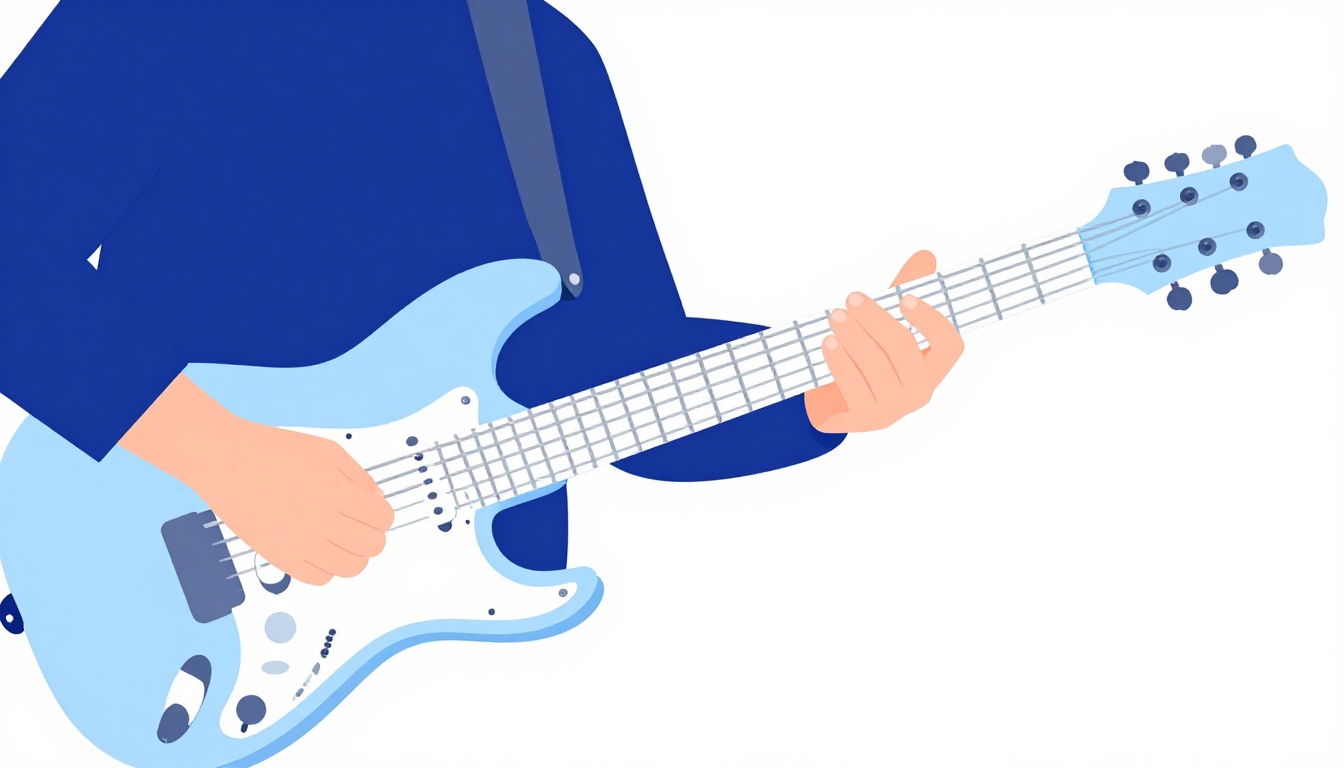
To play the D5 chord on guitar, put your index finger on the 5th fret of the 5th string (A) and your ring finger on the 7th fret of the 4th string (D). Strum only those two strings, and mute everything else, especially the low E string. That gives you D and A, the root and the fifth, which is the whole chord. D5 is a power chord: two notes, no major or minor third, and it is one of the first shapes worth learning because the same two-finger pattern moves to any other root on the neck. This post covers that shape and two more, why the third is missing on purpose, every reason a D5 buzzes or goes dead, and how to move in and out of it fast enough to actually use it in a song.
What Notes Are in a D5 Chord
A D5 chord contains two notes: D, the root, and A, the perfect fifth above it. That is where the "5" in the name comes from, it names the interval, not a scale degree count the way "D7" or "D9" would. A full D major chord adds a third note, F#, which is what makes it sound major. Leave that note out and you are left with D5.
Because the third is missing, D5 is neither major nor minor. It does not resolve toward brightness or darkness the way a full triad does, which is exactly why it works under a screaming lead line, a shouted vocal, or heavy distortion without ever sounding like it is fighting the melody. Guitarists sometimes write this chord as "D no3" or "Domit3" in notation software, both of which mean the same thing: a D chord with the third intentionally left out.
| Note | Role |
|---|---|
| D | Root |
| A | Perfect fifth |
If you add a third note that repeats the D an octave higher, the chord still functions as D5, it just sounds fuller. That third note is optional in every shape below, and this post tells you when to include it.
Every shape in this post assumes standard tuning. If your guitar is tuned to anything else, the fret numbers below will not produce D5.
| String | Standard tuning note |
|---|---|
| 6 (thickest) | E |
| 5 | A |
| 4 | D |
| 3 | G |
| 2 | B |
| 1 (thinnest) | E |
The Standard D5 Shape: 5th Fret Position
This is the shape most players mean when they say "D5." It sits entirely on the 5th and 4th strings, uses two fingers, and moves cleanly to any other power chord just by sliding it.
| String | Fret | Finger |
|---|---|---|
| 6 (low E) | Muted | - |
| 5 (A) | 5 | 1 (index) |
| 4 (D) | 7 | 3 (ring) |
| 3 (G) | Muted or not played | - |
| 2 (B) | Not played | - |
| 1 (high E) | Not played | - |
Rest the side of your index finger, or your fretting-hand thumb wrapped slightly over the top of the neck, against the low E string so it cannot ring by accident. Strum down through only the 5th and 4th strings. If your pick catches the 6th string and it rings out untouched, you will hear a low, muddy note underneath the chord that does not belong there.
Adding the Third Note for a Fuller Sound
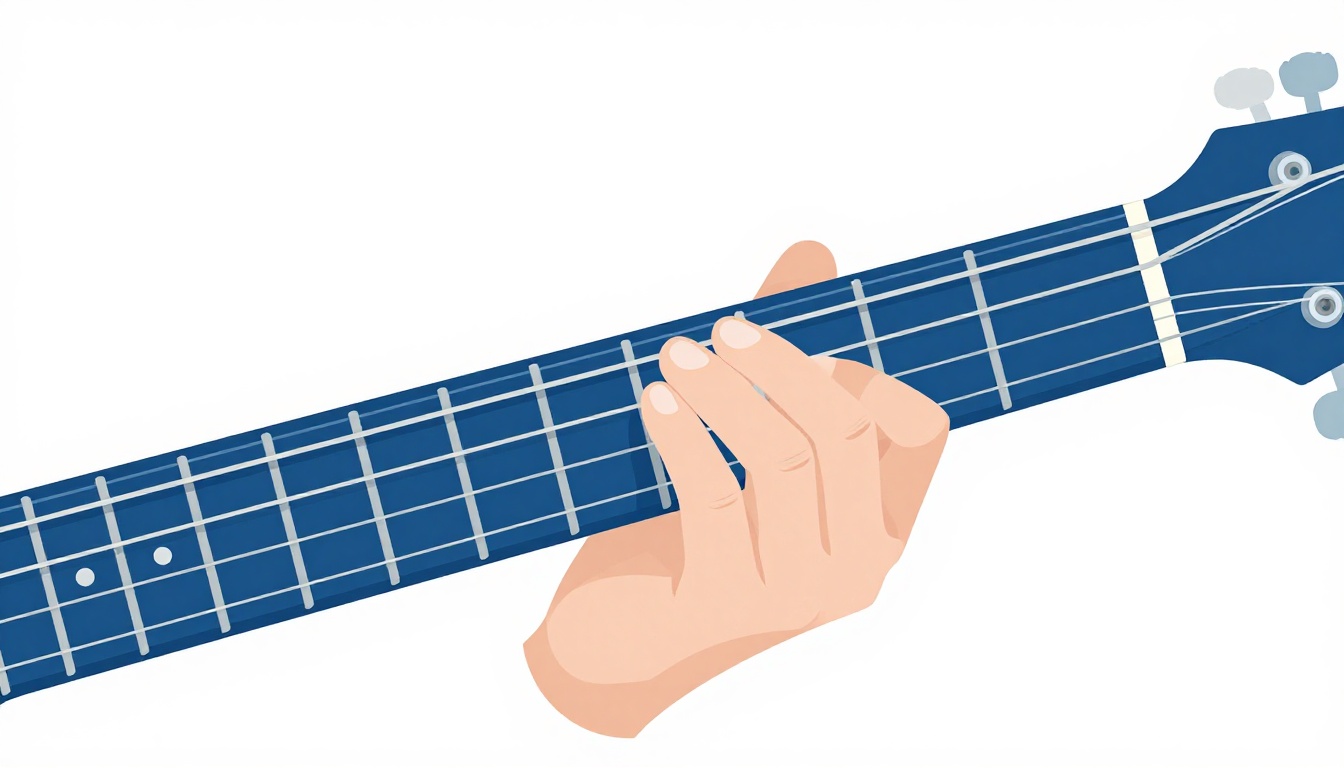
Add your pinky to the 7th fret of the 3rd string (G) and you double the root an octave up, without changing the chord. This three-note version is the one most rock and metal rhythm parts actually use, because it gives the chord more body once distortion or a full band mix is involved.
| String | Fret | Finger |
|---|---|---|
| 6 (low E) | Muted | - |
| 5 (A) | 5 | 1 (index) |
| 4 (D) | 7 | 3 (ring) |
| 3 (G) | 7 | 4 (pinky) |
| 2, 1 | Not played | - |
Keep your ring and pinky fingers close together, almost stacked, rather than spread across the fret. That keeps the stretch small and stops your hand from cramping on faster changes.
The Easier Open-Position D5 Near the Nut
If the 5th fret stretch feels early, there is a second D5 shape near the nut that uses an open string for the root and needs only one fretted note.
| String | Fret | Finger |
|---|---|---|
| 6 (low E) | Not played | - |
| 5 (A) | Not played | - |
| 4 (D) | Open | - |
| 3 (G) | 2 | 1 (index) |
| 2 (B) | Not played | - |
| 1 (high E) | Not played | - |
Strum only the 4th and 3rd strings. The open D string gives you the root, and your index finger on the 2nd fret of the G string gives you the A, the fifth. This is the fastest D5 on the neck to get ringing cleanly, since there is only one finger to place, and it is a good first stop before you tackle the 5th fret version.
The Three-String Open Version
Add your ring finger to the 3rd fret of the 2nd string (B) and you get the same octave-doubling trick as the higher shape, this time built around open strings.
| String | Fret | Finger |
|---|---|---|
| 4 (D) | Open | - |
| 3 (G) | 2 | 1 (index) |
| 2 (B) | 3 | 3 (ring) |
| Others | Not played | - |
This version rings a little brighter than the pure two-note shape because of the extra open string involved, which makes it a good choice for acoustic guitar, where power chords otherwise tend to sound a bit hollow.
The Higher D5 Voicing: 10th Fret Position
There is a third common way to play D5, built around the low E string instead of the A string. It sits higher up the neck and gives the chord a darker, heavier low end because the root sits on the thickest string.
| String | Fret | Finger |
|---|---|---|
| 6 (low E) | 10 | 1 (index) |
| 5 (A) | 12 | 3 (ring) |
| 4 (D) | 12 | 4 (pinky, optional) |
| Others | Not played | - |
Strum from the low E string down through the A string, and the D string if you have added the pinky. This is the same shape guitarists use to play the lowest, heaviest power chords on the neck, and once you know it, you can slide the whole thing down to the open 6th string for E5, the lowest and most common power chord in rock.
Two-Note vs Three-Note D5: Which Should You Play
Start with the two-note version of whichever shape you are learning. It is easier to fret cleanly, easier to mute correctly, and it is still a complete, correct D5 chord, nothing is missing. The three-note version, with the octave added on top, is a thickening choice, not a correctness fix.
Reach for the three-note version when you are playing with distortion, playing alone without a bass player filling in low end, or want the chord to cut through a full band mix. Stick with the two-note version for cleaner tones, faster palm-muted rhythm parts, or any time the extra finger makes a chord change too slow to keep up with the song.
Neither version is the "real" D5 and the other a simplified stand-in. Both are complete, correctly built power chords, and switching between them mid-song, thinner for a verse, fuller for a chorus, is a legitimate dynamic choice rather than a compromise.
Why It's Called "D5" and Not "D Fifth Chord"
The number in a power chord's name refers to the interval above the root, the fifth, not a fret, a finger, or a scale degree count the way it would in a chord like D9 or D11. This trips people up because "5th fret" and "the 5 in D5" sound related but are not connected at all. The 5th fret D5 shape happens to be named after the fret it lives on for this particular chord, but the "5" in the chord's name would stay "5" no matter which fret you played it on.
Written out fully, "D5" is shorthand for "D fifth chord" or "D power chord," both of which mean the same two-note shape. You will see it written as D5 far more often than spelled out, in tab, chord charts, and songbooks alike, because the shorthand is universal across genres that use power chords heavily.
Reading D5 in Tab and Chord Charts
In tablature, power chords are written the same way as any other fretted note, as a number on the string it belongs to, stacked with the other note in the chord directly above or below it. The 5th fret D5 shape looks like this in tab:
e|---|
B|---|
G|---|
D|-7-|
A|-5-|
E|---|
Reading top to bottom, the top line is the thinnest string (high E) and the bottom line is the thickest (low E). The "5" on the A string line and the "7" on the D string line tell you exactly where this post's main D5 shape sits, and the blank lines confirm those strings are not played.
In chord charts and songbooks, you will simply see "D5" written above the lyrics or the beat it lands on, exactly the way "D" or "Dm" would appear. Nothing about the chord symbol tells you which of the three shapes in this post to use, that choice is left to you, based on where your hand already is and which register you want the chord to sit in.
Songs Built Around D5
D5 shows up constantly in rock, punk, and metal rhythm parts, almost always as part of a short progression with two or three other power chords rather than sitting alone. The classic intro riff to "Smoke on the Water" moves through A5, C5, D5, and Eb5 in sequence, D5 acting as one stop along the way rather than the anchor. "Smells Like Teen Spirit" leans on A5, D5, and E5 for its verse and chorus riffs, the same two-finger shape sliding between three neighboring frets. Weezer's "Beverly Hills" builds its main riff from G5, C5, and D5.
None of these songs use a single fixed D5 shape throughout, they move between the positions covered earlier in this post depending on which other chord comes next. That is the real skill power chord riffs test: not holding one shape steady, but sliding the same two fingers cleanly and in time between several frets.
D5 With a Capo
A capo shortens the neck and raises every open string's pitch, which changes what a given fret produces without changing your fingering. If you place a capo on the 2nd fret and play the open-position D5 shape from earlier (open 4th string, index finger 2nd fret of the 3rd string), you are no longer playing D5, you are playing E5, because the capo has raised every note by a whole step.
To keep playing an actual D5 with a capo on, you need to shift your fingering down by however many frets the capo covers. With a capo on the 2nd fret, the open-position D5 shape becomes a C5 shape played behind the capo (open-string equivalent two frets lower). This matters most if you are playing along with a capoed recording and trying to match a specific chord name rather than just matching the sound relative to the capo.
The same logic applies to the movable A-string shape. With a capo on the 5th fret, playing the open-string version of that shape, no fretting at all on the index finger, produces D5, since the capo has already done the work of raising the open A string up to D. This is a common way singers with a capo-heavy acoustic setup reach D5 without stretching to the 5th fret behind the capo as well.
Why Your D5 Isn't Ringing Clean
Power chords look simple, and the fingering usually is, but a D5 that buzzes, sounds muddy, or goes silent on one string almost always comes down to one of these five things.
The Low E String Is Ringing Out Untouched
This is the single most common D5 problem. The 5th fret shape sits right next to the low E string, and an untouched open low E rumbling under a D5 sounds like a wrong note because it functions as one. Angle your index finger slightly, or rest your thumb over the top edge of the neck, so the 6th string is dead the moment you strum.
You Are Pressing With the Pad of Your Finger Instead of the Tip
Power chords need firm, precise contact right behind the fret wire. If your finger lies flat, the pad muffles the string next to it and you lose clarity on notes that should be ringing. Curl your fingers so only the tips make contact, on the pads of the very ends of your index and ring fingers.
Your Fretting Fingers Aren't Landing Right Behind the Fret
Press too far from the fret wire, toward the middle of the fret space, and the string buzzes against the next fret up. This matters more on power chords than on open chords because there is no open string masking a weak note, every note in the chord is fretted and has to hold its own.
The Three-Note Version Is Choking the Middle String
When you add the pinky for the octave note, check that your ring finger is not accidentally leaning onto the string next to it. Ring and pinky sitting on adjacent strings, one fret apart, is a tight formation, and a slightly flattened ring finger will mute the string the pinky is trying to fret.
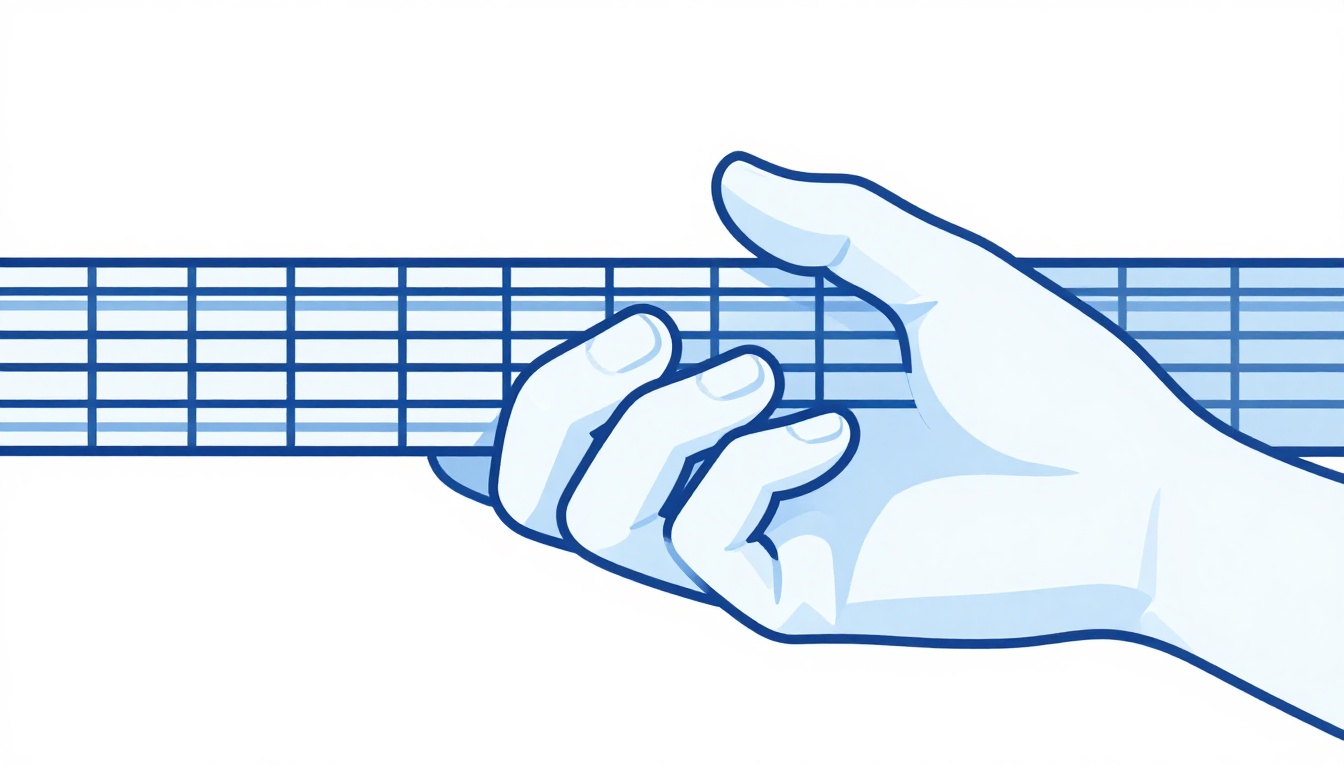
Your Guitar's Action Is Fighting You
If every chord on your guitar, not just D5, takes noticeably more pressure to ring clean than it should, the problem may not be your technique at all. High action, meaning the strings sit further from the fretboard than they need to, forces every finger to press harder for the same result, and that fatigue shows up first on shapes that already ask two fingers to hold firmly, like power chords. This is a setup issue a guitar tech can usually fix in a single adjustment, and it is worth ruling out before you assume the fault is entirely in your hand.
You Are Strumming Strings You Meant to Mute
D5 only asks for two or three strings to ring, and every shape in this post has at least one string deliberately left out. A pick that swings too wide catches the extra strings and the chord loses its punch. Practice strumming slowly enough to feel your pick pass only over the intended strings before you speed up.
Why D5 Actually Sounds Better Through Distortion
This is not just taste, there is a real acoustic reason power chords and distorted guitar tone were made for each other. Distortion works partly through intermodulation, meaning it generates new overtones from the interactions between the notes already present in a chord. A full major chord has three closely spaced notes, and running that through heavy distortion multiplies those interactions into a dense cluster of extra frequencies that clash against each other, which is why a fully strummed major chord through a high-gain amp tends to sound cluttered and muddy rather than powerful.
D5 avoids that problem by construction. With only the root and the fifth present, a simple 3:2 frequency ratio, distortion's added overtones reinforce that ratio instead of fighting it, filling out the sound without adding dissonant clutter. That is the actual mechanism behind the "power" in power chord: it is not just that the chord is simple, it is that the simplicity is exactly what heavy distortion needs to sound big instead of muddy.
Equipment Notes: What Actually Changes the Sound of D5
The chord shape is the same on any guitar, but a few equipment factors change how it comes across, and it helps to know which ones matter and which ones are just tone shaping.
Pickup position matters more than pickup type. A bridge pickup, closer to where the strings vibrate least, gives a tighter, more focused sound that suits palm-muted power chord rhythm work. A neck pickup gives a rounder, fuller sound that can start to blur the two notes of a power chord together once distortion is added.
String gauge affects sustain and clarity more than it affects the chord itself. Heavier strings hold pitch more stably under aggressive picking and tend to sustain longer, which is part of why heavier gauges are common in drop tunings and metal styles built around sustained power chords, though lighter strings are easier to fret and bend and remain a completely reasonable choice for most players.
Amp gain is the setting most directly tied to everything in the section above. Higher gain increases the intermodulation effect that makes power chords sound full, but past a certain point it also increases noise and unwanted string buzz picked up from your fretting hand. If a D5 sounds muddier as you increase gain rather than bigger, check your muting technique before assuming the amp is at fault, un-muted strings become far more audible as gain increases, not less.
How to Palm Mute a D5 Chord for a Tight, Rock Sound
Palm muting is what turns a ringing power chord into the tight, percussive "chugging" sound behind most rock and metal rhythm parts. Rest the side of your picking hand, right where it meets your wrist, lightly across the strings close to the bridge, then strum through it.
The two mistakes that ruin palm muting are pressing too hard and resting too far from the bridge. Press hard and the strings go dead and thuddy with no pitch left at all. Rest too far from the bridge, out over the middle of the strings, and the chord goes muffled and unclear instead of tight. Aim for a light touch right at the edge of the bridge saddles, just enough contact to shorten the ring without killing the pitch.
Practice the contrast on purpose: play four palm-muted D5 chords, then let go and strum four fully open ones. That contrast, tight and controlled against big and ringing, is the actual sound rock rhythm guitar is built on, not the muting alone.
D5 vs D Major: What's the Actual Difference
A D major chord is built from three notes, D, F#, and A, the root, third, and fifth. D5 keeps the root and the fifth and drops the F# entirely. That single missing note is the whole difference, and it changes the character of the chord more than its small size suggests.
D major commits to a bright, resolved sound because the major third tells your ear exactly where the chord sits, happy, settled, finished. D5 removes that information. It states the root clearly and leaves the emotional color open, which is why power chords sit so comfortably under distorted riffs, aggressive vocals, or fast chord changes where a fully harmonized chord would clash or sound too busy.
You cannot substitute one for the other freely. Swap a D5 in for D major in a folk or pop progression and the song loses its harmonic clarity. Swap a full D major in for a D5 in a distorted rock riff and the extra harmonic information can turn muddy or dissonant once the amp adds gain, since distortion emphasizes overtones that a bare root-and-fifth avoids.
D5 Works in Both Major and Minor Keys
Because D5 has no third, it is not tied to a major or minor key the way D major or D minor is. That makes it one of the few chords you can drop into a Dm progression without changing it to D major, and drop into a D major progression without changing it to D minor. The rest of the band, the vocal melody, or the other instruments in the mix supply whichever quality the moment needs, and D5 stays neutral underneath.
This is part of why power chord progressions are so common in rock, punk, and metal, genres that often move between major and minor feeling sections within the same song. A verse built on D5-C5-G5 can sit under a moody, minor-leaning vocal line, and the same three chords can sit under a brighter, major-leaning one, without a single fret changing. Try it: play D5-A5-G5 slowly, and hum first a minor-sounding melody over it, then a major-sounding one. Both will fit, because the chords themselves never commit either way.
Moving the Shape: Turning D5 Into Any Other Power Chord
Every power chord shape in this post is movable. The finger pattern, the distance between the two fretted notes, never changes, only which fret you start on. Slide the 5th fret shape (index on the 5th string, ring two frets up on the 4th string) down two frets and your index finger lands on the 3rd fret of the A string, which is C, giving you C5. Slide it up two frets to the 7th fret and you get E5.
The same is true of the 10th fret shape built on the low E string. Move that whole two-finger pattern to the open strings and you get E5, the most common power chord in rock. Move it to the 3rd fret and you get G5. Learning D5 in both positions means you already know every other power chord on the neck, since the shape carries the sound, not the specific fret.
| Shape used for D5 | Move to fret | New chord |
|---|---|---|
| A-string root shape | 3rd fret | C5 |
| A-string root shape | 7th fret | E5 |
| Low E-string root shape | Open (no fret) | E5 |
| Low E-string root shape | 3rd fret | G5 |
Full Reference: Every Power Chord on Both Shapes
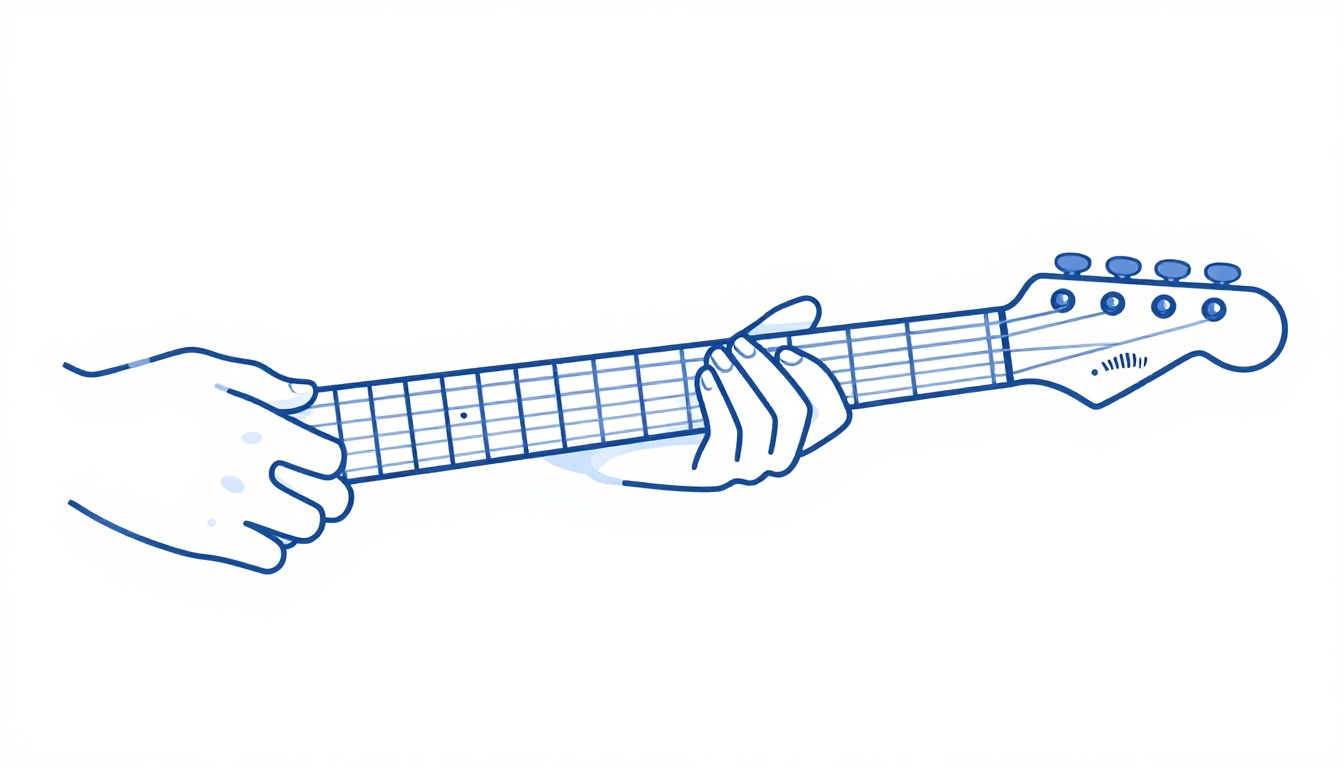
Use this table to find any power chord using the same two fingerings you already learned for D5. The "A-string shape" is the index-and-ring pattern from the 5th fret position. The "low E-string shape" is the pattern from the 10th fret position.
| Fret | A-string shape gives you | Low E-string shape gives you |
|---|---|---|
| Open | A5 | E5 |
| 1 | Bb5 | F5 |
| 2 | B5 | F#5 |
| 3 | C5 | G5 |
| 4 | C#5 | G#5 |
| 5 | D5 | A5 |
| 6 | D#5 | Bb5 |
| 7 | E5 | B5 |
| 8 | F5 | C5 |
| 9 | F#5 | C#5 |
| 10 | G5 | D5 |
| 11 | G#5 | D#5 |
| 12 | A5 | E5 |
Notice that D5 appears twice, once at the 5th fret of the A-string shape, which is the version this post teaches first, and once at the 10th fret of the low E-string shape, the higher, heavier voicing covered earlier. Both are equally correct, they simply put the root on a different string and in a different octave.
D5 in Drop D Tuning
In drop D tuning, the 6th string is tuned down a whole step from E to D, so the low E string and the 4th string (D) match at the octave. That turns the low root note of a D power chord into an open string.
In drop D, you can play D5 by barring your index finger flat across the 6th, 5th, and 4th strings at any single fret, or simply strumming the 6th, 5th, and 4th strings open for D5 with no fretting at all. It is one of the reasons drop D became a standard rock and metal tuning: it turns every power chord rooted on the low E or A string into a one-finger barre instead of a two-finger stretch, which matters at fast tempos. If you play in standard tuning, ignore this section entirely, none of the shapes above assume it.
How Different Genres Play D5 Differently
The chord itself does not change across genres, but how it is picked, muted, and timed does, and knowing the difference helps you match the sound you actually have in your head.
Punk rock tends to favor fast, aggressive down-picking on power chords, often eighth notes with little or no palm muting, which gives the chord a raw, ringing edge rather than a tight, controlled one. Speed and consistency of the down-strokes matter more than dynamic variation.
Metal leans heavily on palm muting, often alternating tightly muted "chugs" with brief unmuted accents for contrast, and frequently uses the lower, heavier 10th fret style voicing built on the low E string rather than the brighter A-string shape.
Alternative and grunge rock, the style Nirvana's power chord work sits in, often mixes open, ringing power chords with brief muted sections and leans on the open-position style voicings near the nut as much as the higher barred ones, giving the chords more resonance than a tightly muted metal riff would have.
None of these are rules, just common tendencies, and the same D5 shape works in all three contexts. What changes is your picking hand, not your fretting hand.
Chord Progressions and Riffs Built on D5
Power chord progressions in rock rhythm playing usually follow the same logic as major-key progressions, just stripped of the third. A D5-G5-A5 progression is the power chord version of a I-IV-V progression in the key of D, the same movement that drives countless folk and pop songs in D major, just with a harder edge.
Try this progression using two of the shapes from earlier in this post: D5 (A-string shape, 5th fret), G5 (low E-string shape, 3rd fret), A5 (A-string shape, open, no fretting on the index finger at all, just the D string fretted two frets up). This progression is a good test of the string-pair jump covered in the changing-chords section above, since the move from D5 to G5 relocates your whole hand to the low E and A strings before A5 brings it back.
A second common progression, this one built entirely on the A-string shape so there is no string-pair jump at all, is D5-C5-G5-D5, sliding down two frets, then up seven, then back down five. It is a good drill specifically for keeping the shape's finger spacing constant while your hand covers a wider range of frets than the first progression asks for.
Changing Into and Out of D5 Quickly
The shape is never the hard part with power chords, the movement is. D5 to A5 on the same string set is the shortest possible move, since both use the same two-finger shape and you are only sliding two frets. D5 to E5 built on the low E string means relocating your whole hand to a new string pair, which takes longer until it is drilled.
Practice chord changes in isolation before you try them inside a song. Play D5, lift your fingers completely, land A5, and repeat slowly with a metronome, adding speed only once the change happens without you having to look at your hand. A metronome is worth using here specifically because power chord rhythm parts live or die on timing, a late chord change is more noticeable in a driving rock riff than almost anywhere else in guitar playing.
Some changes are shorter physical moves than others, and it helps to know which before you assume a slow change is a technique problem rather than just a longer trip across the neck.
| From D5 to | Shape change | Relative difficulty |
|---|---|---|
| A5 (A-string shape) | Same shape, slide 2 frets | Easiest, no string change |
| C5 (A-string shape) | Same shape, slide 2 frets | Easiest, no string change |
| G5 (A-string shape) | Same shape, slide 2 frets | Easiest, no string change |
| E5 (low E-string shape) | New string pair, same finger pattern | Moderate, hand relocates |
| B5 (low E-string shape) | New string pair, same finger pattern | Moderate, hand relocates |
Changes within the same string pair are always faster to build speed on, since your hand only slides rather than jumping to a new pair of strings. When a song mixes both types of change, practice the string-pair jump on its own first, since that is the part most likely to slow the whole riff down.
Building Speed for Fast Power Chord Rhythms
Punk, metal, and driving rock rhythm parts often ask for power chords to change on every beat, sometimes faster, which is a different skill from fretting a single D5 cleanly. Speed on power chords comes from minimizing motion, not from moving your hand faster. Lift your fingers only far enough off the strings to stop them from ringing, a few millimeters, rather than pulling your whole hand away from the neck between chords.
Practice this with a simple drill: hold the D5 shape, then release just enough pressure to silence the strings without losing contact entirely, then press back down. This "ghost" motion, pressure on and off without full separation from the neck, is what fast rhythm guitarists are actually doing, and it looks nothing like the slow, deliberate lift-and-place motion that works fine for learning the shape in the first place. Once the ghosted version feels natural, apply the same light-contact habit to full chord changes between two different shapes.
A Short Warm-Up Before Power Chord Practice
Power chords ask your fretting hand to press firmly with just one or two fingers, which is a different demand than the wider four-finger spread of most open chords. A short warm-up before you start makes the session more productive and lowers the chance of unnecessary hand strain.
Spend one minute doing slow, deliberate finger taps, index and ring finger together, anywhere on the neck, pressing down and releasing without strumming, just to wake up the exact muscles the D5 shape uses. Follow that with thirty seconds of open, relaxed strumming on the open strings, no fretting at all, to loosen your picking hand and set a comfortable strum tempo before you add the left hand back in.
This does not need to be elaborate. The point is simply to arrive at the D5 shape with both hands already warm, rather than using the chord itself as the warm-up and fighting tension for the first few minutes of practice.
Practice Routine for Today
Spend ten minutes across four short blocks.
- Two minutes, 5th fret D5, two-note version only. Fret it, strum, release, repeat, focused entirely on a clean sound with no buzz.
- Two minutes, add the pinky for the three-note version, same shape.
- Three minutes, alternate between palm-muted and open D5, four strums each, to build the muting contrast.
- Three minutes, slide the same shape between D5, C5, and E5, slow and deliberate, aiming for silence between chords rather than a fast but sloppy change.
Do this daily for a week before adding a second power chord shape into the rotation. The two-finger movable shape is the entire foundation of rock rhythm guitar, and it rewards slow, clean repetition far more than fast, messy practice.
A One-Week Plan If You Want Structure
The daily routine above works on its own, but if you want a clearer sense of progress across the week, shift the focus day by day rather than repeating the same four blocks unchanged.
| Day | Focus |
|---|---|
| 1-2 | 5th fret D5 only, two-note version, until it rings clean every time without looking at your hand |
| 3 | Add the three-note version with the pinky, same shape |
| 4 | Introduce palm muting, alternating muted and open strums |
| 5 | Bring in the open-position D5 near the nut as a second shape |
| 6 | Practice sliding between D5, C5, and E5 on the A-string shape |
| 7 | Play through the D5-G5-A5 progression from earlier, slow, with a metronome |
By the end of the week, you should be able to fret D5 in at least two positions without checking your hand, and slide the movable shape to a neighboring chord without a pause you can hear.
Common Mistakes Beyond Buzzing
Strumming too wide. A pick stroke that swings well past the strings you need often clips the low E string or the strings above the shape, adding notes that were never part of the chord.
Gripping the neck too hard. Power chords need firm fingertip pressure, not a hard overall grip. A tense fretting hand tires fast and makes quick chord changes slower, not faster.
Losing the beat during the change. It is tempting to slow the whole strumming pattern down while your hand relocates. Keep strumming through the change, even if the chord briefly sounds wrong, since that habit is what eventually makes the change land in time.
Ignoring the open strings. On the open-position D5 near the nut, an accidentally muted open D string kills the whole chord, since it is the root. Check that nothing, especially your own palm, is resting against it.
Practicing only at performance speed. Power chords are simple enough that it is tempting to skip the slow, deliberate stage entirely and jump straight to speed. That habit tends to bake in small muting and pressure errors that only show up once distortion or a full band mix makes them audible, at which point they are harder to unlearn than they would have been to avoid.
Frequently Asked Questions
Is D5 the same as a D power chord?
Yes. "D5" and "D power chord" name the same two notes, D and A, the root and the perfect fifth. "Power chord" is the general term for this two-note shape on any root, and "D5" is what you call the specific one built on D.
Why does D5 sound the same whether it's "major" or "minor"?
Because the note that makes a chord major or minor, the third, is not part of D5 at all. Only the root and the fifth are present, and neither of those notes determines major or minor quality, so the chord is neither.
Can I use D5 instead of a full D chord in any song?
Not safely in every case. In folk, pop, or acoustic strumming, the full D chord's third is often part of what makes the progression sound resolved, and swapping in D5 can leave the harmony feeling unfinished. In rock or metal rhythm parts, D5 is usually the correct and intended chord already, not a substitute.
Do I need distortion to play D5?
No. D5 works on a clean electric or acoustic guitar too, it just sounds sparser without the extra harmonic content that comes from major or minor thirds. Distortion is common with power chords because it adds overtones that a bare root-and-fifth chord handles better than a full triad does, not because the chord requires it.
Which D5 shape should beginners learn first?
The open-position shape near the nut, since it needs only one fretted finger and gets you a clean, complete D5 fastest. Move to the two-finger 5th fret shape once that feels stable, since that version is the one that transposes to every other power chord on the neck.
Why does my three-note D5 sound worse than my two-note version?
Almost always because the added pinky, or the ring finger next to it, is muting a string it should not be touching. Check that your ring and pinky fingers are curved and only their tips are making contact, and that neither one is leaning onto the string beside it.
Is D5 hard to learn if I'm new to guitar?
No, it is one of the more approachable early chords. The open-position version needs only one finger, and the movable version is a simple two-finger shape without an awkward stretch. Most of the difficulty in power chords in general comes later, from switching between them quickly, not from fretting any single one.
Can I play D5 on an acoustic guitar?
Yes. Power chords are not exclusive to electric guitar, they are simply less common on acoustic because the sparse two-note sound is more associated with distorted rock tones. On acoustic, the open-position D5 near the nut tends to sound fuller than the 5th fret version, since it involves at least one ringing open string, so it is usually the better choice if you are playing unplugged.
What's the difference between D5 and Dsus2?
Both chords replace the third of a D major chord, but with different notes. D5 removes the third and adds nothing else, leaving just the root and fifth. Dsus2 keeps three notes but swaps the third for the second, D, E, and A, which gives it a distinct, slightly unresolved color that D5 does not have. If you hear a chord that sounds like D but not quite major or minor, check whether it has that extra second-degree note ringing, since that is what separates a sus2 chord from a plain power chord.
How is D5 different from D5 in "open D5 tuning"?
They are unrelated despite the shared name. The D5 chord in this post is a shape you fret in standard tuning. "Open D5 tuning" is a different topic entirely, an alternate tuning where the open strings themselves are tuned to form a D5 chord. If you were looking for that tuning rather than the chord shape, this post is not the one you want.
Do I need a specific pick to play power chords well?
No specific pick is required, but a slightly firmer, less flexible pick tends to give power chords more definition, since a very flexible pick can lose energy on the down-stroke instead of transferring it cleanly into the string. This is a preference to experiment with, not a rule, and plenty of players get a great power chord sound with a soft pick.
Why does my D5 sound fine unplugged but muddy through my amp?
This usually comes back to muting rather than the amp itself. Unplugged, a slightly ringing extra string is quiet enough to ignore. Plugged in with any gain or distortion, that same faint ring gets amplified along with everything else, and it reads as mud. Go back through the buzzing and muting causes earlier in this post with the amp on, since problems that are inaudible acoustically often become obvious the moment gain is added.
Can I fingerpick a D5 chord instead of strumming it?
Yes, though it is far less common. Since D5 is only two or three notes, fingerpicking it produces a sparse, open sound rather than the dense strum most rock contexts call for. It works best in slower, more atmospheric parts where you want the interval itself, the bare fifth, to be audible as its own sound rather than blended into a full strum.
What's the fastest way to memorize every power chord shape on the neck?
Use the reference table earlier in this post rather than memorizing chord-by-chord. There are only two shapes to learn, the A-string root and the low E-string root, and every power chord on the neck is one of those two shapes moved to a different fret. Once you can name the notes on the 5th and 6th strings from memory, fret by fret, you already know where every power chord lives, since the root note under your index finger is the chord's name.
Once D5 is ringing cleanly in at least two positions, the next useful step is learning where it sits inside the D major scale, since every note in that scale is a potential root for another power chord built the same way.
GuitarLowKey
Ready for fifteen focused minutes?
Open the web app and train the change that is blocking your song.