
How to Play the Em9 Guitar Chord (The One-Finger Way)
The one-finger open Em9 shape, the movable jazz version, and why the 'easy Em9' shape you find online is often really Emadd9.

To play the Em9 chord on guitar, leave your low E, D, G, and B strings open, mute the A string, press your index finger on the 2nd fret of the high E string, and strum every string except the muted A. That single finger gives you a complete, correctly voiced five-note Em9, root, minor third, fifth, minor seventh, and ninth, all ringing at once. Everything below covers that shape in more detail, a movable version you can carry to any root, and a comparison shape you will see all over the internet mislabeled as Em9 when it is actually a different chord.
String names, numbers, and standard tuning
Every fret number and finger placement in this post refers to the six strings by both name and number, so it helps to have that straight before anything else.
| String number | Name | Standard tuning |
|---|---|---|
| 6 | Low E | E |
| 5 | A | A |
| 4 | D | D |
| 3 | G | G |
| 2 | B | B |
| 1 | High E | E |
Strings are numbered thinnest to thickest, so the 1st string is the high E, the thinnest string, and the 6th string is the low E, the thickest. Standard tuning, low to high, is E-A-D-G-B-E. Every fret position described here assumes standard tuning, so if your open strings are not producing those exact notes, tune up first. A chord that will not ring clean is often a tuning problem wearing a fingering problem's clothes.
What is actually in an Em9 chord
Em9 is a five-note chord: E (the root), G (the minor third), B (the perfect fifth), D (the minor seventh), and F# (the ninth). In scale-degree terms, that is 1, b3, 5, b7, and 9.
The name tells you how it is built. A plain E minor triad is just the root, minor third, and fifth (E, G, B). Add a minor seventh and you get Em7 (E, G, B, D). Em9 takes that whole Em7 chord and stacks one more note on top, the major ninth, which is F#, the same note as the 2nd degree of the E minor scale but voiced an octave higher. That stacking matters: every real Em9 voicing contains a complete Em7 inside it, so if you already know Em7, you already know four of Em9's five notes.
Because five notes is a lot to fit across six strings with four fingers, most guitar voicings of Em9 quietly drop the fifth (B). It is the least essential note in the chord, since the root and the minor third already establish that the chord is minor, and the minor seventh and ninth are what give Em9 its distinct color. Losing the fifth costs you almost nothing you can hear.
The open Em9 chord, string by string
Here is the easiest voicing as a table. "Finger" uses standard numbering: 1 is your index finger, 2 is your middle finger, 3 is your ring finger, 4 is your pinky.
| String | Fret | Finger | Note | Role |
|---|---|---|---|---|
| 6 (low E) | Open | - | E | Root |
| 5 (A) | Muted | - | - | - |
| 4 (D) | Open | - | D | Minor seventh |
| 3 (G) | Open | - | G | Minor third |
| 2 (B) | Open | - | B | Fifth |
| 1 (high E) | 2 | 1 (index) | F# | Ninth |
Four of the six strings ring open, one is muted, and a single finger on the high E string's 2nd fret supplies the note that turns a plain open chord into a genuine Em9. If you already know how to mute the A string for the standard open Em chord's cousin shapes, this will feel immediately familiar.
Which strings to strum
Strum from the low E string through the high E string, but keep the A string out of it. That is the one habit this chord asks you to build: five strings ring, one does not.
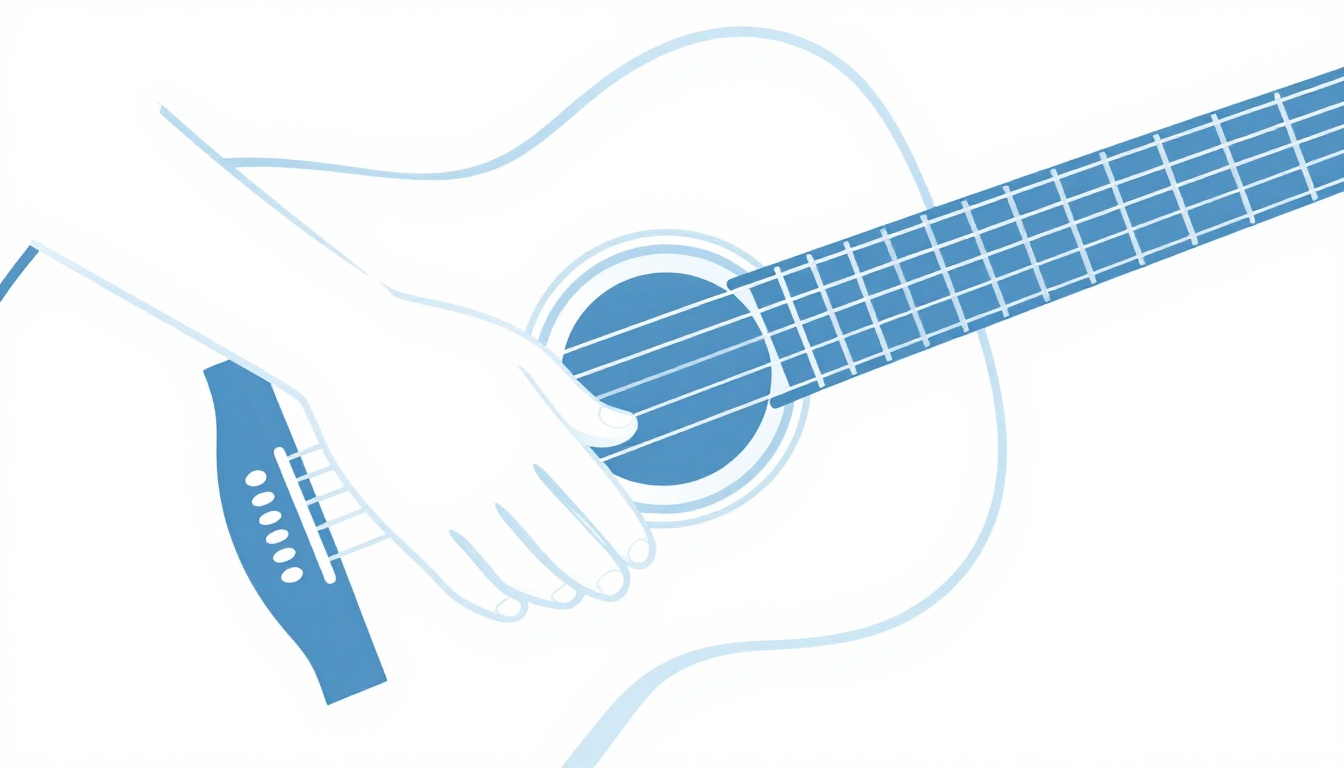
The easiest way to manage this with a pick is to angle your strum so it starts on the low E string and rolls downward without a hard stop, letting the pick glance past the A string quickly rather than dwelling on it. If your pick catches the A string cleanly now and then, that is fine as long as your fretting hand is muting it, which is the next section.
Muting the A string without a spare finger
Every finger in the one-finger Em9 shape is busy or free, none of them are sitting on the A string, so the mute has to come from somewhere else. Two options work well.
The first is your fretting-hand thumb. Let it creep just slightly over the top edge of the neck so its pad rests against the A string, deadening it without touching the low E string beside it. This is a small adjustment, not a full grip change, and it is worth practicing on its own: rest your thumb there, strum all six strings, and confirm the low E still rings while the A string produces only a dull thud.
The second is your strumming hand. Many players simply learn to skip the A string with the pick or their fingers, the same way you learn to skip the low E string on a chord like C or D. This takes less coordination from your fretting hand but more precision from your strumming hand, so pick whichever trade-off suits the hand you trust more at this stage.
Why your Em9 is buzzing, muddy, or sounds wrong
With only one fretted note, there are fewer places for this chord to go wrong than a four-finger shape, but the failure points that exist are worth knowing individually.
Your index finger is flattening across the B string
If your index finger lies flat instead of coming down close to vertical, its side can brush the open B string next to it and choke the fifth out of the chord. Curl the finger so only its tip touches the high E string, and check that your thumb is not creeping up over the top of the neck and flattening your fingers to compensate.
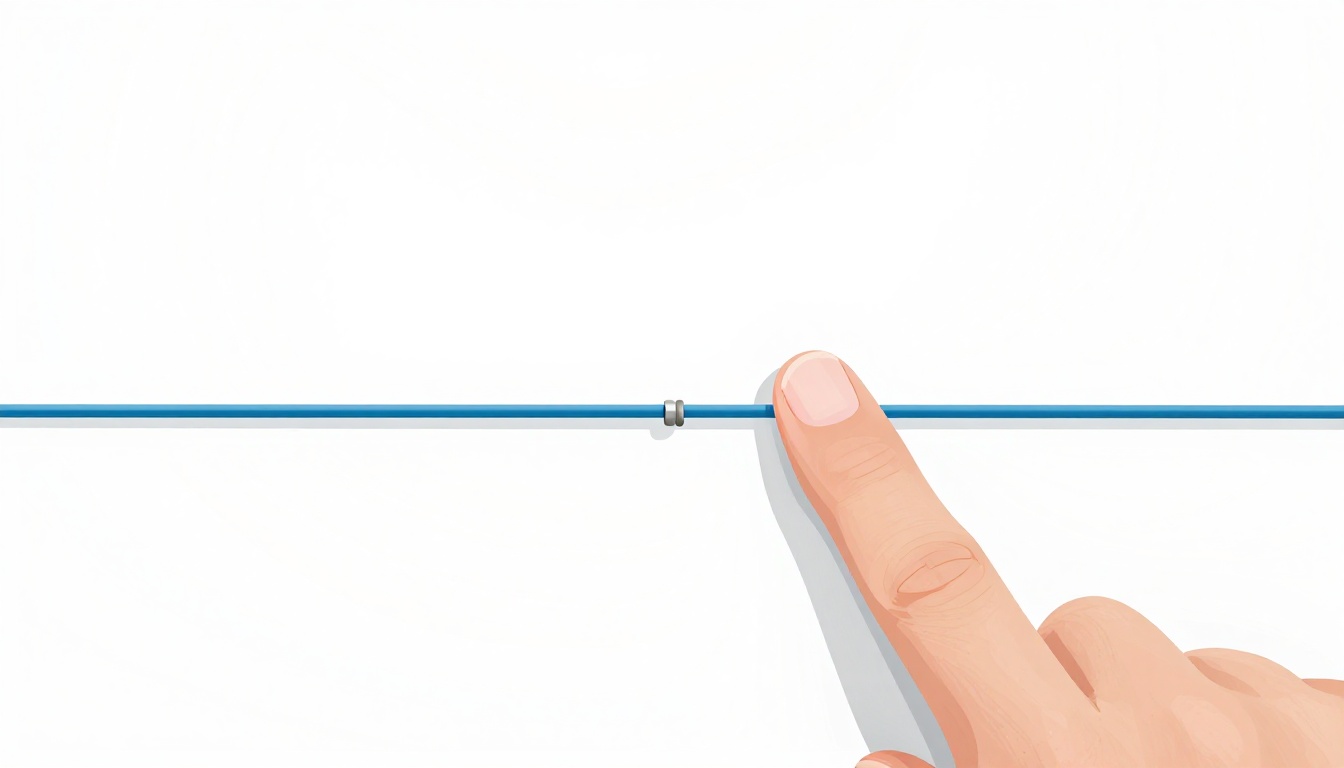
Your finger sits too far from the fret wire
Fret numbers count the space between two metal wires, not the wire itself. Pressing in the middle of that space, rather than right up against the fret wire on the side closer to the guitar's body, takes noticeably more force to avoid a buzz. Move your fingertip until it hugs the fret wire, then pick the high E string alone and listen for a clean, sustained note.
The A string is not actually muted
If you can hear a low, out-of-place note humming underneath the chord, the A string is probably ringing open instead of staying quiet. Since A is not part of Em9 at all, an unmuted A string does not just add unwanted noise, it actively clashes against the root a whole step below it. Go back to the thumb-mute or strumming-hand-skip techniques above and isolate the A string on its own until it reliably produces only a dull thud, never a clear pitch.
You are pressing hard enough to bend the note sharp
New players sometimes over-correct for buzzing by pressing far harder than necessary, which can pull the string slightly out of tune, especially on lighter-gauge strings. The 2nd fret does not need heavy pressure once your finger is positioned correctly against the fret wire. If the high E string sounds faintly out of tune only when this chord is fretted, ease off and see if the pitch settles.
You are playing a shape that is not really Em9
Not every "Em9" diagram floating around online is voiced correctly. The next section covers the single most common mix-up in detail, because it is common enough to deserve its own explanation rather than a single bullet point.
The "easy Em9" shape you'll find online is often Emadd9
Search for an easy Em9 chord and you will run into a shape that looks like this:
| String | Fret | Finger | Note |
|---|---|---|---|
| 6 (low E) | Open | - | E |
| 5 (A) | 2 | 1 (index) | B |
| 4 (D) | 2 | 2 (middle) | E |
| 3 (G) | Open | - | G |
| 2 (B) | Open | - | B |
| 1 (high E) | 2 | 3 (ring) | F# |
Play through the notes in that shape: E, B, E, G, B, F#. Strip out the duplicates and you get E, G, B, and F#. That is a real chord, and a good one, but it is not Em9. It is missing D, the minor seventh, which means every note in it comes from the plain E minor triad plus the ninth alone. That is the definition of Emadd9, not Em9.
The confusion is understandable and extremely common, common enough that guitarists argue about it in forum threads regularly. "9" as a chord symbol, on its own, always implies the seventh is included, the same way "add9" always means it is not. Em9 without qualification means Em7 plus a ninth, five notes total. Emadd9 means the plain minor triad plus a ninth, four notes total, with the seventh deliberately left out.
They are not interchangeable substitutes for each other, either. Emadd9 has a brighter, more open character because it skips the seventh's slightly unresolved pull. Em9 sounds fuller and moodier specifically because that seventh is present, doing the same job it does in a plain Em7 chord. If a chart calls for one and you play the other, it will not sound wrong exactly, but it will sound like a different chord, because it is one.
None of this makes the four-string shape above a bad chord to know. It is a genuinely useful, easy-to-play Emadd9, and if what you are after is that specific brighter sound, this is the shape to reach for. Just file it under its own name rather than assuming it is a shortcut version of Em9.
Em9 vs Em7: what the ninth actually adds
If you already play Em7, you are one note away from Em9, and it helps to know exactly what that note is doing. Em7 gives you root, minor third, fifth, and minor seventh, a chord that already feels a little unresolved and reaching compared to a plain Em triad. Em9 stacks the major ninth on top of that same foundation.
The ninth does not change the chord's basic minor quality or its harmonic function nearly as much as it changes its color. Where Em7 sounds moody and searching, Em9 sounds fuller and more layered, closer to the sound of a chord voiced by a keyboard player reaching for something jazzier than a plain triad. That extra layer is exactly why Em9 shows up so heavily in jazz, neo-soul, and R&B rhythm parts, styles that lean on colorful extended chords as a matter of course rather than an occasional flourish.
A useful practice move once both shapes are solid: hold the one-finger Em7 shape, then lift into the one-finger Em9 shape by muting the A string and adding your index finger to the high E string's 2nd fret. Sliding between the two mid-strum, common in neo-soul and jazz comping, gives a static chord a small, controlled bit of harmonic movement without changing the root at all.
Building Em9 one layer at a time
If Em9 feels like a lot to take in as a single shape, it helps to build it from chords you may already know, since it is genuinely made of layers rather than one arbitrary hand position.
Start with the standard open Em chord: middle finger on the A string's 2nd fret (B, the fifth), ring finger on the D string's 2nd fret (E, a second root an octave up), and every other string open, giving you low E's root, G's minor third, B's fifth again from the open B string, and high E's root again. That is the plain minor triad in full, root, minor third, and fifth, each note present at least once.
Lift your ring finger off the D string and let it ring open instead, and the D string now sounds D, the minor seventh, turning Em into the one-finger open Em7 shape covered on this site's Em7 guide.
From there, Em9 is one more substitution rather than an entirely new hand position. Mute the A string instead of fretting it, which removes the fifth (a note the chord does not strictly need), and move your fretting finger's job from the A string to the high E string's 2nd fret instead, adding F#, the ninth.
Practiced this way, as three related shapes rather than three unrelated diagrams, Em9 stops feeling like an intimidating five-syllable chord name and starts feeling like a small variation on something you likely already know. Play all three in sequence, Em, Em7, then Em9, holding each for a full bar, and listen for how each added or swapped note changes the chord's color without changing its basic minor identity.
Em9 vs E9: two very different chords
Because "Em9" and "E9" differ by a single letter, they get mixed up constantly, especially when spoken aloud or read quickly off a chart. They are not close variations of each other. They are built from different triads entirely.
E9 is a dominant chord: E, G#, B, D, F#, built from a major triad (E, G#, B) with a minor seventh and a ninth added on top. Em9 is built from a minor triad (E, G, B) with the same seventh and ninth added. The only difference on paper is one note, G# instead of G, but that single note is the difference between major and minor, and it changes the entire character of the chord. E9 sounds bright and unresolved, pulling toward a chord a fourth away, the classic function of a dominant chord in blues and funk rhythm playing. Em9 sounds moodier and more settled, doing the work of a minor chord with extra color rather than a dominant chord's forward pull.
If a chart says E9 and you play Em9 instead, or the reverse, the mistake is usually audible immediately, even to an untrained ear, because the interval between the root and third flips from major to minor. Read the chord symbol carefully. E9 and Em9 are one letter apart on the page and two different chords in every other respect.
Where Em9 shows up in real playing
Em9 is not a chord most beginner songbooks reach for early, but it is common once you start playing material that leans on jazz harmony, whether or not the song itself is a jazz song.
In jazz and jazz-influenced pop, Em9 most often appears as a colored ii chord, exactly as shown in the ii-V-I progression later in this post, or as a i chord in a minor-key passage where a plain Em would sound comparatively bare. In neo-soul and R&B, it shows up constantly as a way to add richness to a progression without adding more chords, since a single Em9 held for several bars already contains enough movement on its own, five distinct notes instead of three, to keep a slow groove interesting without a chord change. Bossa nova and related Latin-jazz styles use it similarly, often voiced with the compact shell shape covered later in this post, since that style of rhythm guitar tends to favor tight, partly muted voicings over big, ringing open chords.
Outside those styles, Em9 turns up as a deliberate substitution more than a default choice. A songwriter or arranger reaching for something more colorful than a plain Em or Em7 will sometimes drop in an Em9 specifically for that reason, usually at a moment meant to feel more reflective or unresolved than the chords surrounding it.
Em9 vs Emadd9 vs Em11: the extended-chord family
Beyond the mix-up covered above, a handful of related E minor chords get confused with Em9 on charts because their names look similar.
Em6 replaces the minor seventh with a major sixth (C#) instead of adding a ninth on top of it. It is an entirely different chord built from a different formula, not a simpler or more complex version of Em9.
Emadd9 was covered in detail above: the plain minor triad plus the ninth, no seventh.
Em11 goes one step further than Em9, stacking an eleventh (A) on top of the same Em9 foundation. In practice, the eleventh clashes with the major third in major chords, but in a minor chord like this one it blends more naturally, which is part of why extended minor chords like Em9 and Em11 are so common in jazz voicings while their major-chord equivalents are handled more carefully.
Em7b5 lowers the fifth instead of adding anything on top, giving a tense, unstable half-diminished sound used almost exclusively as a ii chord resolving to a V7 in a minor key. It shares a superficial resemblance to Em9 on a page, a small chord-symbol addition after "Em7", but functions completely differently.
Reading the exact symbol matters more with this family of chords than with almost any other, since a single added or missing character changes which of five or six genuinely different-sounding chords you are supposed to play.
A movable jazz voicing of Em9
The open-position shape above depends on open strings, which means it is locked to the key of E minor. Jazz players more often reach for a movable shape built on the A string, which drops the fifth entirely and can slide to any root without changing its fingering.
| String | Fret | Finger | Note | Role |
|---|---|---|---|---|
| 6 (low E) | Muted | - | - | - |
| 5 (A) | 7 | 2 (middle) | E | Root |
| 4 (D) | 5 | 1 (index) | G | Minor third |
| 3 (G) | 7 | 3 (ring) | D | Minor seventh |
| 2 (B) | 7 | 4 (pinky) | F# | Ninth |
| 1 (high E) | Muted | - | - | - |
Build it from the index finger out. Place your index finger on the D string's 5th fret first, since it is the lowest fret in the shape and gives your hand a reference point. Then bring your middle finger down on the A string's 7th fret, your ring finger on the G string's 7th fret, and your pinky on the B string's 7th fret. The low E and high E strings are both muted, either by resting your fretting-hand fingers lightly against them or by keeping your strum tight to the middle four strings.
Because this shape has no open strings, it is fully movable. Slide the entire shape down two frets, keeping the same finger pattern, and the root on the A string moves from the 7th fret to the 5th fret, turning Em9 into Dm9. Move it up two frets instead and you get F#m9. This is the version to learn once the open shape feels automatic, since it is the one that actually transposes.
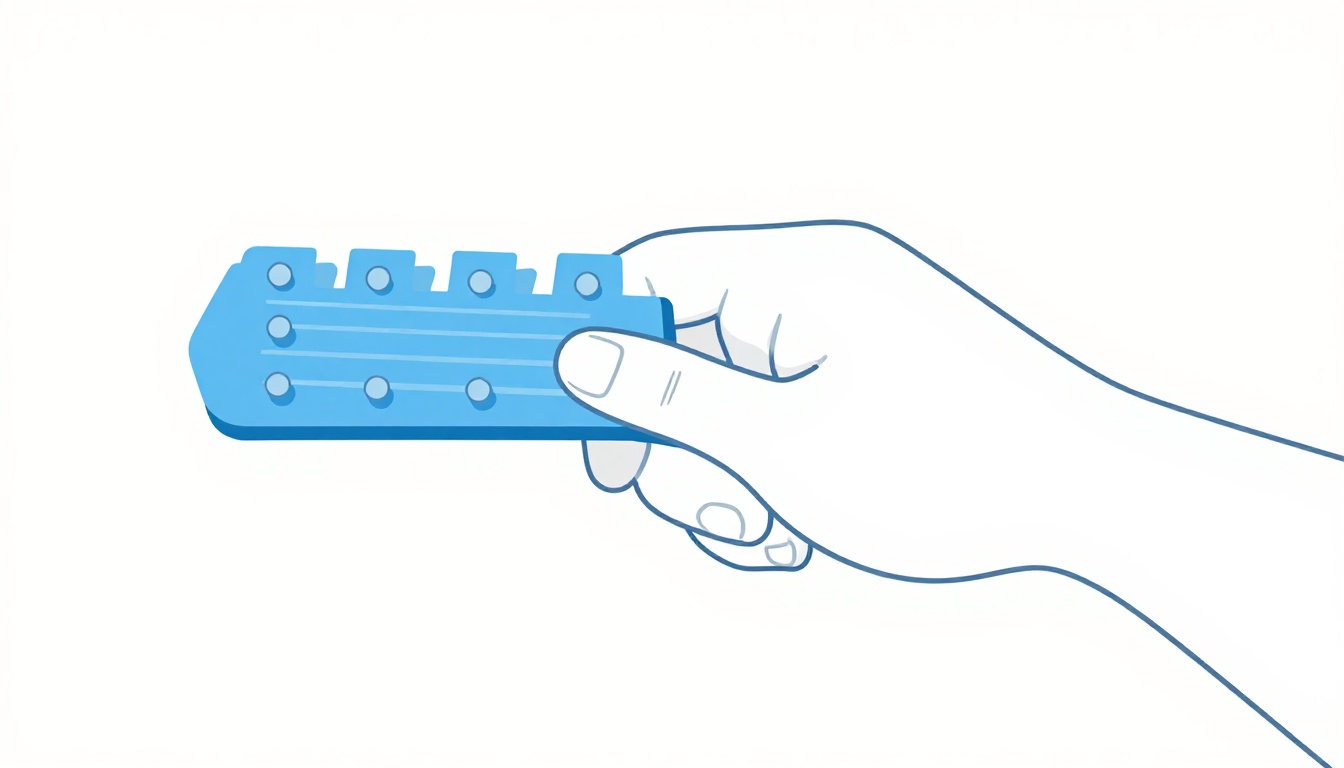
If your pinky is not independent enough yet to land cleanly on the B string while your ring finger holds the G string a fret away, there is an easier way to distribute the same four notes. Since the A, G, and B strings all share the same 7th fret in this shape, you can flatten your ring finger into a small three-string barre across them instead, freeing your pinky entirely and leaving only your index finger, on the D string's 5th fret, to place separately. The notes produced are identical either way. Use whichever finger assignment your hand finds steadier.
Em9 further up the neck
The open Em9 shape can also move up the neck as a barre-style voicing, using the 12th fret, the octave point where every open string's note repeats exactly one octave higher.
| String | Fret | Finger | Note | Role |
|---|---|---|---|---|
| 6 (low E) | 12 | 1 (index, partial barre) | E | Root |
| 5 (A) | Muted | - | - | - |
| 4 (D) | 12 | 1 (index, partial barre) | D | Minor seventh |
| 3 (G) | 12 | 1 (index, partial barre) | G | Minor third |
| 2 (B) | 12 | 1 (index, partial barre) | B | Fifth |
| 1 (high E) | 14 | 4 (pinky) | F# | Ninth |
This is simply the open shape from earlier shifted up twelve frets, with the same string left out for the same reason: the A string is still not part of the chord. Because four strings need to be fretted at the same 12th fret, this works best as a partial barre with your index finger, laid flat but not pressing hard on the A string in between, since you will not be striking that string anyway. Your pinky reaches ahead to the 14th fret on the high E string for the ninth.

This voicing is a genuine stretch on an acoustic guitar, where the body gets in the way of your hand at the 12th fret. It works more comfortably on an electric guitar with a cutaway, or as a chord you pick one note at a time, letting each note ring into the next, rather than strumming it as a single block.
Where Em9 fits in a key
Like any chord, Em9 is not just an isolated shape, it shows up predictably in certain keys, built from notes that already belong to those keys' scales.
| Key | Em9's role | Why |
|---|---|---|
| G major | vi9 (a colored relative minor) | E is the 6th note of the G major scale, and G, B, D, F# are all diatonic to it |
| D major | ii9 | E is the 2nd note of the D major scale, and the chord functions as a richer ii in a ii-V-I |
| C major | iii9 | E is the 3rd note of the C major scale |
The D major row is the one worth paying attention to. A ii chord has a strong natural pull toward the V chord that follows it, and jazz players lean on the extended ii9 voicing specifically to make that pull sound richer without changing its function. If you see Em9 in a chart written in D major, there is a good chance an A chord, often A7, A9, or A13, and then a D or Dmaj7 are close behind.
Knowing this does not change how you finger the chord, but it changes how you predict what is coming. A plain Em, without any extensions, tends to read as a settled minor chord wherever it appears. Em9, with its added color, more often signals that the progression is reaching toward a jazzier destination, so if you see it in a chart, expect the surrounding chords to lean the same way, extended sevenths, ninths, and thirteenths rather than plain triads. The G major row works the same way in a lighter form: a vi9 in the key of G still functions as the relative minor, but the added ninth signals a slightly more sophisticated arrangement than a straightforward Em would.
Chord progressions built around Em9
Recognizing Em9 inside a real progression, rather than as an isolated shape, is what makes it useful once you are playing through actual songs rather than practicing a single chord on its own.
| Progression | Chords in order | What it demonstrates |
|---|---|---|
| ii-V-I in D major | Em9, A13, Dmaj7 | A jazz-flavored turnaround, using extended chords in place of plain triads at every step |
| A minor-key resolution | Em7, Em9, Dmaj7 | Sliding from Em7 into Em9 before resolving, adding movement inside a single held chord |
The first row is a classic jazz cadence: ii, V, I, dressed up with a ninth, a thirteenth, and a major seventh instead of plain triads. If you already play the Dmaj7 chord, this progression is a natural next step once your Em9 shape is solid, since the destination chord is one you likely already know.
The second row is a smaller, subtler move: staying on essentially the same root while adding color partway through, then resolving. This is the same technique mentioned earlier, sliding between Em7 and Em9 mid-phrase, placed inside an actual harmonic destination rather than as an isolated exercise.
For a broader look at how chords like this fit together in jazz-influenced playing, this guide to jazz chords for guitar covers the shapes that show up alongside Em9 most often.
Changing into and out of Em9
The shape itself is rarely the hard part with a chord like this. The hard part is arriving at it and leaving it without a gap in the sound, particularly since Em9 tends to appear in progressions built from other unfamiliar shapes rather than the simple open chords most beginners learn first.
Em9 to Dmaj7
The three-finger open Dmaj7 shape frets the D string open, the G string's 2nd fret with your index finger, the B string's 2nd fret with your middle finger, and the high E string's 2nd fret with your ring finger. Coming from the one-finger Em9 shape, your index finger has to release the high E string and your hand has to build three fresh finger placements at once, but all three land on the same 2nd fret, which makes the change easier to think of as one hand shape landing together rather than three separate movements.
Em9 to Am
Standard open Am uses your middle finger on the D string's 2nd fret, your ring finger on the G string's 2nd fret, and your index finger on the B string's 1st fret, with the low E string muted. Coming from Em9, every finger is landing fresh, and the low E string flips from being an important ringing root to a string you need to actively mute, so build the habit of resting your thumb over the top of the neck as your hand arrives in the Am shape.
Em9 to G
Standard open G places your middle finger on the low E string's 3rd fret, your index finger on the A string's 2nd fret, and your ring finger on the high E string's 3rd fret. Since the A string is already muted rather than fretted in Em9, your index finger has a fresh landing spot to find on the way to G, so practice that single finger placement in isolation before adding the other two.
Em9 to A (or A7, A13)
Standard open A places your index, middle, and ring fingers together on the 2nd fret across the D, G, and B strings, with the low E muted and the A and high E strings open. Because Em9 also uses the high E string's 2nd fret, one finger is effectively already in position, though it moves to a different string, so this change rewards moving your whole hand as a single block once the A shape is familiar as a unit.
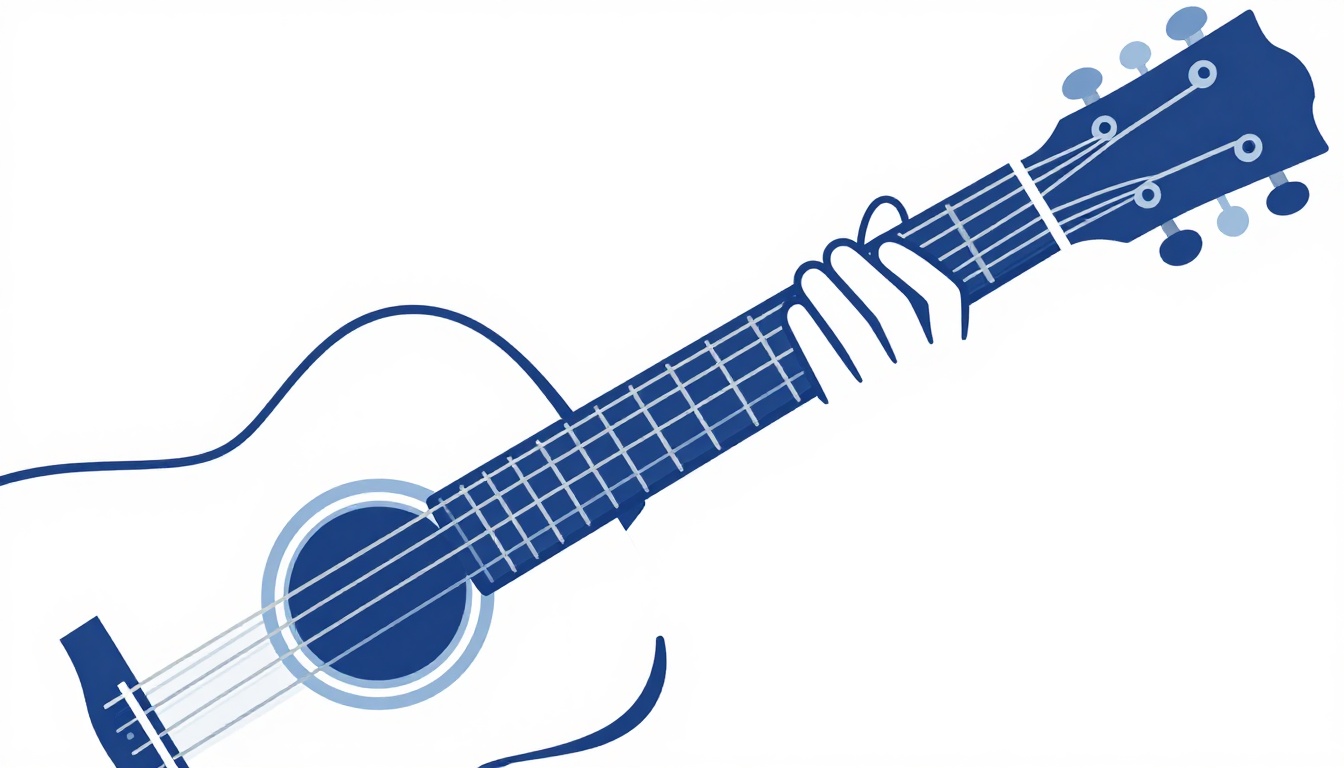
For all four of these changes, the same practice method works: fret Em9, then the target chord, back and forth slowly with a full stop between each one, checking that every string rings clean before moving on. Only once that is reliable should you add rhythm, holding Em9 for a full bar and changing precisely on the beat, gradually tightening the gap until there is none.
Using Em9 in a strumming pattern without losing the groove
Because Em9 asks you to skip one string rather than strum straight through all six, it behaves slightly differently in a strumming pattern than a fully open chord, and it is worth practicing deliberately rather than assuming your usual strum will translate directly.
Start with a slow, even down-up-down-up pattern, keeping your strumming arm's motion continuous even on the beat where the pick passes over the muted A string. New players sometimes tense up and stop the strumming arm's motion entirely to avoid that string, which throws off timing far more than an occasional stray A string ever would. It is better to let the pick brush past the muted string on a consistent, relaxed strum than to strum stiffly in order to dodge it perfectly.
Once that feels natural, try a more clipped, percussive pattern. Strum down, then immediately ease off your fretting hand's pressure without lifting your fingers off the strings entirely, muting the chord into a short, chunky thud, then press back down for the next strum. This staccato approach, alternating a ringing chord with a muted chunk, is common in neo-soul and R&B rhythm guitar, styles where Em9 shows up often, and it gives a single held chord a sense of rhythmic movement without ever changing which chord you are playing.
A useful exercise: strum Em9 once on beat one and let it ring for a full bar, then try the same bar again with a muted chunk added on beats two and four instead. Listen to how differently the same five notes read depending on whether they are held open or interrupted rhythmically. Neither approach is more correct than the other, they simply suit different moments in a song, but having both available means the chord is not locked into a single feel.
Fingerpicking Em9
Because Em9's open notes already cover four of its five chord tones, it is a comfortable chord to fingerpick, similar in spirit to fingerpicking a plain open Em7, though the muted A string changes the pattern slightly.
A simple starting pattern skips the A string entirely and uses your thumb for the low E string, then your index, middle, and ring fingers for the D, G, and B strings, with your ring or index finger reaching the high E string.
| Beat | String | Picking finger |
|---|---|---|
| 1 | 6 (low E) | Thumb |
| 2 | 4 (D) | Index |
| 3 | 3 (G) | Middle |
| 4 | 2 (B) | Ring |
| & | 1 (high E) | Ring or index |
Play the low E string alone on the first beat, then roll upward through the D, G, and B strings, landing on the high E string's fretted note last. Because your thumb never needs to touch the A string in this pattern, you sidestep the muting problem entirely rather than needing to actively deaden that string, which makes fingerpicking a genuinely easier way to play a clean Em9 than strumming is while you are still building the mute habit.
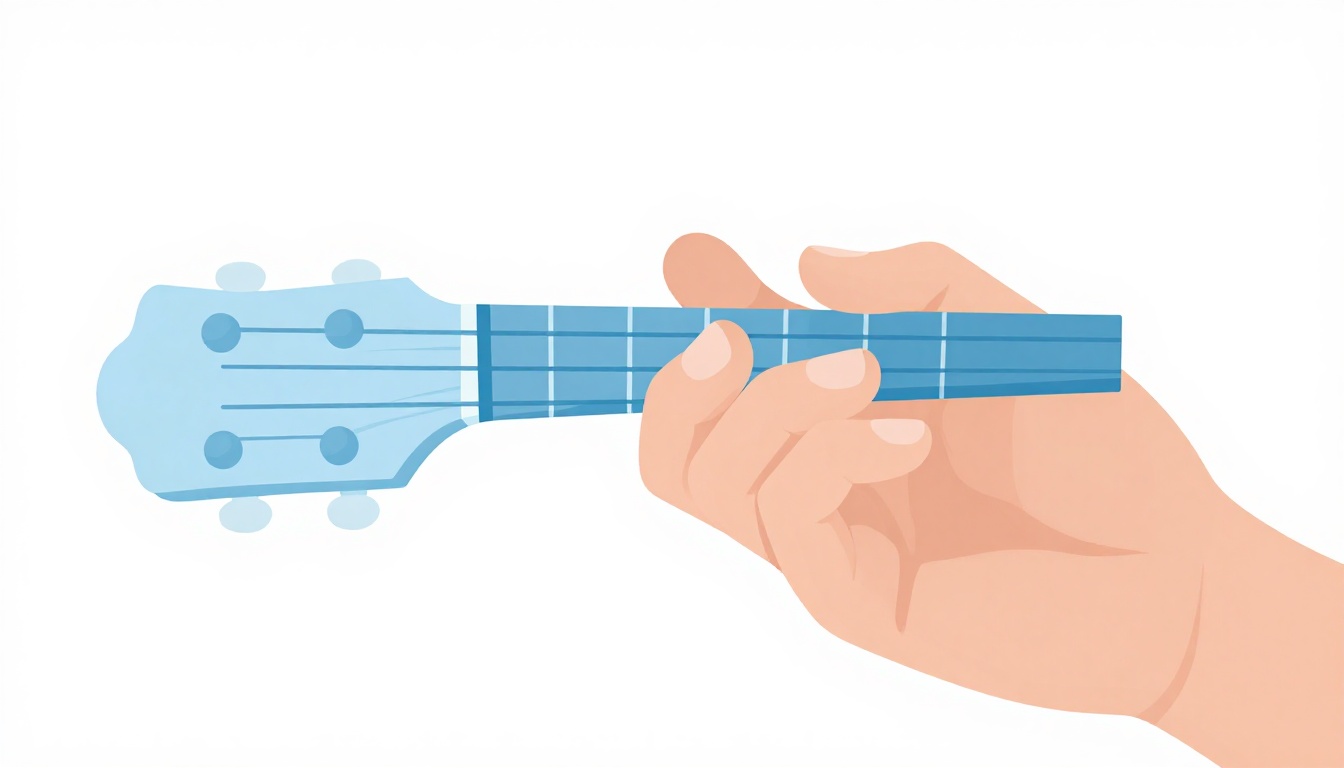
Once that basic roll feels steady, try starting from the high E string's fretted note and working your way down to the low E string instead, or breaking the pattern into a broken arpeggio that lingers on the ninth before resolving down to the root. Because every string you are playing belongs cleanly to the chord, there is no wrong note to land on inside this shape, which makes it a forgiving place to experiment with picking order before trying the same experiments on a chord with strings you genuinely need to avoid.
Fingerstyle is also simply the more common approach to a chord like this in the genres where it shows up most. Jazz and neo-soul players comping through a progression will often pluck a chord like Em9 rather than strum it, letting the individual notes speak with slightly different timing and volume than a single strum allows. If you are learning Em9 specifically to play that kind of music, spending more of your practice time on the fingerpicked version than the strummed one is time well spent.
Em9 on acoustic vs electric guitar
The fingering does not change between instruments, but how the chord behaves does, and it is worth knowing what to expect before assuming something in your playing is wrong.
On an acoustic guitar, the open low E, D, G, and B strings ring loudly and sustain for a long time, giving Em9 a big, layered, resonant sound that fills the space well on its own with very little strumming effort. This is a large part of why the chord works so well as a single sustained sound in a slower song, rather than something you need to strum repeatedly to keep alive.
On an electric guitar, particularly with any gain or distortion, that same resonance behaves differently. Overdrive makes open strings ring out longer and picks up unwanted noise, including a poorly muted A string, far more readily than a clean acoustic tone does. If you are playing Em9 through a distorted amp, muting the A string cleanly matters more, not less, since a distorted signal will amplify a stray hum that a clean acoustic would mostly hide.
Clean electric tone sits closer to acoustic in forgiveness, though jazz and neo-soul players, the genres where this chord shows up most, tend to favor a warm, mostly clean electric tone specifically because it lets every one of Em9's five notes stay distinct rather than blurring together the way heavy distortion would.
A warm neck-position pickup, rolled-back tone control, and a light touch tend to suit this chord better than a bridge pickup dialed up bright, simply because Em9 already has more going on harmonically than a plain triad. A bright, aggressive tone stacked on top of five ringing notes can start to sound cluttered rather than rich, where the same chord through a softer, rounder tone reads as full and controlled instead.
Common mistakes beyond buzzing
A few habits show up specifically with Em9 that are not about buzzing or muted strings so much as how the chord gets used.
Assuming any "Em9-looking" shape online is correct. As covered earlier, the most common easy version circulating online is actually Emadd9, missing the seventh entirely. Check any new shape against the five real chord tones, E, G, B, D, F#, before trusting it.
Strumming the A string out of habit. Because the muted string here is the A rather than the more commonly muted low E, players used to skipping the low E on other chords sometimes strum straight through the A string without thinking, since their habit is built around a different string.
Treating the ninth as optional decoration. Some players learn Em9 as "Em7 with an extra note if you feel like it" and let the ninth drop out under pressure during a song. If the chart calls for Em9 specifically, the ninth is doing real harmonic work, particularly in a jazz ii-V-I, and dropping it changes the chord's function, not just its color.
Confusing Em9 with Em6, Em11, or Em7b5 from a chart. Covered in detail above, but worth repeating: a small difference in the chord symbol after "Em" points to a genuinely different chord, not a stylistic variation you can freely substitute.
Forcing a strum where a slower, arpeggiated approach suits the chord better. Em9 is a dense, colorful chord built for genres that often favor space and sustain over constant strumming. A single clean strum, or a slow fingerpicked roll, frequently suits it better than repeated fast strumming.
Switching tone settings without reconsidering the voicing. A voicing that sounds full and clear through a clean, warm tone can sound cluttered through a bright or distorted one, and the fix is often to change which voicing you are playing, dropping to the sparser movable shell shape, rather than fighting the tone control alone.
A practice routine for today
Fifteen minutes is enough to make real progress on this chord if you spend it deliberately.
- Five minutes on the shape alone. Fret the one-finger Em9, strum from the low E string through the high E string while skipping the A string, and listen for any string that sounds buzzed, dead, or ringing when it should be muted. Isolate and fix it using the causes listed earlier in this post before moving on.
- Five minutes on muting the A string. Practice both the thumb-mute and the strumming-hand-skip approaches from earlier, switching between them, so you have a backup method if one starts to slip during a faster passage.
- Five minutes on one transition. Pick a single change, Em9 to Dmaj7 is a good place to start if you already know that shape, and repeat it slowly with a full stop between chords. Once ten changes in a row ring clean, add a metronome at a slow tempo and change precisely on the beat.
Repeat this same fifteen minutes for a few days before adding the movable jazz shape or a second transition. Progress on a chord this dense comes from consistency across several short, focused sessions rather than one long session where your muting technique starts to slip as your hand tires.
FAQ
Is Em9 hard to play for a beginner? The open one-finger shape covered at the top of this post is genuinely easy, no harder than a one-finger Em7. What takes more practice is muting the A string cleanly, since that habit is new if you have not played a chord that mutes that specific string before.
Do I have to play all five notes of Em9? No. Most real-world voicings, including the ones in this post, already drop the fifth (B), since it adds the least to the chord's characteristic sound. As long as the root, minor third, minor seventh, and ninth are present, it still reads and sounds like Em9.
What is the difference between Em9 and Emadd9? Em9 includes the minor seventh (D) in addition to the ninth (F#), while Emadd9 adds the ninth directly to the plain minor triad and leaves the seventh out entirely. They share three of four notes but sound and function differently, and the easy shape widely shared online as "Em9" is very often actually Emadd9.
Can I use Em9 instead of Em7 in a song? Often, yes, since Em9 contains every note of Em7 plus one more. It will sound fuller and slightly jazzier than a plain Em7, which fits some songs well and sounds out of place in others, particularly simpler folk or pop arrangements where the extra color reads as unnecessary.
Why does my Em9 sound like it has a wrong note in it? This is almost always the A string ringing when it should be muted. Since A is not part of the chord at all, an unmuted A string clashes noticeably rather than just sounding a little off. Work through the muting section above and isolate the A string specifically.
What genres actually use Em9? Jazz, neo-soul, and R&B lean on it heavily, along with related styles like bossa nova, where extended chords are the norm rather than an occasional flourish. It appears far less often in straightforward folk, punk, or classic three-chord pop writing.
Is there a movable version of Em9 I can transpose to other keys? Yes, the shell voicing covered earlier in this post, fretted on the A, D, G, and B strings with both outer strings muted, has no open strings and slides to any root. Moving the whole shape down two frets turns it into Dm9, for example.
Does Em9 change fingering with a capo on? No. A capo shifts every open chord's pitch up without changing the shape your fretting hand makes, so the open Em9 shape played with a capo still uses the same fret and finger positions described in this post, just sounding higher than it would without one.
Can I play Em9 as a barre chord anywhere on the neck? Yes, using the movable shell voicing covered earlier in this post rather than the open shape. Because it drops the fifth and uses no open strings, it slides cleanly to any root without any adjustment to the fingering itself.
Is Em9 the same chord as Em7add9? Yes. "Em7add9" and "Em9" describe the same five notes, root, minor third, fifth, minor seventh, and ninth. "Em9" is simply the more common shorthand, since a plain "9" in a chord symbol already implies the seventh is included without needing to spell it out separately.
GuitarLowKey
Ready for fifteen focused minutes?
Open the web app and train the change that is blocking your song.