
The F Major Scale on Guitar: Fret by Fret, No Open Root
The F major scale in open position with exact frets and fingers, why F has no open-string root like D or E, and how it connects to the F barre chord.

The F major scale is F, G, A, Bb, C, D, and E, and on guitar the most common starting point is the 1st fret of the 6th string (low E), fretted with your index finger. From there the scale climbs through open strings and frets 1 through 3 on the way up, all in one hand position, no shifting required. The table below gives you the exact frets and fingers for a full two-octave run.
Standard Tuning, So Every Fret Number Below Makes Sense
Everything in this post assumes standard tuning, low string to high string:
| String | 6 | 5 | 4 | 3 | 2 | 1 |
|---|---|---|---|---|---|---|
| Note | E | A | D | G | B | E |
Say the string names out loud once before you start: 6th string (low E), 5th string (A), 4th string (D), 3rd string (G), 2nd string (B), 1st string (high E). Every fret number in this post is measured from the nut, and finger numbers follow the standard convention: 1 is your index finger, 2 is middle, 3 is ring, 4 is pinky.
Warming Up Before You Play This Scale
A cold hand fumbles a shape it can play perfectly once warm, so spend a minute or two on simple movement before you touch the scale itself:
- Finger taps, no strings: rest all four fingers of your fretting hand lightly on the neck, one per fret across four consecutive frets, and lift and tap each one individually, index through pinky, without pressing hard enough to sound a note.
- Chromatic crawl: on any single string, play frets 1, 2, 3, and 4 in order with index, middle, ring, and pinky, then shift up a string and repeat. This is not part of the F major scale itself, it is finger independence work that makes the scale's own stretches easier once you get to them.
- Wrist and finger stretches: a few seconds of gently extending your fingers backward and rotating your wrist, away from the guitar, reduces the stiffness that makes any stretch across frets feel tighter than it needs to.
None of this needs more than two or three minutes, and it pays for itself the moment the scale's own reach stops feeling like the first stretch of the session. If you are still building basic fretting-hand comfort, it is worth spending time on that first, since a scale is far easier to learn once your hand is no longer fighting the guitar itself; our full guide to getting started covers that groundwork.
What the F Major Scale Is Made Of
Every major scale is built from the same recipe of whole steps and half steps: whole, whole, half, whole, whole, whole, half. Starting on F and following that pattern gives you:
| Degree | 1 | 2 | 3 | 4 | 5 | 6 | 7 | 8 (octave) |
|---|---|---|---|---|---|---|---|---|
| Note | F | G | A | Bb | C | D | E | F |
| Step to next | Whole | Whole | Half | Whole | Whole | Whole | Half | - |
Only one note in this scale carries an accidental: Bb, the 4th degree. That single flat is what people mean when they say F major "has one flat" as its key signature. It is the fewest accidentals of any major scale outside of C major itself, which makes the scale simple on paper. The catch is where that Bb falls on the neck, which is the actual reason F trips up more players than D or E major do.
The half steps land between the 3rd and 4th degrees (A to Bb) and between the 7th and 8th degrees (E to F). Those two spots are where your fretting hand moves only one fret instead of two, and they are worth noticing early because they are what makes a scale sound like a scale rather than a run of evenly spaced notes.
Why F Major Doesn't Start on an Open String
D major starts on the open 4th string. E major starts on the open 6th string. F major has no equivalent shortcut: F itself is never an open string in standard tuning, so the root always has to be fretted, at minimum the 1st fret of the 6th string or the 1st fret of the 1st string.
That single fact is the whole reason F has a reputation for being less friendly to beginners than its neighboring keys. It is the same reason the F chord is famous as the first barre chord anyone learns instead of an easy open shape, a connection this post comes back to later. The scale itself is not harder to understand than D or E major, and once your index finger is anchored at the 1st fret, most of what follows uses open strings freely. The root is just the one note in the whole shape you cannot get for free.
There is a second wrinkle: the open 2nd string (B) does not belong to this key at all, since F major needs Bb, a half step below it, not B natural. Every open-position shape in this post is built to avoid that string sounding open, which is also why F major scales look slightly different in shape from the D and E major scales you may already know.
This is also why F is usually not among the first few scales or chords a new guitarist learns. Method books tend to start with C, G, D, A, and E, precisely because each of those keys hands you a free root note and, in most cases, a free open chord shape too. F breaks that pattern on both fronts at once, which is why it can feel like a step up in difficulty rather than simply the next key in line. The scale itself does not deserve that reputation any more than the chord does, it is just the first key that asks your fretting hand to do work the earlier keys did for free.
The F Major Scale in Open Position (One Octave)
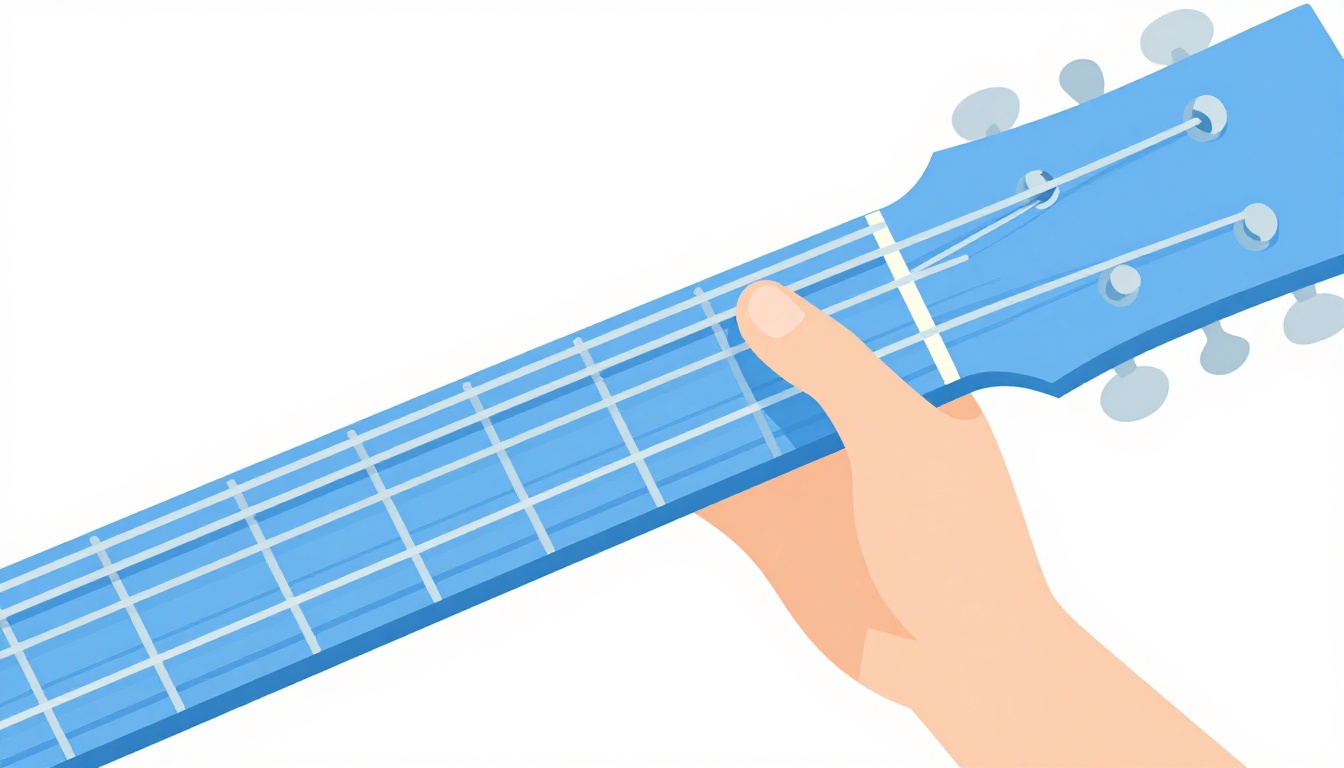
This is the version to learn first. It starts with your index finger anchored at the 1st fret of the 6th string and never asks you to move that hand position for the whole octave.
| String | Open | 1st fret | 2nd fret | 3rd fret |
|---|---|---|---|---|
| 6 (low E) | - | F (root) | - | G |
| 5 (A) | A | Bb | - | C |
| 4 (D) | D | - | E | F (octave) |
Read it as a sequence, not a grid: F, G, A, Bb, C, D, E, F, moving from the 6th string to the 5th string to the 4th string as you climb.
Playing It in Order, One Note at a Time
Ascending, the fingering runs like this:
- 6th string (low E), 1st fret: F (root, index finger)
- 6th string, 3rd fret: G (ring finger)
- 5th string (A), open: A
- 5th string, 1st fret: Bb (index finger)
- 5th string, 3rd fret: C (ring finger)
- 4th string (D), open: D
- 4th string, 2nd fret: E (middle finger)
- 4th string, 3rd fret: F (ring finger, octave)
Every fretted note in this shape falls on the 1st, 2nd, or 3rd fret, played with index, middle, or ring finger respectively. There is no pinky in this pattern and no position shift, which makes it a genuinely easy scale to hold once the index finger is anchored, the single-fret start is just the one thing you cannot avoid. Coming back down, play the same eight notes in reverse, 4th string 3rd fret down to the 6th string 1st fret.
Why This Shape Never Touches the Open 2nd String
Look back at the fingering list and notice what never appears: the 2nd string (B), open or otherwise, is completely absent from this octave. That is not an oversight, it is the direct result of the open B not belonging to F major. Instead, the notes that would naturally sit near that string, C and D, are reached on the 5th and 4th strings instead, one string lower than where a D major or E major player might expect them.
This is worth internalizing early, because it is the single most common slip once a player has learned this scale on autopilot: reaching for the open 2nd string out of habit from another key, hearing it clash, and not knowing why. If a note in this scale ever sounds wrong on the 2nd string, check whether you accidentally played it open. In F major, that string is only ever used fretted, never open.
Extending to Two Octaves, Same Fingers, No Shift Required
The genuinely useful thing about this particular F major shape is that it keeps going for a full second octave without asking for a new hand position or a new finger. Continue past the first F:
| String | Open | 1st fret | 2nd fret | 3rd fret |
|---|---|---|---|---|
| 3 (G) | G | - | A | Bb |
| 2 (B) | - | C | - | D |
| 1 (high E) | E | F (octave) | - | - |
Chained onto the first octave, the full two-octave scale runs:
F(6,1) - G(6,3) - A(5,0) - Bb(5,1) - C(5,3) - D(4,0) - E(4,2) - F(4,3) - G(3,0) - A(3,2) - Bb(3,3) - C(2,1) - D(2,3) - E(1,0) - F(1,1)
Every single note across both octaves sits on an open string or the 1st, 2nd, or 3rd fret. That means the whole two-octave scale uses only index, middle, and ring fingers, in the same hand position from the first note to the last. This is unusual: most two-octave scale shapes on guitar need at least one position shift or a pinky reach. F major's one-flat key signature happens to line up so cleanly with the open strings that it does not.
Reading This Scale From Tab
If you would rather read this as tab than as a table, the one-octave version looks like this, low string to high:
e|---------------------------------
B|---------------------------------
G|---------------------------------
D|---------------0---2---3---------
A|---0---1---3----------------------
E|-1---3-----------------------------
And the fuller two-octave version, continuing onto the top three strings:
e|---------------------------0---1--
B|-----------------1---3------------
G|-------0---2---3------------------
D|-0---2---3-------------------------
A|0---1---3---------------------------
E|1---3--------------------------------
Read left to right, one note at a time, same order as the note-by-note list above.
Finding F Anywhere on the Neck
The open-position shape above is the easiest starting point, but it is not the only place F major lives on the neck. Since F itself is never open, it is worth knowing every place the root note sits so you can find your bearings anywhere on the fretboard:
| String | Low root | Higher root |
|---|---|---|
| 6 (low E) | Fret 1 | Fret 13 |
| 5 (A) | Fret 8 | - |
| 4 (D) | Fret 3 | Fret 15 |
| 3 (G) | Fret 10 | - |
| 2 (B) | Fret 6 | Fret 18 |
| 1 (high E) | Fret 1 | Fret 13 |
Notice the 4th string root at fret 3 and the 6th string root at fret 1 are the same two anchor points the open-position scale above already uses. That is not a coincidence, those are the two lowest, easiest-to-reach F notes on the entire neck, which is exactly why the open shape is built around them.
Playing the Scale Along a Single String
Every shape in this post spreads the scale across several strings, which is how you would actually play it in a song, but there is a separate exercise worth doing at least once: play the whole scale on a single string, moving your hand up the neck one note at a time.
On the 6th string, that is F at the 1st fret, G at the 3rd, A at the 5th, Bb at the 6th, C at the 8th, D at the 10th, E at the 12th, and F again at the 13th. Nothing here is new information, it is the same notes already listed in this post, just heard in a straight line rather than split across strings.
The point of this exercise is not speed or performance, it is hearing the whole and half step pattern with nothing else to distract from it: no open strings, no string crossings, just the distance between one note and the next. Guitarists who do this across a few different keys tend to internalize where the half steps fall much faster than by only ever practicing scale shapes that are already laid out for them.
Moving the Same Shape Up to the 13th Fret
Every note is exactly twelve frets higher one octave up, so if you take the open-position shape and add twelve to every fret number, replacing "open" with "12th fret," you get the identical scale played an octave higher, entirely fretted:
| String | 12th fret | 13th fret | 14th fret | 15th fret |
|---|---|---|---|---|
| 6 (low E) | - | F (root) | - | G |
| 5 (A) | A | Bb | - | C |
| 4 (D) | D | - | E | F (octave) |
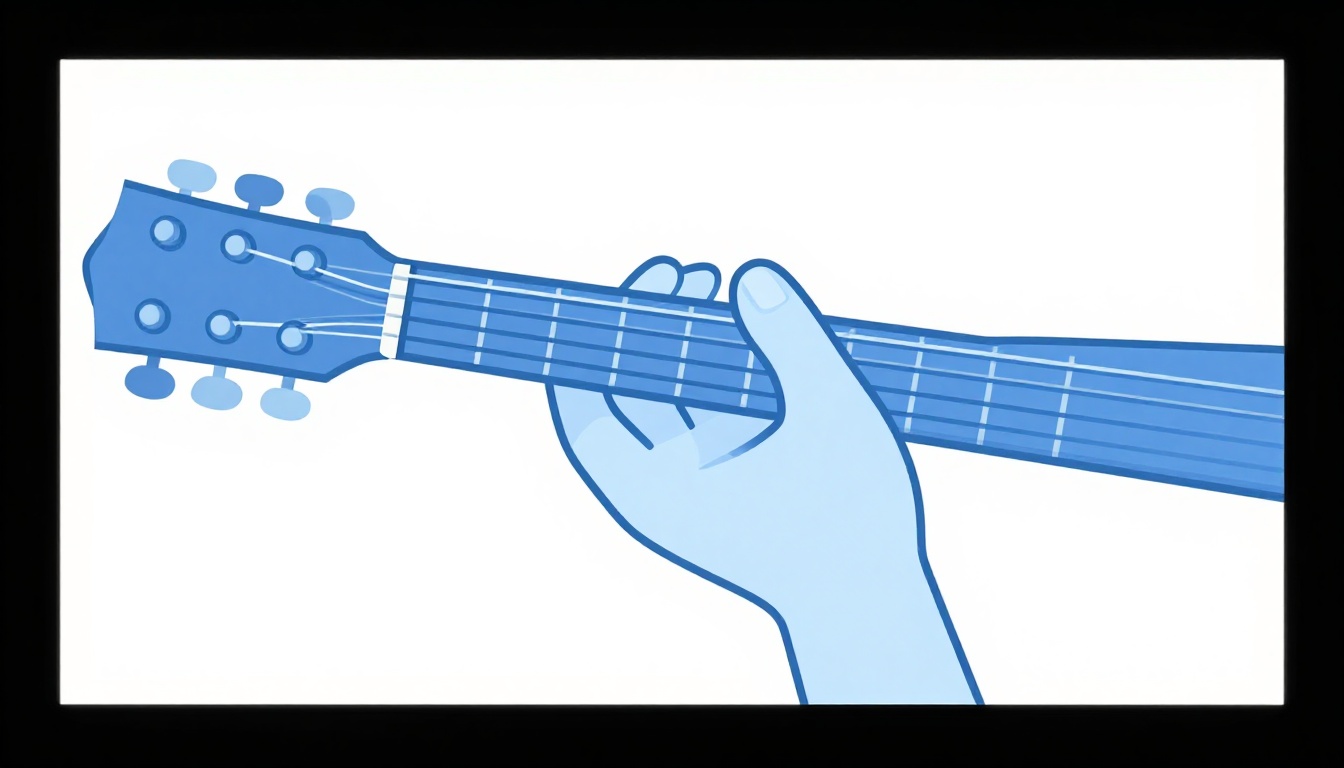
This higher version is genuinely movable in a way the open one is not: because every note here is fretted rather than open, you can slide the entire shape to any fret and get the major scale of whatever note is now under your index finger. Slide it down two frets and you are playing Eb major from the same fingers. Slide it up one and it is F# major. The open-position version lower on the neck cannot do this, since its open strings are fixed pitches that only spell out F major in that one spot.
A Fully Movable Shape Starting on the 5th String
The open-position shape earlier in this post is the easiest to learn, but it only produces F major because of where its open strings happen to fall. If you would rather start with a shape you can move to any key from day one, root the scale on the 5th string instead, at the 8th fret, using no open strings at all:
| String | 5th fret | 6th fret | 7th fret | 8th fret |
|---|---|---|---|---|
| 5 (A) | - | - | - | F (root) |
| 4 (D) | G | - | A | Bb |
| 3 (G) | C | - | D | - |
| 2 (B) | E | F (octave) | - | - |
Played in order, that is F(5,8), G(4,5), A(4,7), Bb(4,8), C(3,5), D(3,7), E(2,5), F(2,6). Every note falls between the 5th and 8th fret, which maps neatly onto index, middle, ring, and pinky if you treat the 5th fret as your index finger's home: index on the 5th fret, ring on the 7th, pinky on the 8th, with the 6th fret picked up by whichever finger is closest on its way past. Because nothing here is open, the same finger pattern relative to your index finger produces G major two frets up, or D major seven frets down, with no other changes.
This is the shape worth reaching for once the open-position version feels automatic, since it is the one that keeps working after you move off the low frets, and it is the same shape a teacher usually means by a movable "box" pattern.
Why Different Sources Show F Major Starting at Different Frets
If you go looking for more F major scale diagrams beyond this post, you will find shapes that start at the 1st fret, the 5th fret, the 6th fret, the 9th fret, and the 12th fret, and it can look at first like every source disagrees. They do not. Guitar teaching commonly breaks any major scale into five overlapping positions, often called CAGED positions, each one covering a different stretch of the neck, and each position's starting fret shifts depending on where the root note falls for that particular key.
The two shapes taught in this post, the open-position one anchored at the 1st fret and the movable one anchored at the 5th fret, are two of those five positions for F major. The other three exist further up the neck and repeat the same seven notes yet again, just reached from different strings. None of them is more correct than another, they are different entry points into the same fretboard, and most players only ever need the two covered here to play comfortably through most of the neck's lower half.
Using a Capo to Borrow the E Major Shape
There is a shortcut around F's missing open root, and it is one guitarists already use for the F chord itself: a capo. Clip a capo onto the 1st fret and every open string is raised exactly one semitone, low E becomes F, A becomes Bb, D becomes Eb, and so on. Play the open-position E major scale shape from the fret numbers relative to the capo, root on what is now your open 6th string, and the notes that sound are F major, not E major, because the capo has done the semitone lift for you.
This is not a substitute for learning the fretted F major shapes in this post, since a capo will not always be on hand and every other key still needs its own fretting. It is, however, a genuinely useful trick if you already know the open E major scale well and want F major to feel familiar immediately rather than starting from a new shape.
Reading F Major in Written Notation
Everything in this post has been given as frets, strings, and tab, since that is what a guitar neck actually asks you to track. If you ever read this scale from standard notation instead, the one-flat key signature (a single flat symbol on the B line or space) tells you that every B in the piece is played as Bb unless a natural sign cancels it for that measure. Nothing else in the key signature changes: F, G, A, C, D, and E are all written and played as their natural, unaltered selves.
This is worth knowing even if you never plan to read notation regularly, because it is the cleanest way to see why F major is considered a simple key on paper: one accidental, applied consistently, compared to keys with several sharps or flats stacked at once.
Stack thirds on top of each note of the F major scale and you get the seven chords that belong to the key:
| Degree | Chord | Notes |
|---|---|---|
| I | F | F, A, C |
| ii | Gm | G, Bb, D |
| iii | Am | A, C, E |
| IV | Bb | Bb, D, F |
| V | C | C, E, G |
| vi | Dm | D, F, A |
| vii° | Edim | E, G, Bb |
Three of these are major chords (F, Bb, C), three are minor (Gm, Am, Dm), and one is diminished (Edim), which almost never gets used on its own but shows up briefly in passing chord movement. If you already know the open F, Bb, C, Gm, Am, and Dm shapes, you already have every chord this scale produces available to you.
Chord Progressions Built in F Major
Any combination of the chords above, played in an order that keeps returning to F, sits naturally inside the key:
- F - Bb - C - F (I - IV - V - I), the most common shape a progression in F takes.
- F - Dm - Bb - C (I - vi - IV - V), a longer four-chord loop.
- Dm - Bb - F - C (vi - IV - I - V), the same four chords starting from the relative minor.
- F - Am - Bb - C (I - iii - IV - V), swapping in the iii chord for a softer lift into the IV.
None of these need anything outside the seven chords table above, which is the entire point of learning a key's diatonic chords: once you know them, you can predict what is likely to come next in a song written in F, even before you have heard it. It is also why the scale and the chords are worth learning together rather than separately, since every note in every one of these chords is already a note you have fretted somewhere in this post's scale shapes.
F Major Scale vs. F Major Pentatonic
The F major pentatonic scale drops two notes from the full seven-note scale: the 4th (Bb) and the 7th (E). What is left is F, G, A, C, D, five notes instead of seven.
Those two dropped notes happen to be the ones that create the half steps (A to Bb, E to F), so a pentatonic run is naturally smoother and harder to land on a wrong-sounding note, which is exactly why it is the first scale most guitarists reach for when soloing. The full major scale you have just learned includes the pentatonic notes as a subset, plus the two extra color tones that give a melody its sharper edges and its sense of resolution back to the root.
F Major and Its Relative Minor, D Minor
Every major scale shares its exact notes with a minor scale built on its 6th degree, called the relative minor. For F major, that is D minor: D, E, F, G, A, Bb, C, the same seven notes as F major, just starting and resolving on D instead of F.
This is why the same one-flat key signature is used for both F major and D minor on written music, and it is also why the F major scale shapes in this post double as D minor scale shapes: play any of them starting and ending your phrases on D instead of F, and you are playing D minor using notes you already know.
F Major vs. F Minor (Same Root, Different Scale)
Do not confuse the relative minor above with F minor, the parallel minor. F minor keeps the same root, F, but lowers the 3rd, 6th, and 7th degrees: F, G, Ab, Bb, C, Db, Eb. Three notes change (A becomes Ab, D becomes Db, E becomes Eb), and the result carries four flats instead of one, a noticeably darker key signature for a noticeably darker-sounding scale.
If a song sounds like it is centered on F but the notes you are hearing do not match anything in this post, check whether it is actually in F minor rather than F major. The root note staying the same is what makes the two easy to mix up by ear alone.
Why F Major Turns Up in Band and Horn-Driven Music
If you play alongside horns or a school band, F major shows up more often than a guitarist coming from rock or pop might expect. The French horn itself is pitched in F, and band arrangements frequently land in flat keys as a result, since the players a band leans on most are the ones for whom F is the naturally comfortable key rather than an awkward one. If you find yourself accompanying a horn section, a brass-heavy arrangement, or a school ensemble more often than a typical guitar-only setlist, it is worth having this scale further along than the bare open-position basics, since it is likely to come up sooner than in a guitar-only band.
Common Mistakes When Learning This Scale
Reaching for the Open 2nd String Out of Habit
Covered above, but worth repeating as its own mistake: the open B string is the one note in easy reach that is not in this key. If a note sounds sour partway through the scale, check whether your finger drifted there.
Rushing Past the Half Steps
The A-to-Bb and E-to-F half steps are the two places the scale's shape tightens up, one fret instead of two. Playing through them at the same speed as the rest without noticing the tighter spacing is how the scale ends up sounding rushed or uneven, even at a slow tempo.
Fretting the Root With the Wrong Finger
The whole open-position shape depends on the index finger sitting at the 1st fret and staying there. Starting with a different finger on the root note throws off every finger assignment that follows, since the shape is built around that first note anchoring the hand position.
Treating the Flat as Harder Than a Sharp
Bb and A# are the same pitch. Some players get tangled up because "flat" sounds unfamiliar next to keys like D and E major that use sharps, but the note itself, and the fret it sits on, does not care what you call it. Learn the shape, not the name.
Starting Every Practice Rep From the Root
Always beginning on F and always ending on F trains your fingers to play the scale as one fixed sequence rather than a set of notes you can enter and leave from anywhere. Once the shape is comfortable, start on G, or on C, and play the same notes in the same order from a different point in the pattern.
Muting Adjacent Strings Inconsistently
Because this shape moves between open and fretted notes on strings that sit right next to each other, a finger that lingers too long on a fretted note can bump the next string and mute it, or a fretted finger lifted too early can let the previous note ring on top of the new one. Lift and land each finger cleanly, one note at a time, before speed becomes the goal.
Treating the Open and Movable Shapes as Unrelated
Once you have learned both the open-position shape and the movable shape further up the neck, it is tempting to think of them as two separate scales to memorize. They are the same seven notes, F, G, A, Bb, C, D, and E, arranged differently because they start from different strings and different frets. Learning them side by side, rather than months apart, makes it obvious that a scale shape is just one way of arranging notes that already exist all over the neck, not a fixed object tied to one spot.
Adjusting the Shape for Smaller Hands or a Left-Handed Setup
Nothing in the open-position shape requires a stretch beyond three consecutive frets, so it does not usually need modification for smaller hands the way wider four-fret patterns can. If the 1st-to-3rd-fret reach on a single string still feels tight, shift your whole hand slightly toward the guitar's body so your wrist, not just your fingers, is doing part of the reaching, rather than splaying your fingers wider from a fixed wrist position.
For a left-handed guitar strung and played in mirror image, every string number, fret number, and note name in this post stays exactly the same, only the physical direction changes: what is described here as moving toward the body becomes moving toward the headstock, and vice versa. The 6th string is still the low E string closest to your body when you hold the instrument.
If even the 1st-to-3rd-fret span feels like too much of a stretch while your hand is still building strength, fall back to the single-string version described earlier in this post. Moving your whole hand up the neck one note at a time asks nothing of your fingers that four-fret stretches do, since only one finger is ever fretting anything at once. It is slower to play in a song, but it is a genuinely useful way to learn the scale's sound and note order before your hand has the reach for the full multi-string shape.
How This Scale Connects to the F Barre Chord
Play the open-position F major scale, then land on the full F barre chord and you are looking at the same 1st-fret starting point from two different angles: the index finger anchoring the 1st fret across the 6th string in the scale is the exact same finger and fret that starts the barre in the chord, laid flat across all six strings instead of just the one.
That is not a coincidence, it is the same reason both are considered harder than their neighbors in D and E: F has no open-string shortcut in either the scale or the chord, so the index finger has to do work at the 1st fret that other keys get from an open string or an open chord shape. If you have already built the finger strength and the barre technique for the F chord, the scale's single-fret anchor will feel familiar rather than new.
Playing the Scale in Melodic Patterns
Once the straight ascending and descending run feels automatic, try playing the scale in patterns instead of a straight line. A common one is thirds: play the root, skip to the next note up, then step back to fill in what you skipped, so F, A, G, Bb, A, C, Bb, D, and so on up the scale. Patterns like this train your fingers and your ear to jump around inside a key rather than only ever walking through it in order, which is closer to how melodies actually move.
Another useful pattern is playing four notes up, then three notes down, then continuing up from where you left off: F, G, A, Bb, then back down to G, A, then up to C, and so on. There is no single correct pattern to drill, the point is simply to stop treating the scale as a fixed sequence and start treating it as a pool of notes you can draw from in any order.
A third pattern worth trying is descending in thirds rather than ascending: start on the octave F, drop to D, step up to E, drop to C, step up to D, and continue back down to the root. Descending patterns are worth just as much practice time as ascending ones, since most players default to only ever drilling a scale going up and end up noticeably shakier coming back down in a real solo.
Once these patterns feel natural in the open-position shape, repeat all of them in the movable shape starting on the 5th string. The notes are identical, but the string crossings land in different places, which is exactly the kind of repetition that makes a scale portable rather than tied to one spot on the neck.
Training Your Ear Alongside Your Hand
A scale you can play correctly but cannot hear in your head yet is only half learned. As you go through the shape, sing or hum each note before you play it, even quietly and even if you are not confident in your pitch. Matching your voice to the fret you are about to play, rather than the other way around, is what eventually lets you hear a melody and find it on the neck without hunting for it note by note.
This matters more in F major than in a key like C, precisely because F's flat can sound unfamiliar to an ear trained mostly on sharps or on no accidentals at all. Spending time hearing Bb against the rest of the scale, rather than only fretting it, is what makes the key start to feel as natural as any other.
A Practice Routine for the F Major Scale
Start every session with the one-octave shape, slowly, both ascending and descending, focused on clean fretting rather than speed. A metronome at a tempo where you do not fumble a single note is more useful than a faster tempo full of mistakes.
Once the one-octave version is solid, add the second octave and practice the full run, still slow, still with a metronome. From there, work in the melodic patterns above for a few minutes each, then finish with a few minutes of switching between the scale and the F barre chord, since that transition is what ties the whole key together in an actual piece of music.
How the Routine Should Change Over Two Weeks
In the first few days, spend almost the entire practice window on the one-octave shape and the half-step spots specifically, since getting those two frets correct is what the rest of the scale depends on. By the end of the first week, the two-octave version should be comfortable enough to play without stopping to think about which string comes next. In the second week, shift the balance toward the melodic patterns and the ear training, since by then your fingers should already know where the notes are, and the harder work becomes hearing and using them musically rather than just locating them.
A Sample Week, Day by Day
A concrete week looks something like this:
- Day 1 to 2: the one-octave open-position shape only, slow, both directions, with particular attention on the A-to-Bb and E-to-F half steps.
- Day 3 to 4: add the second octave, still slow, still with a metronome, aiming for an even tone on every note rather than a faster tempo.
- Day 5: introduce the movable shape starting on the 5th string, at a tempo slower than either open-position octave, since it is a new hand position.
- Day 6: the melodic patterns from the section above, in the open-position shape first, then the movable shape.
- Day 7: switch between the scale and the F barre chord a few times, then rest, since a day off is part of how the shape settles into memory rather than staying effortful.
None of these days need more than ten or fifteen minutes. A short session done daily beats a long session done twice a week, since the shape needs repetition spread out over time to become automatic rather than one long block of concentration.
Using the Scale to Start Soloing in F Major
The F major scale is the raw material for any solo played over a song in the key of F, but playing it straight up and down rarely sounds like a solo. The difference comes from choosing which notes to land on and for how long, particularly over the chords listed earlier in this post.
Targeting the Right Notes Over Each Chord
Over an F chord, the notes F, A, and C, the chord's own notes, sound the most stable and resolved. Over a Bb chord, Bb, D, and F do the same job. Over a C chord, it is C, E, and G. A simple, reliable way to start improvising is to hold the underlying chord in mind and let your longer, more emphasized notes land on that chord's own tones, using the rest of the scale as passing notes to connect between them.
Checking That You Are Actually Playing F Major
If a phrase you have built from this scale sounds off, run through this shortlist: is your Bb actually a fret lower than a B natural would be, not accidentally left as an open string; are you starting and resolving your phrases on F rather than drifting to D minor's pull toward D; and are you avoiding the open 2nd string entirely, since that one note does not belong in this key at all. Most F major mistakes trace back to one of those three habits.
How F Major Compares to Other Open-Position Keys
Set next to the D major scale or the E major scale, F major is the odd one out: both of those keys start on an open string and use no accidentals beyond a couple of sharps, while F major's root is always fretted and its one flat sits in a spot that rules out an open string you might otherwise reach for out of habit. None of that makes F harder to understand, the whole-step and half-step recipe underneath it is identical to every other major scale, it simply asks a little more of your fretting hand from the very first note. Once that first-fret anchor is comfortable, the rest of the shape moves as freely as any open-position scale on the neck.
Keeping the Scale Sharp After You Have Learned It
Once both shapes in this post are comfortable, the scale still needs occasional upkeep or it fades the way any unused skill does. A quick way to keep it current is to use it as your warm-up before practicing anything else, a minute or two through both octaves at a tempo a little faster than feels quite comfortable, since a warm-up is exactly the low-stakes moment to push tempo without it costing you anything if a note slips.
Raising the metronome by only a few beats per minute every few sessions, rather than jumping tempo in large steps, is what turns a scale you can technically play into one you can play without thinking about it, which is the actual point of learning it in the first place.
Frequently Asked Questions
Is the F major scale hard for beginners? Not conceptually. It follows the exact same whole-step and half-step pattern as every other major scale. What makes it feel harder at first is that the root note is never an open string, so your index finger has to fret the 1st fret from note one, unlike D or E major where the root is free.
Why does F major have a flat instead of a sharp? Key signatures follow a fixed order in which accidentals are added as you move around the circle of fifths. F major is one step in the flat direction from C major, which is why its one accidental is written as Bb rather than as an enharmonically identical A#.
What is the easiest way to start learning this scale? Anchor your index finger at the 1st fret of the 6th string, play the one-octave open-position shape in this post slowly with a metronome, and only add the second octave once the first one is clean both ascending and descending.
Does the F major scale use the open B string? No. The open 2nd string is B natural, and this key needs Bb, so every version of this scale in this post avoids that string open. Any note near it is played fretted on the 5th, 4th, 3rd, or 2nd string instead.
How is the F major scale related to F minor? Only by sharing a root note. F minor lowers the 3rd, 6th, and 7th degrees compared to F major, giving it four flats instead of one and a noticeably darker sound, even though both scales start and resolve on the same note.
What is the relative minor of F major? D minor. It shares every note with F major, just organized around D as the tonal center instead of F, which is also why the two scales share the same one-flat key signature.
Can I use the F major pentatonic scale instead of the full scale? Yes, and many guitarists do, especially when soloing. It uses five of the same seven notes (F, G, A, C, D), leaving out the two notes that create the scale's half steps, which makes it a safer, smoother-sounding starting point before you add the full scale's extra color tones.
Is this scale shape movable to other keys? The open-position version in this post is not, since it depends on open strings that are fixed pitches. The fully fretted version starting at the 13th fret, further up in this post, uses no open strings at all and can be slid to any fret to play the major scale of whatever note ends up under your index finger.
GuitarLowKey
Ready for fifteen focused minutes?
Open the web app and train the change that is blocking your song.