
Fmaj7 Guitar Chords: Every Shape and How to Play Them Clean
Every Fmaj7 guitar chord shape, from the easy three-finger open version to the full barre and jazz voicings, plus fixes for the buzz and clean changes.

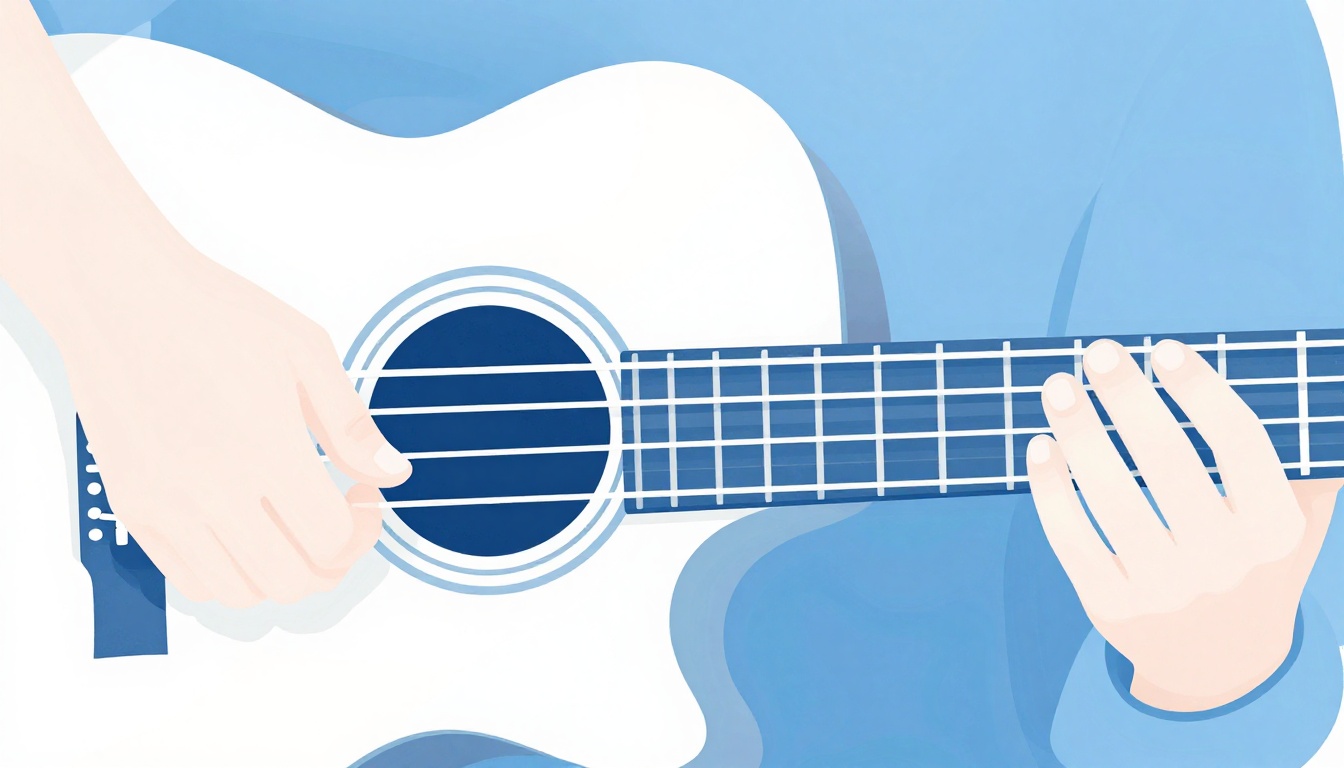
To play Fmaj7 on guitar without a barre, mute the low E and A strings, put your ring finger on the 3rd fret of the D string, your middle finger on the 2nd fret of the G string, your index finger on the 1st fret of the B string, and let the high E string ring open. Strum only the top four strings. That is the whole shape, and it is genuinely easier than the plain F chord it is often confused with. Everything below covers the other voicings you will meet further up the neck, why this one buzzes when it does, and how it actually differs from F, F7, and Fm.
The Fmaj7 chord, string by string
Here is the full shape as a table. "Finger" uses standard numbering: 1 is your index finger, 2 is your middle finger, 3 is your ring finger, 4 is your pinky.
| String | Fret | Finger |
|---|---|---|
| 6 (low E) | Not played | - |
| 5 (A) | Not played | - |
| 4 (D) | 3 | 3 (ring) |
| 3 (G) | 2 | 2 (middle) |
| 2 (B) | 1 | 1 (index) |
| 1 (high E) | Open | - |
Three fingers, each on its own string and fret, no barre, and no two fingers competing for the same fret. The high E string rings open on top, supplying the major 7th, which is the note that gives this chord its whole character. If you already know a standard open D chord, the ring-middle-index staircase down the D, G, and B strings will feel familiar, since it uses a very similar hand shape, just with the low E and A strings left out entirely.
Why Fmaj7 skips the barre entirely
The standard F major chord is one of the first genuinely hard shapes a new guitarist meets, because it asks for a full six-string barre with the index finger at the 1st fret, which takes real finger strength and weeks of practice to sound clean. Fmaj7 is a different chord built from a different, and easier, physical shape.
Nothing about the open Fmaj7 shape above requires a barre. Every finger has one job, on one string, at one fret. That is not a simplified or "cheat" version of F, the way a two-finger mini-F sometimes gets treated. It is a complete, correct Fmaj7 chord, with all four of its notes present and ringing. Fmaj7 is not a substitute you can drop into every song that calls for plain F, since it changes the harmony by adding a note, but where a songwriter has actually written Fmaj7, or where the chord fits the mood of a passage you are arranging yourself, it gives you an F-flavored sound without the barre standing in the way.
This matters most for players who are still building the finger strength a full barre needs. Rather than avoiding F-family chords entirely until the barre is ready, or reaching for a thinner, muted mini-F every time, Fmaj7 gives you a genuinely complete chord to play in the meantime, one that stands on its own rather than functioning only as a placeholder. Plenty of experienced players keep using it long after the barre stops being difficult, simply because they prefer how it sounds in a given song.
A fingering adjustment for a weak or short ring finger
The open shape asks your ring finger to do the most work, fretting the D string, while your middle and index fingers handle the strings above it. For most players that is a natural staircase, ring lowest, middle in the middle, index highest, but if your ring finger is noticeably weaker or shorter relative to your middle finger, the D string note can end up buzzing even when the other two ring cleanly.
Two adjustments help before you consider changing the fingering itself. First, check your thumb position on the back of the neck: a thumb pressed too high, near the top edge, closes the angle between your fingers and the fretboard and makes the ring finger's job harder than it needs to be. Dropping your thumb slightly toward the middle of the neck's back usually frees up more finger strength than it seems like it should. Second, rotate your whole hand a few degrees so your fingers approach the strings more from an angle than straight on, which gives a shorter ring finger more reach without stretching.
If the D string still will not ring cleanly after both adjustments, some players substitute the pinky for the ring finger on that single note. It is a less common choice, since it leaves the ring finger doing nothing, but a few players find their pinky has more independent strength than their ring finger does. There is no wrong answer between the two: use whichever finger gives you a clean note on the D string, since nothing about the chord's sound changes based on which finger presses it.
Which strings to strum
Strum the top four strings only, from the 4th string (D) down through the 1st string (high E). Leave the 6th string (low E) and 5th string (A) out of the strum entirely.
Neither the low E nor the A string is part of Fmaj7, whose four notes are F, A, C, and E. Letting either ring adds a note that clashes with the chord sitting above it, usually heard as a dull, out-of-key rumble under the rest of the strum.
Two habits keep them out reliably:
- Aim your downstroke to start on the D string. This takes deliberate attention for the first week or two, then becomes automatic.
- Let your ring finger's underside lean against the A string, and your fretting hand's palm rest lightly against the low E string. Because your ring finger is already reaching for the D string, the side of that same finger is often close enough to the A string to mute it without any extra motion. A slight downward angle of the wrist brings the heel of your palm close enough to the low E string to do the same job there.
Strum slowly and listen to the very first sound in the chord. If you hear a low thump before the rest of it rings, one of the two bass strings is sneaking into the strum.
What actually makes it "maj7"
Fmaj7 is a major seventh chord built from four notes: F, A, C, and E. That is an F major triad (F, A, C) with a major seventh, E, stacked on top.
| Note | Interval from F | Role in the chord |
|---|---|---|
| F | Root | Root |
| A | Major third | Major third |
| C | Perfect fifth | Perfect fifth |
| E | Major seventh | Major seventh |
The "seventh" in the name refers to E, the note a major seventh above F, sitting one half step below the octave F. That closeness to the octave, without quite reaching it, is what gives major seventh chords their particular sound: warm and settled like a major chord, but with a floating, slightly unresolved edge that a plain triad does not have. Players often describe it as dreamy, jazzy, or lush rather than bright or driving.
This is a different chord from F7, which flattens that seventh to Eb, and from Fm7, which flattens both the third and the seventh. All three share the letter name F and the word "seventh," and all three sound different enough that mixing them up is one of the more common mistakes tied to this chord family. There is a full comparison further down.
Why your Fmaj7 is buzzing or sounds dead
If a note is not ringing cleanly, the cause is almost always one of these, and they are worth checking one at a time rather than guessing.
Your ring finger is landing flat instead of on its tip
The D string sits closest to the strings on either side of it, so a ring finger that lies down flat instead of arching on its tip tends to brush against the A string or the G string without meaning to. Curl your fingers so only the very tip contacts the string, leaving the rest of the finger clear of its neighbors.
A finger is pressing in the middle of the fret space instead of near the wire
Press close to the metal fret wire itself, not halfway back toward the previous fret. The closer to the wire, the less pressure you need for a clean note, and the less likely any string is to buzz against the fret in front of it.
The high E string is not actually open
Because your index finger is already doing work on the B string right next to it, it is easy for the side of that same finger to brush against the high E string and deaden it without you noticing. Play the high E string on its own after forming the chord. If it sounds muted or thuddy instead of ringing clearly, adjust your index finger's angle slightly away from that string.
The low E or A string is ringing when it should not be
Covered in the strumming section above, this is a strumming-accuracy problem rather than a fretting problem. Fix it by adjusting where your downstroke starts, not by pressing harder on the notes you do want.
Not enough downward pressure from the ring finger specifically
The D string carries more tension than the thinner strings above it, and a ring finger, already one of the weaker fingers for most players, sometimes gives it less pressure than it needs. If the D string buzzes specifically, isolate it: fret only that note and pick the string on its own, adding pressure gradually until the buzz disappears, so you learn exactly how much force that finger needs for this chord.
A two-note shell version for background comping
Because Fmaj7's chord tones line up conveniently across two adjacent strings, you can suggest the chord with just two fretted notes.
| String | Fret | Finger |
|---|---|---|
| 6 (low E) | Not played | - |
| 5 (A) | Not played | - |
| 4 (D) | 2 | 2 (middle) |
| 3 (G) | Not played | - |
| 2 (B) | 1 | 1 (index) |
| 1 (high E) | Not played | - |
Fret the D string at the 2nd fret and the B string at the 1st fret, then pick just those two strings, skipping the G and high E strings between and above them. That gives you E (the major 7th) and C (the 5th), the two chord tones that carry Fmaj7's particular color most strongly. It leaves out the root and the third entirely, so it only works where something else in the mix, usually a bass player or another instrument, is already supplying the rest of the chord. On its own, treat this as a texture for light fingerpicking or comping behind a melody, not a full substitute for the six-note or four-note versions above.
Fmaj7 further up the neck: the full six-string barre shape
Once the open shape feels solid, this movable version plays all six strings and gets you comfortable with a barre chord that is one finger lighter than a plain F barre.
| String | Fret | Finger |
|---|---|---|
| 6 (low E) | 1 | 1 (barre) |
| 5 (A) | 3 | 3 (ring) |
| 4 (D) | 2 | 2 (mini barre with G string) |
| 3 (G) | 2 | 2 (mini barre with D string) |
| 2 (B) | 1 | 1 (barre) |
| 1 (high E) | 1 | 1 (barre) |
Your index finger barres all six strings at the 1st fret, the same as it would for a standard F chord. Your ring finger frets the A string at the 3rd fret, also the same as standard F. The difference is the D string: instead of a pinky reaching for the 3rd fret there, your middle finger flattens slightly to cover both the D and G strings together at the 2nd fret, a small two-string mini barre. That one change, moving the D string's note down a fret, is what turns a plain F barre chord into Fmaj7, and it means this version needs only three fretting fingers instead of four.
The jazz voicing: Fmaj7 rooted on the A string
This voicing moves the root off the low E string and up to the A string, which is the standard way jazz and R&B players reach for major seventh chords once they start moving around the neck rather than staying near the open strings.
| String | Fret | Finger |
|---|---|---|
| 6 (low E) | Not played | - |
| 5 (A) | 8 | 1 (barre, root) |
| 4 (D) | 10 | 3 (ring) |
| 3 (G) | 9 | 2 (middle) |
| 2 (B) | 10 | 4 (pinky) |
| 1 (high E) | 8 | 1 (barre) |
Your index finger lays flat across the top five strings at the 8th fret, though only the A string and high E string actually sound at that fret since the other fingers override the D, G, and B strings at higher frets. Your middle finger takes the G string at the 9th fret, your ring finger the D string at the 10th fret, and your pinky the B string at the 10th fret. The low E string stays out of the chord entirely.
This is the same shape as an open Amaj7 chord, just picked up and moved eight frets higher so the root lands on F instead of A. Once you can find it here, sliding the identical shape to any fret gives you a different major seventh chord, with whatever note is under your index finger's barre on the A string telling you which one.
This is the voicing to reach for once you are comping behind a singer or another instrument rather than carrying a song alone, since leaving out the low E string keeps the chord from muddying whatever bass note is already underneath it. It also sits in a comfortable position for moving smoothly into the other chords a jazz progression tends to call for nearby on the neck, which is part of why it is the shape most commonly taught for maj7 chords once a player moves past open position.
Warm-ups that make the movable shapes easier
The full barre shape and the jazz voicing further up the neck both ask more of your hand than the open shape does, and a short warm-up before practicing either one makes a real difference.
Start by pressing your index finger flat across all six strings at the 5th fret, holding for five seconds, and releasing, without picking any notes yet. Repeat this five times. This isolates the exact muscle the barre relies on, without also asking your other fingers to do anything at the same time, which makes it easier to feel whether your index finger's pressure is even across all six strings or dropping off toward the low E or high E side.
Next, practice the mini barre from the full six-string Fmaj7 shape on its own: your middle finger flattened across just the D and G strings at the 2nd fret. Press, check that both strings ring cleanly, release, and repeat. This two-string mini barre is a smaller version of the same skill the full index-finger barre needs, and it is a faster muscle to build since it involves less of the hand.
Finally, once both of those feel steady, slide the full barre shape up and down a few frets without stopping to fret anything else, just the index finger's barre moving from fret 1 to fret 3 and back. This builds the general strength and calluses that any barre chord needs, Fmaj7 included, and it transfers directly to the jazz voicing at the 8th fret once your hand is ready to move that far up the neck.
Fmaj7 on a nylon-string or classical guitar
The open Fmaj7 shape transfers directly to a nylon-string or classical guitar, and the wider string spacing on most classical necks can actually make the three separate fretted notes easier to land precisely, since there is more room between strings for each fingertip. Nylon strings also carry noticeably less tension than steel strings, which can make the D string's note easier to press cleanly if that has been a sticking point.
The tradeoff shows up on the barre and jazz voicings instead. A classical guitar's neck is usually wider across its width, which means the index finger has to stretch further to reach all six strings on the full barre shape, and the same width makes the two-string mini barre on the D and G strings slightly more of a reach than it is on a narrower steel-string neck. None of this makes the chord impossible on a nylon-string guitar, but if the barre and jazz voicings feel harder there than they did on a steel-string instrument, the wider spacing is very likely why, not a mistake in your technique.
Fmaj7 under distortion: why this chord usually stays clean
You will hear Fmaj7 constantly in jazz, soul, and acoustic music, and rarely in heavily distorted rock or metal, and that pattern comes down to physics rather than genre convention alone. The root and the major 7th, F and E, sit only a half step apart, and any two notes that close together produce a rapid, buzzing beat when they ring at the same time. On a clean or lightly overdriven tone, that beat is subtle enough to read as warmth and color. Heavy distortion adds a dense layer of extra harmonics on top of every note it processes, and those close-together overtones from F and E start clashing with each other far more audibly, turning the chord's warmth into mud.
This is why jazz and neo-soul players reach for maj7 chords constantly on a clean amp setting, while rock and metal players tend to lean on power chords and plain triads, which avoid any notes a half step apart, when distortion is heavy. None of this means Fmaj7 is off-limits with any gain at all. A light overdrive, the kind common in blues-rock and indie guitar tones, still lets the chord read clearly. It is specifically heavy, saturated distortion that tends to turn this chord's most distinctive feature into noise.
Fmaj7 with a capo, using a shape you already know
A capo lets you play Fmaj7 using an entirely different open chord shape somewhere else on the neck, which is useful if none of the shapes above feel comfortable yet.
| Capo position | Shape you play | Sounds as |
|---|---|---|
| 1st fret | Open Emaj7 shape | Fmaj7 |
| 3rd fret | Open Dmaj7 shape | Fmaj7 |
| 5th fret | Open Cmaj7 shape | Fmaj7 |
Each of these works because a capo shortens the string length by exactly the number of frets it clamps, which raises every open string's pitch by that many half steps. E raised one half step is F, so a capo at the 1st fret turns an open Emaj7 shape into Fmaj7. D raised three half steps is F, so a capo at the 3rd fret does the same with Dmaj7. C raised five half steps is F, which is why a capo at the 5th fret turns Cmaj7 into Fmaj7.
The tradeoff is the same one that comes with any capo: every other chord in the song has to move with it. If a progression uses Fmaj7 alongside plain C and G chords, capoing to borrow an easier Fmaj7 shape means finding capo-adjusted versions of those chords too, which is its own small puzzle. This is a genuinely useful workaround for specific songs, not a permanent replacement for learning the open or barre shapes above.
Fmaj7 vs F major: when each one actually fits
F major is F, A, and C, a plain triad. Fmaj7 is the same triad with E added on top. That single extra note is the entire difference, and it changes the chord's mood more than its size suggests: F major sounds resolved and settled, while Fmaj7 sounds softer and slightly suspended, like it has not quite finished arriving.
That difference decides when the substitution works. In songs that use F as a passing or ambient chord, one that moves through on its way somewhere else rather than landing and staying, Fmaj7 is often an upgrade, adding warmth without disrupting the progression. Acoustic, singer-songwriter, and jazz-leaning songs lean on this constantly. In songs that resolve strongly onto F, where the chord is meant to feel like a firm landing point, particularly in rock, country, and more classical-leaning progressions, Fmaj7 tends to sound too floaty for the job, and the plain triad is the right call. If a song goes to F and keeps moving, Fmaj7 is worth trying. If a song stops on F, use the real thing. For the full F barre chord and its easier variations, including a no-barre shape and how to fix its own buzzing, see the dedicated guide.
Fmaj7 vs F7: do not mix these up
These two chord names are one letter apart and it is common to see them confused, but they land on very different moods. F7 is F, A, C, and Eb, a major triad with a flattened seventh. Fmaj7 is F, A, C, and E, the same triad with a natural, unflattened seventh instead.
That one-note difference, Eb versus E natural, changes the chord's character completely. F7 leans forward and sounds restless, wanting to resolve to another chord, which is exactly why it shows up constantly in blues turnarounds. Fmaj7 is smooth and settled by comparison, closer in feeling to plain F major than to F7. If a chord chart just says "F7," it means the dominant, bluesier version. "Fmaj7" or "FM7" always means the natural-seventh version covered in this article. For the dominant chord's own shapes, including a barre-free version, see the F7 chord guide.
Fmaj7 vs Fm and Fm7: the minor mix-up
A different kind of confusion comes from the letter "m." Fm, F minor, is F, Ab, and C, a minor triad, built from a flattened third rather than the major third that F and Fmaj7 both use. Fm7 adds a flattened seventh, Eb, on top of that minor triad.
Nothing about Fm or Fm7 shares fingering with Fmaj7 beyond the root note, since the flattened third changes the shape completely. Where the confusion actually causes mistakes is on chord charts written by hand or transcribed by ear, where a lowercase "m" can be easy to miss or misread against "maj." When in doubt, "Fm" or "F minor" always means the minor chord, while "Fmaj" or "FM" always means the major seventh version this article covers. They are not interchangeable in a progression, since swapping one for the other changes whether a passage sounds bright or somber.
Fmaj7 vs Fmaj9: one extra note
Fmaj9 is Fmaj7 with one more note added on top: F, A, C, E, and G, the 9th. That 9th is the same note as the 2nd of the F major scale, just placed an octave higher, and it adds a shimmering, even more open color on top of what Fmaj7 already has.
You do not need a different hand shape to hear the difference. On the jazz voicing further up the neck, moving your pinky off the B string's 10th fret note and instead letting a different fingering bring in a G note turns that same basic shape into Fmaj9, which is part of why jazz players treat maj7 and maj9 chords as close relatives rather than as separate things to learn from scratch. If a chart calls for Fmaj9 and you only know Fmaj7, playing Fmaj7 in its place is a reasonable stand-in for most songs, since three of its four notes overlap completely and the missing 9th is more of a color than a structural note.
Where Fmaj7 sits in a key
Fmaj7 shows up naturally in two different keys, for two different reasons, and knowing both helps you predict where a songwriter is likely to reach for it.
In the key of C major, Fmaj7 is the IV chord, built by stacking thirds on the fourth note of the C major scale: F, A, C, and E, all four of them notes that belong to the C major scale itself. That makes Fmaj7 a completely natural, no-sharps-or-flats choice anywhere a song in C reaches for its IV chord instead of plain F.
In the key of F major, Fmaj7 is the I chord, the tonic. Any major key's tonic seventh chord is a major seventh chord built on the root, which is why the "home" chord of a song in F, played as a seventh chord rather than a plain triad, is always Fmaj7 rather than F7 or Fm7.
Changing from Fmaj7 to C
This is one of the smoothest changes available, because both chords share notes and finger positions.
Lift only your ring finger off the D string, keep your middle and index fingers roughly where they are, and add the A string at the 3rd fret with your ring finger for the C shape, while your middle finger's G string note and index finger's B string note either stay in place or shift only slightly depending on which C voicing you land on. Because so little of the hand actually has to move, this change works well as one of your first drilled transitions.
The most common mistake here is not a fretting error at all: it is forgetting to bring the low E string back into the strum. Fmaj7 mutes it deliberately, but a standard open C chord needs it muted too, so the habit carries over cleanly in this particular direction. Where players trip up is the A string, since Fmaj7 also mutes it but C needs it fretted and ringing, and a hand that has settled into "mute strings 5 and 6" during Fmaj7 sometimes forgets to wake the A string back up for C. Listen specifically for that string on the change, not just for buzzing.
Changing from Fmaj7 to G
F and G sit a whole step apart, so this change asks your whole hand to relocate rather than adjust in place, which makes it one of the less forgiving transitions in this article to rush. From the open Fmaj7 shape, lift all three fingers together and reset them for a standard open G chord, ring finger on the low E string's 3rd fret, middle finger on the A string's 2nd fret, and depending on which G voicing you use, a third finger on the high E string's 3rd fret.
Because none of the fingers share a string or fret between the two shapes, the fastest way to build this change is to practice the release and the landing as two separate, deliberate motions at first: lift everything cleanly off Fmaj7, then place the G shape as a single coordinated motion, rather than trying to slide or roll from one to the other. Speed comes later, from repetition, not from trying to shortcut the movement itself.
Changing from Fmaj7 to Am
Fmaj7 and Am share a note, A, which makes this change a little smoother than the move to G even though the shapes still do not overlap directly. A standard open Am chord uses your middle finger on the D string's 2nd fret, your ring finger on the G string's 2nd fret, and your index finger on the B string's 1st fret, which means the index finger's job barely changes position at all between the two chords, staying on the B string at the 1st fret in both.
That shared index-finger position is worth drilling on its own: form Fmaj7, then move only your middle and ring fingers into their Am positions while leaving your index finger exactly where it already is. Once that partial move feels automatic, add the full release and reset for the strings your index finger is not covering.
Changing from Fmaj7 to Dm7
Fmaj7 to Dm7 is a common move in both pop and jazz progressions, and it is a short one physically. From the open Fmaj7 shape, your ring finger slides from the D string's 3rd fret down to the C string's 1st fret region for a typical open Dm7 voicing, while your middle and index fingers make small adjustments on the strings above. Because Dm7 and Fmaj7 share two notes, F and A, the two chords blend into each other easily even when the change is not perfectly clean, which makes this a forgiving pair to practice on.
The ii-V-I in F: Gm7, C7, Fmaj7
This three-chord movement, built from the ii, V, and I chords of a key, is one of the most common progressions in jazz, and in the key of F it runs Gm7 to C7 to Fmaj7. Each chord pulls toward the next: Gm7 sets up tension, C7 raises it further as the dominant chord, and Fmaj7 resolves it, landing on the tonic seventh chord discussed above.
Practicing this move on its own, slowly and without a metronome at first, builds the specific hand memory that makes jazz-leaning progressions feel natural instead of like three unrelated shapes stitched together. Once the three chords connect smoothly at a slow tempo, gradually add a metronome and increase the speed. The shell voicings and guide-tone logic that make progressions like this one sound clean rather than muddy are covered in more depth in a separate guide focused entirely on jazz chord shapes.
Changing from Fmaj7 to the full barre F chord
If a song moves between the open sound of Fmaj7 and the fuller sound of plain F, the cleanest path is through the barre voicing of Fmaj7 covered earlier, not the open shape. Both the barre Fmaj7 and the standard F barre chord share the same index-finger barre and the same ring-finger position on the A string, so the only finger that has to move is the one on the D string, sliding from the 2nd fret up to the 3rd. Practicing that single-finger shift in isolation, without strumming, is faster than trying to relearn the whole chord change from open position every time.
Fmaj7 as a passing chord, and where it shows up in real songs
Fmaj7 is a fixture of jazz standards written in or passing through the key of F. In "Fly Me to the Moon," one of the most widely played jazz standards, Fmaj7 appears as the IV chord in the progression before a minor ii-V movement, and again later in the tune's turnaround section, making it one of the chords a guitarist needs under their fingers to play the song at all. Beyond jazz, the chord turns up constantly in acoustic and singer-songwriter music wherever a progression wants an F-flavored moment that does not fully resolve, for exactly the reasons covered in the F-major comparison above.
You will also hear the general sound of maj7 chords like this one, though not always this exact one, throughout neo-soul, R&B, and the mellower end of indie and bedroom-pop production, genres that lean on the smoother, jazz-adjacent harmony major seventh chords bring. If a recording in one of those styles sounds like it is gliding rather than landing on its chords, a maj7 chord, sometimes this one, is often part of why.

Common mistakes beyond buzzing
A handful of habits show up again and again with this chord specifically, separate from the fretting issues covered earlier.
Confusing "maj7" with a plain "7"
As covered above, F7 and Fmaj7 are built from different notes, not two ways of writing the same chord. If a chart calls for one and you play the other, it will sound wrong even if every finger placement felt confident. Check whether the chart says "maj7," "M7," or a triangle symbol, all of which mean this chord, versus a bare "7," which means the bluesier dominant version instead.
Strumming too hard and burying the open high E string
Because one of Fmaj7's four notes comes from an open string, an aggressive strum can drown that note's subtler ring under the three fretted notes below it. This chord tends to sit better with a slightly lighter touch than a full barre chord needs, letting the open string actually contribute its sound instead of getting buried.
Reaching for the full barre chord out of habit
If you already know the standard F barre chord well, your pinky may land on the D string's 3rd fret out of pure muscle memory when you meant to play the open Fmaj7 shape, turning the chord back into plain F without you noticing. Check the D string specifically. It should be at the 2nd fret, not the 3rd.
Miscounting the fret on the movable jazz voicing
The A-shape voicing further up the neck is only correct if your index finger lands on the right fret, and it is easy to be off by one when counting up an unfamiliar part of the neck. Count from the nut, not from an inlay marker you assume is a certain fret, and check against the 12th fret, which on almost every guitar has a distinct double-dot marker. Landing a fret off turns Fmaj7 into a different major seventh chord entirely, one that sounds merely "wrong" rather than obviously broken, which makes the mistake harder to catch by ear alone than an outright buzz.
Changing between chords is still the real skill
Every section above eventually comes back to the same point: the Fmaj7 shape itself is not the hard part. Once your fingers know where to land, the actual skill being built is moving into and out of that shape on time, without a pause, while a song keeps moving underneath you. Treat each "changing from" section above as its own short drill rather than something to absorb by reading, since the shape and the change are two different things your hand has to learn separately.
Playing Fmaj7 fingerstyle instead of strumming
Because three of the four notes in the open shape sit close together on adjacent strings, Fmaj7 works well as a fingerpicked chord, not only a strummed one. A simple pattern using your thumb on the D string and your index, middle, and ring fingers on the G, B, and high E strings in sequence lets each note ring out and overlap with the next, which suits this chord's already floating, unresolved character better than a hard strum does. Try picking the notes slowly in order, letting each one ring into the next, before adding any rhythm on top. This is also a useful way to check that all three fretted notes and the open string are ringing cleanly, since a fingerpicked pattern exposes a dead or buzzing string far more obviously than a fast strum does.
A practice routine for today
Fifteen focused minutes is enough to make real progress on this chord, in keeping with the idea behind practicing guitar in short daily sessions rather than occasional long ones.
- Two minutes: form the open Fmaj7 shape from nothing, five separate times, resetting your hand fully between each one. Check the shape first, the sound second.
- Three minutes: strum the chord slowly, four strings only, and pick the D string on its own if anything sounds muted, using the troubleshooting section above to diagnose it.
- Five minutes: practice one chord change, Fmaj7 to C first since it shares the most finger positions, or Fmaj7 to Dm7 once that one feels solid. Change on a slow, steady four count, no strumming in between, just the new shape landing cleanly on the beat.
- Five minutes: if you already know a plain F barre chord, alternate between the barre F and barre Fmaj7 shapes on every other beat, moving only your middle and pinky fingers each time. This single-region drill builds the exact habit that keeps the two chords from blurring into each other later.
Repeat this most days rather than saving it for one long weekly session. A shape this size is built through frequent, short repetition, since your hand is learning a physical position, not memorizing a fact.
As the open shape becomes automatic, fold the warm-ups from earlier into the same fifteen minutes on alternating days rather than treating them as a separate practice block. A few minutes on the index-finger barre press and the two-string mini barre, worked in ahead of the chord-change drill above, is what turns the full barre and jazz voicings from something you can technically play into something your hand reaches for without thinking.
FAQ
What notes are in an Fmaj7 chord? F, A, C, and E. F is the root, A is the major 3rd, C is the perfect 5th, and E is the major 7th, the note that gives the chord its distinctive open, slightly unresolved character compared to plain F major.
Is Fmaj7 easier than the F chord? Yes, for most players. The open Fmaj7 shape uses three fingers, each on its own string and fret, and needs no barre at all, while the standard F chord asks for a full six-string barre that takes real finger strength to sound clean. Some players learn Fmaj7 as their first F-family chord for exactly this reason.
What is the difference between Fmaj7 and F7? One note. Fmaj7 uses E, the major 7th, while F7 uses Eb, the flat or minor 7th. That single half step is also the difference between a soft, settled-sounding chord and a bluesy, unresolved one that wants to move somewhere else.
Can I use Fmaj7 instead of a plain F chord in a song? Often, yes, especially in acoustic, pop, and jazz-influenced songs where the extra warmth of the major 7th fits the mood. It changes the character of the chord, though, so it is worth listening for whether the song wants that softer, floating color or the brighter, more resolved sound of plain F before swapping one for the other, particularly in songs that land firmly on F as a final chord.
Why is it written "Fmaj7" instead of just "F7"? Because "F7" already refers to a different chord, the dominant seventh version with a flattened 7th note. Writing "maj7," "M7," or the triangle symbol used in some jazz notation makes it explicit that the 7th is major, not flattened, so the two chords are never confused on a chart.
Do I need to mute both the low E and A strings on every voicing? Only on the open shape and the two-note shell version. The full barre voicing and the jazz voicing further up the neck bring in more strings deliberately, since those shapes are built to include the root on the low E string or the A string as part of the chord.
What is a ii-V-I progression, and why does it keep coming up with this chord? It is a three-chord movement, built from the ii, V, and I chords of a key, that resolves strongly to the tonic. In the key of F, that is Gm7 moving to C7 resolving to Fmaj7. It is one of the most common chord movements in jazz, which is why Fmaj7 turns up constantly in jazz standards written in or passing through F.
Is Fmaj7 the same as F major 7th, FM7, or FΔ7? Yes. All four are different ways of writing the identical chord: F, A, C, and E. Chord charts and lead sheets vary in which notation they use, but none of them represent a different chord from the others.
GuitarLowKey
Ready for fifteen focused minutes?
Open the web app and train the change that is blocking your song.