
Hotel California Lyrics With Guitar Chords, Verse by Verse
Every chord behind Hotel California, section by section: the Bm-F#7-A-E-G-D-Em progression, the capo 2 shortcut the Eagles used live, and the coda.

"Hotel California" runs on eight chords in a fixed loop: Bm, F#7, A, E, G, D, Em, F#7. Almost every recording you have heard of it plays those chords with a capo on the 2nd fret instead, using the easier open shapes Am, E7, G, D, F, C, Dm, E7, which sound at the same pitch. The chorus adds nothing new, just G, D, F#7, Bm, then G, D, Em, F#7. That is the entire harmonic content of a six and a half minute song. What follows is every one of those shapes, in the order they fall through the lyric, both with a capo and without one.
If you already know a handful of open chords, the capo 2 version of this song is within reach this week. The two barre chords, whether you play them as Bm and F#7 in the real key or as F and Am-adjacent shapes with a capo on, are the only real obstacle, and both have working alternatives covered below. The rest of this post walks through every shape section by section, the exact chord order under each part of the lyric, why the Eagles themselves played it with a capo on stage, and the specific reasons a chord change on this song stops sounding clean.
Hotel California at a Glance
| Detail | Value |
|---|---|
| Written by | Don Felder (music), Don Henley and Glenn Frey (lyrics) |
| Recorded by | Eagles |
| Album | Hotel California (1976) |
| Key | B minor |
| Capo | None on the studio recording; capo 2 is the standard, widely taught easier version |
| Chords (capo 2 shapes) | Am, E7, G, D, F, C, Dm, E7 |
| Chords (actual pitch, no capo) | Bm, F#7, A, E, G, D, Em, F#7 |
| Tempo | About 75 BPM |
| Time signature | 4/4 |
Everything in that table gets its own section below, chord by chord and part by part.
The Key This Song Is Actually In
The studio recording of "Hotel California" is in B minor, played with no capo, which means the chords you hear on the record are Bm, F#7, A, E, G, D and Em. Don Henley's vocal was originally tracked a step and a half higher, then the whole song was transposed down to B minor to sit better in his range, which is part of why the chord shapes needed for the real key involve two barre chords rather than open ones.
Almost nobody actually plays it that way at home, and that is not a shortcut anyone needs to feel bad about. Guitarists learning this song overwhelmingly reach for a capo on the 2nd fret, which lets every one of those same pitches be played as an open Am, E7, G, D, F, C or Dm shape instead. A capo shortens the vibrating length of every string by the same amount, raising the whole guitar's pitch uniformly, so an Am shape played behind a capo on the 2nd fret rings out as Bm without asking your hand to barre anything. Standard tuning is E-A-D-G-B-E, low string to high, and that relationship holds whether or not a capo is clamped on, which is why the same shapes transfer cleanly.
| String | Open note | Note with capo on 2nd fret |
|---|---|---|
| 6 (low E) | E | F# |
| 5 (A) | A | B |
| 4 (D) | D | E |
| 3 (G) | G | A |
| 2 (B) | B | C# |
| 1 (high E) | E | F# |
This post covers both versions in full. The capo 2 shapes are what most players use and what the rest of the chord-by-chord sections below are built around, since they are the more approachable path in. The full no-capo version, for anyone who wants to play it exactly as recorded, gets its own dedicated section further down. For a broader map of how capo position changes every shape you already know, the guitar capo chart on this site covers frets 1 through 7 in full.
The Full Chord Progression, Verse and Intro
The intro states the whole progression once through, then the verses ride the same eight chords under each line of lyric. Here is the order, with the capo 2 shape on top and the pitch it actually sounds at underneath.
| Order | Shape you play (capo 2) | Chord it sounds as |
|---|---|---|
| 1 | Am | Bm |
| 2 | E7 | F#7 |
| 3 | G | A |
| 4 | D | E |
| 5 | F | G |
| 6 | C | D |
| 7 | Dm | Em |
| 8 | E7 | F#7 |
That eight-chord loop repeats for the intro (twice through), then again under each verse line, so once it is memorized in order, most of the song's guitar part is already familiar territory. The chorus, covered in its own section below, uses a shorter four-chord loop built from the same pool of shapes, just in a different order.
The Am Shape (Sounds as Bm)
Am opens the progression and is the chord you return to at the start of almost every pass through the loop.
| String | Fret | Finger |
|---|---|---|
| 6 (low E) | Muted | - |
| 5 (A) | Open | - |
| 4 (D) | 2 | 2 (middle) |
| 3 (G) | 2 | 3 (ring) |
| 2 (B) | 1 | 1 (index) |
| 1 (high E) | Open | - |
Mute the low E string, leave the 5th string (A) open as the root, and place your index finger on the 2nd string (B) at the 1st fret, your middle finger on the 4th string (D) at the 2nd fret, and your ring finger on the 3rd string (G) at the 2nd fret. It is one of the first open chords most players learn, and its familiarity is exactly why this song's capo 2 version is such a common entry point into playing it: the hardest chord in the whole loop, in this shape, is a shape you likely already know.
Behind a capo on the 2nd fret, this same shape sounds as Bm, the true tonic of the song. For a full breakdown of what Bm sounds like without a capo, including the six-string barre version and its easier alternatives, see the B minor chord guide.
The E7 Shape (Sounds as F#7)
E7 follows Am and closes the loop too, appearing twice in each full pass through the progression.
| String | Fret | Finger |
|---|---|---|
| 6 (low E) | Open | - |
| 5 (A) | 2 | 2 (middle) |
| 4 (D) | Open | - |
| 3 (G) | 1 | 1 (index) |
| 2 (B) | Open | - |
| 1 (high E) | Open | - |
Place your index finger on the 3rd string (G) at the 1st fret and your middle finger on the 5th string (A) at the 2nd fret. Every other string rings open. Four of the six strings are unfretted here, which is part of why E7 sounds so full for a chord that only asks two fingers to move.
Behind the capo, this shape becomes F#7, the dominant chord that keeps pulling the progression back toward Bm every time it appears. It is worth noticing that this song leans on that same F#7-to-Bm pull twice in every loop, once in the middle and once at the very end, which is a large part of why the progression feels like it is circling rather than resolving anywhere final, fitting for a lyric about a place you can check out of but never leave.
The G Chord
G follows E7 and lightens the harmony after two chords built around the low strings.
| String | Fret | Finger |
|---|---|---|
| 6 (low E) | 3 | 2 (middle) |
| 5 (A) | 2 | 1 (index) |
| 4 (D) | Open | - |
| 3 (G) | Open | - |
| 2 (B) | Open | - |
| 1 (high E) | 3 | 4 (pinky) |
Place your index finger on the 5th string (A) at the 2nd fret, your middle finger on the 6th string (low E) at the 3rd fret, and your pinky on the 1st string (high E) at the 3rd fret. Leaving your index and middle fingers on the lower two strings while your pinky reaches for the top string is what makes this fingering, rather than the version that uses the ring finger on the high E string, the faster one to move in and out of when a chord change is coming up quickly on either side.
Behind the capo, G sounds as A, and it is the chord under the line where the progression first opens up melodically after the darker Bm-F#7 opening.
The D Chord
D sits in the middle of the progression, between G and F, and shares more of its shape with G than any other pair in this song.
| String | Fret | Finger |
|---|---|---|
| 6 (low E) | Muted | - |
| 5 (A) | Muted | - |
| 4 (D) | Open | - |
| 3 (G) | 2 | 1 (index) |
| 2 (B) | 3 | 3 (ring) |
| 1 (high E) | 2 | 2 (middle) |
Mute both low strings, leave the 4th string (D) open as the root, and place your index finger on the 3rd string (G) at the 2nd fret, your middle finger on the 1st string (high E) at the 2nd fret, and your ring finger on the 2nd string (B) at the 3rd fret. This triangular three-finger shape is one of the more compact chords a beginner learns, and it sounds as E once the capo is on.
The F Shape (Sounds as G)
F is the one shape in this progression that asks the most of a newer player's hand, and it is worth learning properly rather than avoiding.
| String | Fret | Finger |
|---|---|---|
| 6 (low E) | 1 | 1 (barre) |
| 5 (A) | 3 | 3 |
| 4 (D) | 3 | 4 |
| 3 (G) | 2 | 2 |
| 2 (B) | 1 | 1 (barre) |
| 1 (high E) | 1 | 1 (barre) |
This is the full barre version of F, index finger flattened across all six strings at the 1st fret, with your middle finger on the 3rd string (G) at the 2nd fret, ring finger on the 5th string (A) at the 3rd fret, and pinky on the 4th string (D) at the 3rd fret. If that full barre is not reliable yet, this simplified, no-barre version drops the bottom two strings and keeps the notes that matter most.
| String | Fret | Finger |
|---|---|---|
| 6 (low E) | Muted | - |
| 5 (A) | Muted | - |
| 4 (D) | 3 | 3 |
| 3 (G) | 2 | 2 |
| 2 (B) | 1 | 1 |
| 1 (high E) | Muted or 1 (barred with finger 1) | 1 |
Both versions are correct. The four-string version loses a little low-end weight but keeps the chord fully identifiable, and plenty of guitarists play this song with that version permanently rather than the full barre. Behind the capo, F sounds as G, which is the chord under the progression's brightest-sounding moment, right before it turns back down through C, Dm and E7 toward the loop's end.
The C Shape (Sounds as D)
C follows F and is one of the more familiar shapes in the entire progression.
| String | Fret | Finger |
|---|---|---|
| 6 (low E) | Muted | - |
| 5 (A) | 3 | 3 (ring) |
| 4 (D) | 2 | 2 (middle) |
| 3 (G) | Open | - |
| 2 (B) | 1 | 1 (index) |
| 1 (high E) | Open | - |
Mute the low E string, place your ring finger on the 5th string (A) at the 3rd fret, your middle finger on the 4th string (D) at the 2nd fret, and your index finger on the 2nd string (B) at the 1st fret. This is standard open C, unchanged from any other song that uses it, and behind the capo it sounds as D.
The Dm Shape (Sounds as Em)
Dm is the last new shape in the loop before it returns to E7 and starts again.
| String | Fret | Finger |
|---|---|---|
| 6 (low E) | Muted | - |
| 5 (A) | Muted | - |
| 4 (D) | Open | - |
| 3 (G) | 2 | 2 (middle) |
| 2 (B) | 3 | 3 (ring) |
| 1 (high E) | 1 | 1 (index) |
Mute both low strings, leave the 4th string (D) open, and place your index finger on the 1st string (high E) at the 1st fret, your middle finger on the 3rd string (G) at the 2nd fret, and your ring finger on the 2nd string (B) at the 3rd fret. Behind the capo, Dm sounds as Em, the one genuinely minor-sounding color in the loop's second half before E7 pulls everything back to the top.
The Chorus: "Welcome to the Hotel California"
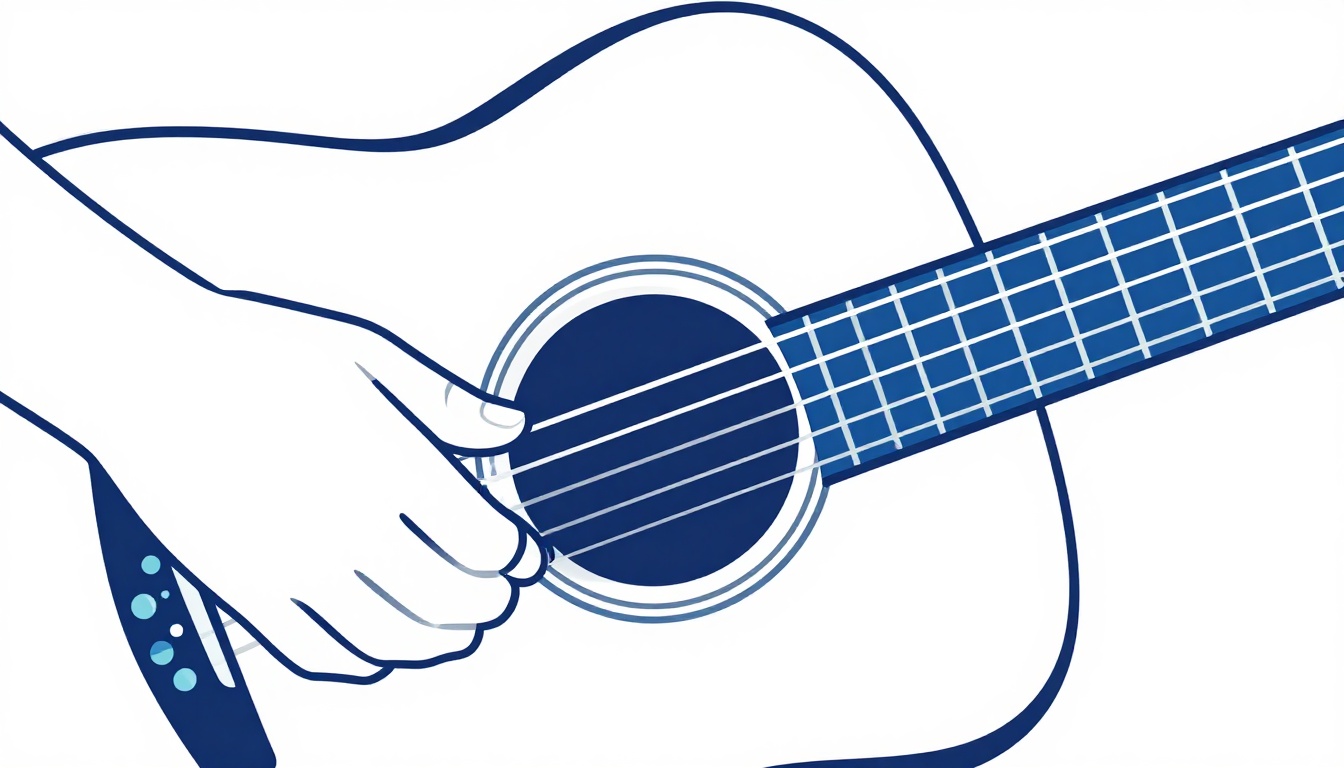
The chorus does not introduce a single new chord. It rearranges four shapes you already have from the verse loop into a shorter, four-bar pattern that repeats twice with a small variation the second time through.
| Order | Shape (capo 2) | Sounds as | Lyric cue |
|---|---|---|---|
| 1 | F, then C | G, then D | "Welcome to the Hotel California" |
| 2 | E7 | F#7 | "Such a lovely place" |
| 3 | Am | Bm | "Such a lovely face" |
| 4 | F, then C | G, then D | "Plenty of room at the Hotel California" |
| 5 | Dm | Em | "Any time of year" |
| 6 | E7 | F#7 | "You can find it here" |
Notice the second half of the chorus swaps Am for Dm compared to the first half, which is the only real difference between the two passes through the pattern. Everything else, including the F-to-C movement that opens both halves, is identical. Once F-to-C is comfortable on its own, which is worth isolating and practicing as a pair before attempting the full chorus, the rest of this section falls into place quickly, since nothing in it is a shape you have not already built in the sections above.
Playing It With No Capo: The Real B Minor Shapes
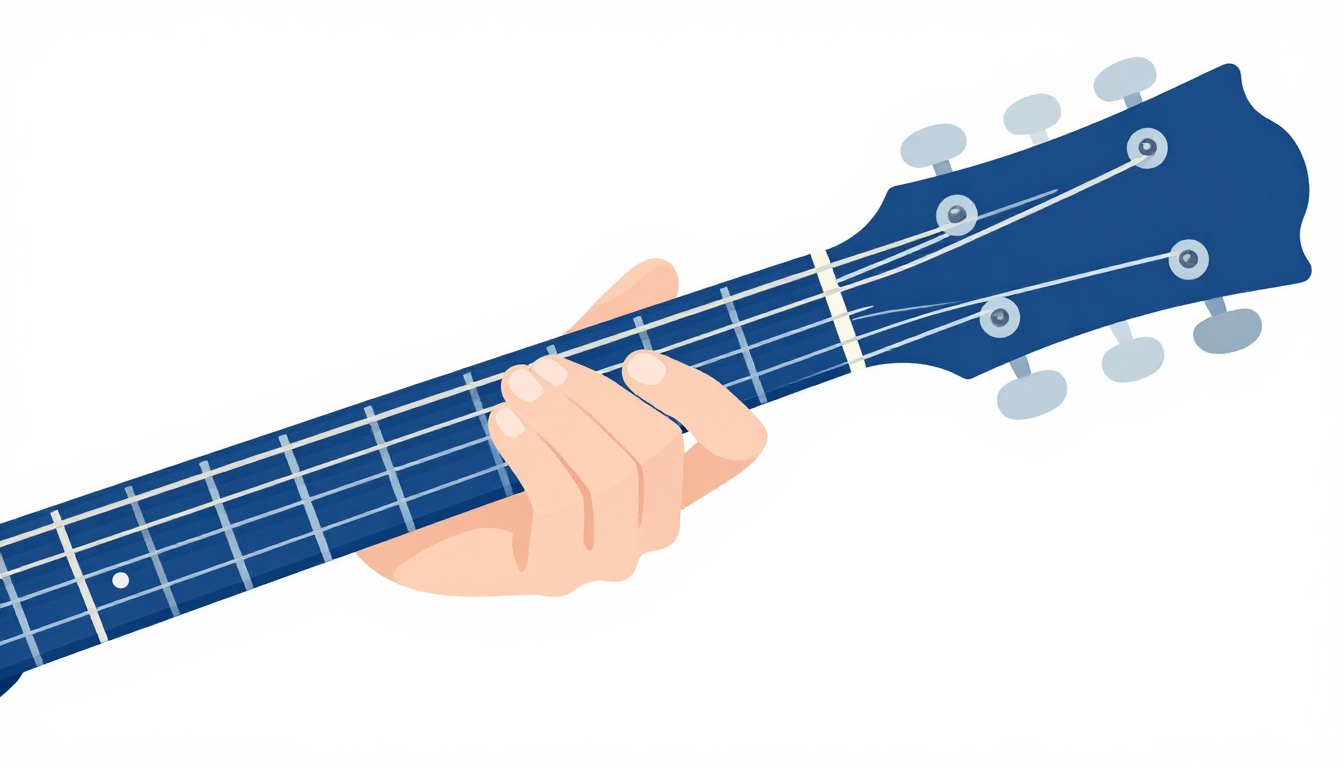
If you want to play this song exactly as it sits on the record, with no capo, every shape above needs to move up to its actual pitch. The chord names change, but the finger patterns and the order they fall in stay identical, which makes this a smaller jump than it first looks.
| Shape you played with a capo | Actual chord with no capo |
|---|---|
| Am | Bm |
| E7 | F#7 |
| G | A |
| D | E |
| F | G |
| C | D |
| Dm | Em |
Two of these, Bm and F#7, are barre-based and were covered by the B minor chord guide and the F#7 chord guide linked earlier, both of which include full six-string versions and easier, lower-effort alternatives. A, E, G, D and Em are all standard open shapes most guitarists already know from other songs.
A:
| String | Fret | Finger |
|---|---|---|
| 6 (low E) | Muted | - |
| 5 (A) | Open | - |
| 4 (D) | 2 | 1 (index) |
| 3 (G) | 2 | 2 (middle) |
| 2 (B) | 2 | 3 (ring) |
| 1 (high E) | Open | - |
E:
| String | Fret | Finger |
|---|---|---|
| 6 (low E) | Open | - |
| 5 (A) | 2 | 2 (middle) |
| 4 (D) | 2 | 3 (ring) |
| 3 (G) | 1 | 1 (index) |
| 2 (B) | Open | - |
| 1 (high E) | Open | - |
Em:
| String | Fret | Finger |
|---|---|---|
| 6 (low E) | Open | - |
| 5 (A) | 2 | 2 (middle) |
| 4 (D) | 2 | 3 (ring) |
| 3 (G) | Open | - |
| 2 (B) | Open | - |
| 1 (high E) | Open | - |
G and D in the no-capo version use the exact same shapes already covered in the capo sections above, since neither of those chords changes name between the two versions of the song, only its position relative to the other chords around it shifts.
The honest tradeoff is that the no-capo version puts two full barre chords, Bm and F#7 in one common voicing, directly next to open chords in a fast-moving loop, which is a harder hand workout than the capo 2 version asks for. Neither approach is more correct than the other. The capo 2 version is not a simplification invented for beginners; it is the same version most professional guitarists reach for when they want to play this song without spending a barre chord's worth of effort on every single pass through the progression.
Why It Is Not Working
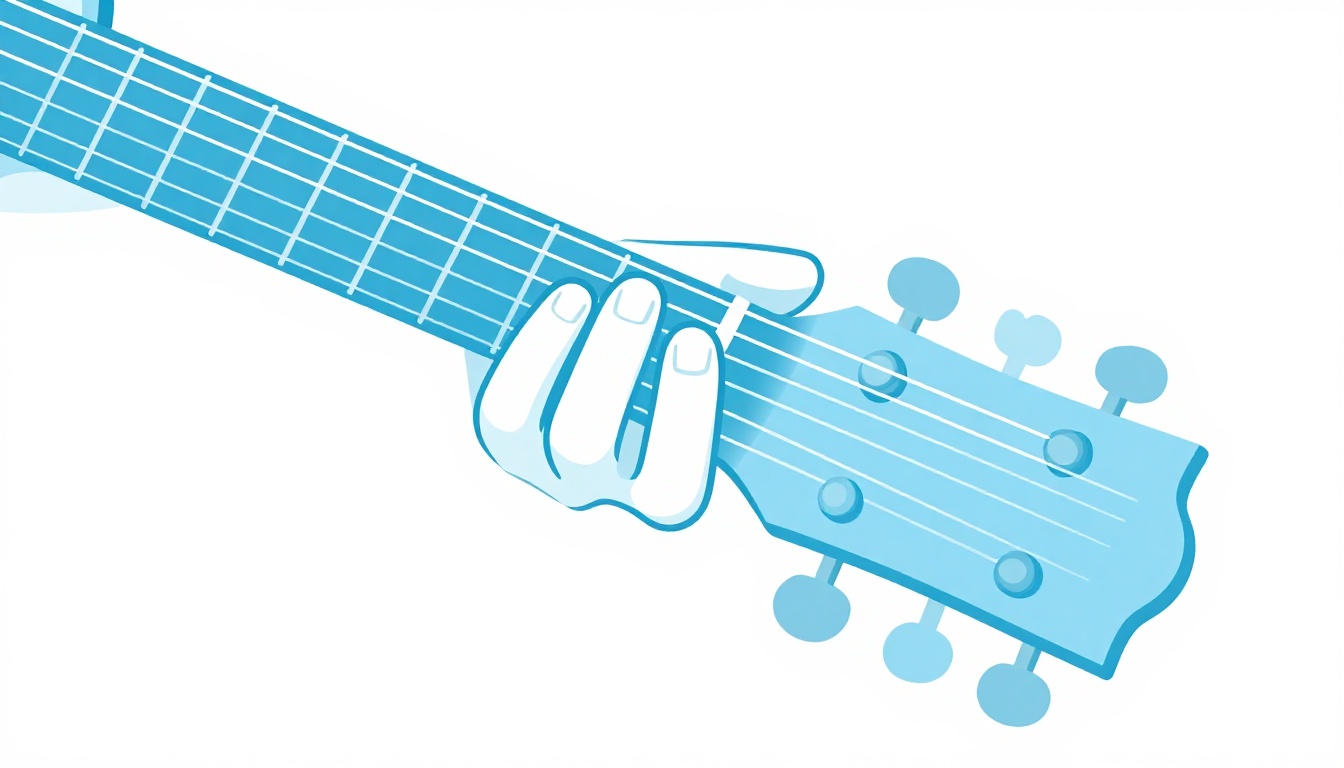
If every shape checks out but the song still does not sound clean, it is almost always one of the following, not a sign you need a different chord.
The F Barre Buzzes or Sounds Muted
This is the single most common issue on this song, since F is the only full barre chord in the capo 2 version and it needs to fire cleanly on every pass through the loop. Buzzing on a barre almost always means uneven pressure across the index finger, often from the finger rolling flat onto its pad rather than staying on its side. Roll the index finger slightly toward its outer edge, keep your thumb centered behind the neck rather than creeping over the top, and press just behind the fret wire rather than in the middle of the fret space.
The Am to E7 Change Sounds Sloppy
Am and E7 open and close the loop, and the change between them happens quickly. Look at what actually moves: your index finger goes from the 2nd string at the 1st fret to the 3rd string at the 1st fret, a small lateral shift rather than a full hand reset. Most sloppy changes here come from lifting the whole hand off the neck between chords instead of sliding that one finger across while the others settle into place around it.
The G to D Change Loses the High E String
If the top string drops out or buzzes right after moving from G to D, check that your middle finger, which frets the high E string on D, is landing cleanly rather than glancing off the string on its way from the G shape's pinky position. Practice this specific two-chord change in isolation, slowly, watching just that one finger.
Dm Sounds Thin Compared to the Rest
Dm only uses three strings actively and mutes the two lowest ones, which makes it naturally quieter than the fuller six-string chords around it in the loop. This is not a mistake to fix, it is simply how the chord is built, but if it sounds unintentionally weak, check that you are still strumming with the same intensity rather than unconsciously softening your strum because the chord feels smaller under your fingers.
The Whole Loop Rushes by the Second Time Through
Because this progression repeats with only small variations, it is common to speed up slightly on the second or third pass without noticing, especially once the shapes stop requiring conscious thought. Play against a metronome the first several times through the full loop, and resist the urge to let familiarity turn into rushing.
Easier Versions for Small Hands and New Players
If the F barre or the no-capo Bm and F#7 shapes are still out of reach, there are real, correctly fingered ways to keep playing the whole song without changing what a listener hears.
For F, the four-string no-barre version covered above carries the chord's identity fully and is a completely legitimate permanent substitute, not just a stepping stone.
For the no-capo version's Bm, a simplified two-finger voicing works: mute everything except the 5th, 4th and 2nd strings, barre only those with a partial finger position, or lean on the capo 2 shortcut entirely rather than attempting the full barre before it is ready. The B minor chord guide covers a full three-finger version in more depth.
For F#7 with no capo, the easiest version needs no barre at all: mute the low E and A strings, place your ring finger on the 4th string (D) at the 4th fret, your middle finger on the 3rd string (G) at the 3rd fret, your index finger on the 2nd string (B) at the 2nd fret, and let the high E string ring open.
If none of that feels comfortable yet, the capo 2 version using Am, E7, G, D, F, C and Dm is not a lesser way to play this song. It is the version most working guitarists actually use, and every shape in it besides F is a standard open chord most players already carry into the song from elsewhere.
Where the Song Came From
Don Felder wrote the music for "Hotel California" on a twelve string acoustic guitar in 1976, sitting on a couch at a rented beach house in Malibu. He recorded a rough instrumental demo at home using a Roland drum machine and his own bass playing underneath the twelve string part, made up a guide guitar solo on the spot with the intention of refining it later in the studio, and sent the cassette to Don Henley and Glenn Frey along with several other instrumental sketches. Henley wrote the lyrics, drawing on the band's experience of the excess and disillusionment they had witnessed living in Los Angeles, and the song became the title track of the Eagles' 1976 album of the same name.
When it came time to record the guitar parts in Miami, Felder had left the original demo cassette behind in Los Angeles, and had to have someone play it to him over the phone from his home studio so the band could reconstruct it. Because Henley wanted the finished track to follow that original demo closely, Felder ended up relearning several passages he had originally improvised, note for note, from a recording of his own earlier performance.
Twelve string guitars are tuned identically to a standard six string in note names, just with each of the four lowest string pairs adding an octave-higher unison string and the top two pairs doubled in unison, which is part of what gives the instrument its shimmering, layered sound on the original demo. For more on how a twelve string is strung and tuned, see the 12-string guitar tuning guide on this site.
What the Lyrics Are Actually About
Don Henley has described "Hotel California" as a song about the journey from innocence to experience, using the image of a traveler who checks into a strange, beautiful hotel that turns out to be impossible to leave as a metaphor for the excesses of the music industry and the broader American dream the band had watched up close after moving to Los Angeles. The hotel itself is not a real place. It stands in for the seductive, ultimately trapping side of success, wealth and the California lifestyle the Eagles found themselves living inside by the mid 1970s.
None of that changes a single chord in this post, but it explains why the music sits where it does. A song about something that looks inviting on the surface and turns out to be inescapable underneath is well served by a progression that keeps circling back to the same minor tonic no matter how far it wanders through brighter, major-sounding chords along the way, which is exactly what the Bm-based loop covered throughout this post does.
The Steely Dan Line in the Second Verse
One lyric in particular, the line about stabbing something "with their steely knives" but being unable to kill "the beast," is a direct nod to the band Steely Dan. Glenn Frey confirmed in later interviews that the reference was intentional: Steely Dan had namechecked the Eagles first, in their own song "Everything You Did," with the line "turn up the Eagles, the neighbors are listening," and Henley and Frey wanted to return the favor. Frey later said the two bands shared a manager at the time and that the lyric was a deliberate allusion rather than a piece of unrelated wordplay, part of an effort to write something stranger and less literal than the band's earlier, more straightforward songs, in the spirit of Steely Dan's own oblique lyric writing.
It is a detail worth knowing mainly because it shows how much of this song's lyric works by suggestion and reference rather than plain statement, the same quality that keeps people still arguing over what exactly the hotel represents decades after the song's original 1977 release as a single.
The Guitar Solo, and Why You Don't Need to Copy It Note for Note
The song's closing instrumental section, roughly two minutes of harmonized guitar lines played by Don Felder and Joe Walsh together, is one of the most recognized guitar passages in rock music, voted the best guitar solo of all time by readers of Guitarist magazine in 1998. Felder and Walsh worked out the interlocking parts together over several days in the studio, trading and harmonizing melodic lines on a Fender Telecaster and a Gibson Les Paul rather than one guitarist simply soloing over the other.
None of this is required to play the rhythm chords covered throughout this post. The coda is a separate, fully composed lead guitar arrangement layered on top of the same Bm-based chord loop the rest of the song already uses, not a different progression to learn. If you want to play along with the record through that section, simply continue the same eight-chord loop, capo 2 or no capo, straight through the outro, the same way you would through any other repeat of the verse pattern. Trying to reproduce the actual solo note for note is a separate, much more advanced project, and skipping it entirely takes nothing away from being able to play and sing the song in full.
The 1994 Unplugged Version That Made Capo 2 Standard
When the Eagles reunited for their 1994 MTV special and the resulting Hell Freezes Over album, they performed "Hotel California" fully acoustic with three guitars: Glenn Frey on a twelve string acoustic with a capo on the 2nd fret, and Joe Walsh and Don Felder each on a nylon string acoustic. That performance is the same capo 2 arrangement taught throughout this post, played by the band that wrote the song, not an internet-era simplification invented after the fact.
That detail is worth knowing because it settles a question a lot of players quietly wonder about: whether playing this song with a capo is somehow a lesser version of it. It is not. The band itself chose the capo 2 arrangement for one of its most famous live performances, almost two decades after the original studio recording, because it lets the same chord relationships ring out on lighter, more open shapes.
Playing It on Electric or Acoustic
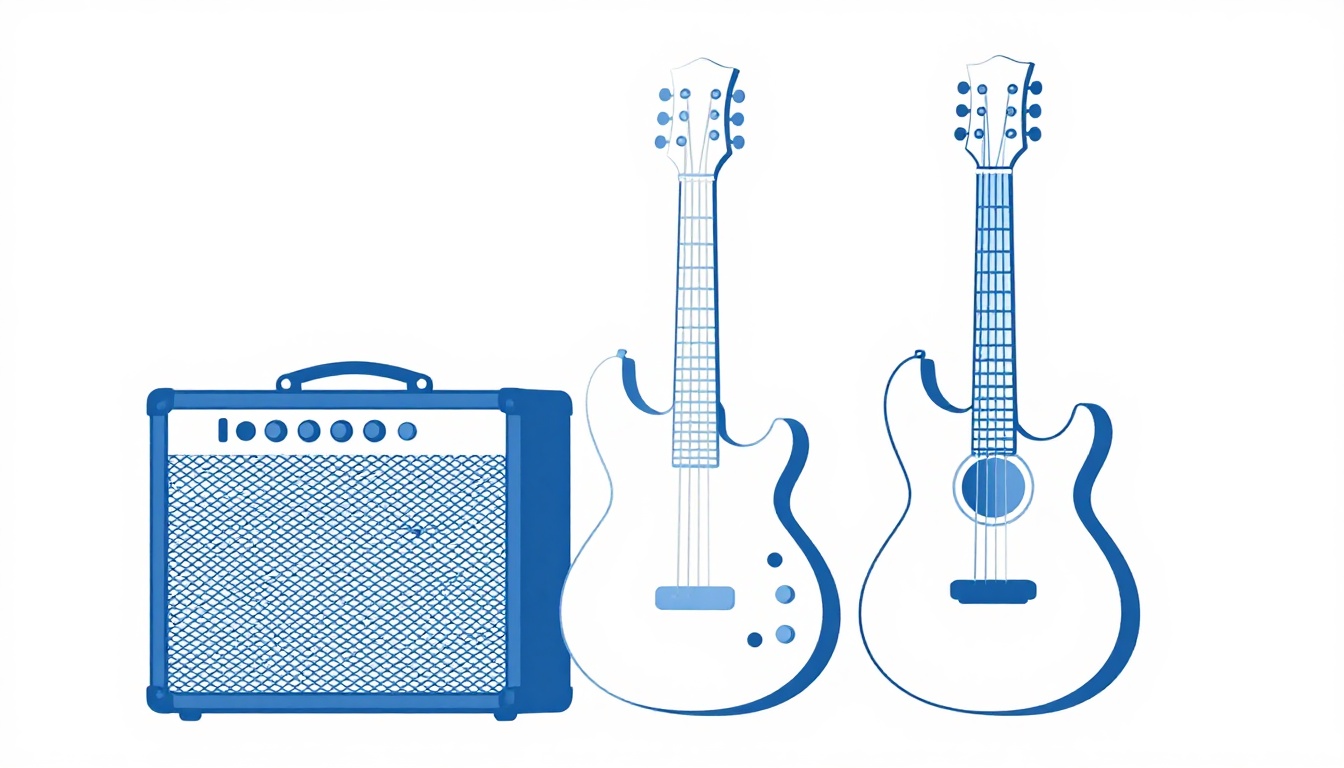
The 1976 studio recording layers a fingerpicked twelve string acoustic under a full band arrangement that eventually includes multiple electric guitars for the closing solo, but every chord shape in this post plays identically regardless of what instrument is in your hands. Nothing about Am, E7, G, D, F, C, Dm or their no-capo equivalents changes based on whether you are holding a steel string acoustic, a nylon string classical guitar, or an electric.
What changes is feel and texture. An acoustic guitar gets you closest to the fingerpicked intro and the general character of the verses, since that is the instrument the original demo and much of the finished recording were built around. A clean electric tone, played with a light touch and a touch of reverb, is a completely reasonable substitute and closer to what Joe Walsh and Don Felder used for the coda, though the rhythm chords underneath the verses and chorus were never meant to carry a heavy, distorted tone. If you only have an electric guitar available, back off any distortion for the chord sections of this song and save a more aggressive tone, if you have one, for attempting any part of the solo later on.
The Progression in Roman Numerals
Seeing this progression written as scale degrees rather than chord names makes the pattern easier to recognize the next time it shows up in a different key, since the shape of the movement, not the specific chords, is what repeats across songs.
| Chord (in B minor) | Roman numeral | Role |
|---|---|---|
| Bm | i | Tonic, the home chord |
| F#7 | V7 | Dominant, pulls back toward i |
| A | VII | Borrowed major chord, brightens the minor key |
| E | IV | Subdominant, built on the fourth degree |
| G | VI | Relative major's tonic, a common minor-key destination |
| D | III | Relative major of B minor |
| Em | iv | Minor subdominant, a darker color than plain E major |
What makes this loop distinctive is how far it wanders from the tonic before returning. Most simple pop progressions stay close to the i, IV and V chords. This one visits VII, VI and III, essentially touring through the relative major key of D before F#7 pulls everything back to Bm, which is a large part of why the progression feels like it is drifting rather than sitting still, even though it is built from entirely ordinary chords.
Strumming and Fingerpicking the Intro
The studio recording opens with a fingerpicked arpeggio pattern across the chord loop rather than a strummed one, which is part of what gives the intro its unhurried, unfolding feel before the full band enters. A simple starting pattern picks the bass note of each chord with your thumb, then rolls through the remaining strings with your index, middle and ring fingers in sequence, low to high, timed evenly rather than rushed.
Strumming the same progression works too, and is the more approachable starting point if fingerpicking is new to you. A steady down, down, up, up, down, up pattern in a relaxed 4/4 feel covers the verses comfortably. Save a fuller, slightly more energetic strum for the chorus, where the lyric itself opens up into the song's most direct, sung-along-with moment.
Reading This Song's Chords on a Chart
If you end up working from a printed or online chord chart for this song rather than the tables above, a few notation habits are worth recognizing so nothing on the page slows you down. A chord name written directly above a syllable in the lyric, the way "Bm" might sit over the word "on" at the start of the first line, tells you to change to that chord exactly on that syllable, not slightly before or after it. A colon followed by two dots facing a set of bars is a repeat sign, telling you to play that section again, which is how most charts notate the eight-chord loop covered throughout this post without writing it out separately for every verse. A number in parentheses after a repeated section, such as "(x2)," tells you exactly how many times to repeat it.
You may also see the progression written with a capo indicated at the top of the chart as "Capo II" or "Capo 2," which simply confirms the chart is giving you the easier shapes from this post rather than the real-key barre chords. If a chart gives chord names that do not match either version in this post exactly, check whether it lists a different capo position; some transcriptions place the capo at other frets and use different open shapes to reach the same B minor tonic, which is a valid alternative approach but will not match the specific shapes taught here note for note.
Playing Along With the Recording
Because the studio recording is in B minor with no capo, playing along with it directly means using the no-capo Bm, F#7, A, E, G, D and Em shapes covered earlier in this post. If you would rather use the easier capo 2 shapes, clip a capo onto your 2nd fret before playing along, and your Am, E7, G, D, F, C and Dm shapes will land at the same pitch as the record without any further adjustment.
What will not work is mixing the two approaches within a single pass through the song. Pick either the no-capo real-key shapes or the capo 2 open shapes for a given run-through, since switching between them mid-song means retraining your hand's sense of where each chord lives on the neck in real time, which is a much harder skill than either version on its own.
Changing Between Chords Is the Real Skill
Every shape in this post, whether you are using the capo 2 versions or the full no-capo barre chords, is something most players with a few weeks of practice can already form on its own. What actually determines whether this song sounds right is how cleanly and quickly you move between them, especially through the eight-chord loop that repeats under almost the entire song. Treat the individual shapes as the easy part and the transitions, particularly Am to E7 and F to C, as the thing worth the majority of your practice time.
How Long It Takes to Learn This Song
For a player who already knows a handful of open chords and has some barre chord experience, a clean run-through of the capo 2 version of "Hotel California" is realistic within one to two weeks of short daily practice, since only the F barre stands between that player and every shape in the progression. Add another week or so if you are also aiming to play the eight-chord loop up to the recording's actual tempo without hesitating on the Am-to-E7 or F-to-C changes.
For a newer player still building basic open chords from scratch, or for anyone working toward the full no-capo version with its two barre chords, expect the timeline to stretch closer to four to six weeks. Barre chords in general take longer to feel natural than open chords do, and this song asks for two of them in the harder version rather than the one the capo 2 version requires. Either way, the fastest path through is the same one covered throughout this post: isolate whichever single chord or change is genuinely difficult for your hands specifically, drill it slowly on its own away from the rest of the song, and only fold it back into a full run-through once it holds up on repeat.
Singing and Playing at the Same Time
Once the chord loop and the chorus changes are solid on their own, singing along is usually the next real obstacle on this song, partly because the vocal melody phrases loosely against the chord changes rather than landing squarely on each one. Two things make this easier to build.
First, get the guitar part running close to automatically, so your strumming or fingerpicking hand keeps steady time even when your attention shifts toward the words. Trying to consciously think through each chord shape while also singing tends to make both halves suffer. Second, learn the vocal melody on its own, without the guitar, tapping or counting a steady beat as you sing it, until you know exactly where each phrase falls. Once each half is separately automatic, combining them becomes a matter of doing both slowly at first and gradually bringing the tempo up, the same way you would build any other new skill on the instrument.
Common Mistakes That Are Not About the Chord Shapes
Some of what makes this song sound off has nothing to do with fretting any individual chord correctly and everything to do with habits around the whole performance.
Treating the Intro as Filler
Because the intro is the same eight-chord loop that runs through the rest of the song, it is tempting to rush through it to get to the first verse. The intro is also the first thing most listeners recognize about this song, whether fingerpicked as on the original recording or strummed, and it deserves the same steady, unhurried tempo as everything that follows it.
Losing Dynamics Across a Six-Minute Song
The full album version runs six and a half minutes, considerably longer than most songs a beginner learns first, and it is easy to play every verse and chorus at exactly the same volume and intensity throughout. The recording itself builds gradually, with more instrumentation layered in as the song goes and the closing solo section as its clear peak. On a solo guitar, matching that shape means playing the first verse a little more quietly and simply, opening the sound up gradually through each repeat of the chorus, and letting your playing feel like it is building toward something rather than staying flat from the first bar to the last.
Stopping Completely on a Missed Change
A missed chord change during practice, particularly on the F barre or the Am-to-E7 move, is normal and expected this early. Stopping entirely to fix it trains your hands to expect an interruption every time that specific change comes up, which slows down learning the song as a whole more than an imperfect change ever would. Keep the tempo moving through a mistake, and treat the next repetition of the loop as the place the correction actually happens.
Practice Routine
Fifteen minutes spent deliberately on this song will get you further than the same fifteen minutes spent strumming through it from the top on every attempt.
Spend the first five minutes on the full eight-chord loop alone, no lyric, moving through Am, E7, G, D, F, C, Dm and E7 slowly with a metronome until the order is automatic. Spend the next five minutes isolating the F barre chord specifically, checking each string individually for buzz before folding it back into the loop. Spend the final five minutes on the chorus's F-to-C change, since it is the one transition the chorus repeats most often. Only once each piece is solid on its own should you try running the full song front to back, and it is completely fine to play it slower than the recording until every change lands cleanly.
Frequently Asked Questions
What key is "Hotel California" in?
B minor, on the original Eagles studio recording, played with no capo. Most guitarists play it instead with a capo on the 2nd fret, using Am, E7, G, D, F, C and Dm shapes that sound at the same pitch as the real key's Bm, F#7, A, E, G, D and Em.
Does the song really need a capo?
No, but it is the standard, widely used way to play it, including by the Eagles themselves during their 1994 Hell Freezes Over acoustic performance, where Glenn Frey played a twelve string with a capo on the 2nd fret.
What is the hardest chord in the song?
With a capo on, F is the one full barre chord in the progression and the most common sticking point. Without a capo, both Bm and F#7 are barre-based, which makes the no-capo version noticeably harder on the fretting hand overall.
How many chords does "Hotel California" actually use?
Seven distinct chords, repeated in a fixed loop: Bm, F#7, A, E, G, D and Em with a capo 2 equivalent of Am, E7, G, D, F, C and Dm. The chorus reuses the same seven chords in a shorter arrangement rather than introducing new ones.
Do I need to learn the famous guitar solo to play this song?
No. The coda solo played by Don Felder and Joe Walsh is a separate lead guitar arrangement layered over the same chord loop used throughout the rest of the song. You can play and sing the full song by continuing that same loop straight through the outro.
Who wrote "Hotel California"?
Don Felder wrote the music on a twelve string acoustic guitar, and Don Henley wrote the lyrics with Glenn Frey. It was released as the title track of the Eagles' 1976 album.
Is the intro strummed or fingerpicked on the original recording?
Fingerpicked. A simple thumb-and-fingers arpeggio pattern across the chord loop opens the song before the full band enters, though strumming the same progression is a fully valid alternative if fingerpicking is new to you.
Why does the progression feel like it never resolves?
Because it spends most of its time on chords borrowed from the relative major key, VII, VI and III in Roman numeral terms, before the F#7 chord pulls it back to the Bm tonic. That wide detour before returning home is a large part of why the loop feels like it is circling rather than settling.
What does the "steely knives" line refer to?
It is a deliberate nod to the band Steely Dan, confirmed by Glenn Frey in later interviews. Steely Dan had referenced the Eagles first in one of their own songs, and Henley and Frey wrote the line as a reply, part of a broader effort to write lyrics that worked by suggestion rather than plain statement.
How long is the full song?
The album version runs about six and a half minutes, including the roughly two-minute instrumental coda played by Don Felder and Joe Walsh. The single edit released in 1977 trims that down slightly to just over six minutes.
Is B minor a hard key for a beginner guitarist?
Not with a capo. The no-capo version does ask for two barre chords, Bm and F#7, which are genuinely more demanding than open shapes. With a capo on the 2nd fret, the entire song is playable using mostly open chords that most beginners already have from other songs, with only the F barre as a real obstacle.
GuitarLowKey
Ready for fifteen focused minutes?
Open the web app and train the change that is blocking your song.