
How to Read Bass Guitar Tabs for Beginners
How to read bass guitar tabs for beginners: the four lines, the fret numbers, every technique symbol you will see, and what tabs never tell you.
A bass tab is four horizontal lines, one per string, with numbers on them telling you which fret to press. The bottom line is your thickest string, the low E, and the top line is your thinnest, the G. Read the numbers left to right, press the fret shown, pluck the string it sits on, and you are playing the line. That is the whole system. Everything else in this post is the detail that turns "I can decode the numbers" into "I can actually play the song."
What a Bass Tab Actually Looks Like
Before the symbols and the exceptions, look at the shape of the thing. A basic four-string bass tab is drawn like this:
G|--------------------------------|
D|--------------------------------|
A|--------------------------------|
E|--------------------------------|
Four lines, each one labeled with the open string it represents, running left to right across the page. Nothing is happening yet because there are no numbers on it. The moment you add a number, you have a note:
G|--------------------------------|
D|--------------------------------|
A|--------------------------------|
E|--0-----3-----5-----3-----------|
That line says: play the open low E string, then the 3rd fret of the low E string, then the 5th fret, then back to the 3rd, in that order, moving left to right. Nothing here tells you which finger to use or how long to hold each note, and that is deliberate. Tab is a map of where, not a full script of how long or how hard. You will fill in the rest with your ears and, eventually, with instinct.
Standard tuning on a four-string bass, low to high, is E, A, D and G. Every tab you meet as a beginner assumes this tuning unless it says otherwise, so if a line you are trying to play sounds wrong in a way that reading the numbers correctly should not produce, check your tuning first.
How the Four Lines Map to Your Strings
The line at the bottom of the tab is your low E string, the thickest one, closest to the floor when the bass hangs on a strap. The line at the top is your G string, the thinnest one, closest to your chin. In between, from bottom to top, are A and D.
| Line position | String | Thickness | Standard pitch |
|---|---|---|---|
| Top | G string (1st) | Thinnest | G |
| 2nd from top | D string (2nd) | D | |
| 3rd from top | A string (3rd) | A | |
| Bottom | E string (4th, low E) | Thickest | E |
This mirrors what you see when you hold the bass and look down at the strings: the thick E is nearest the floor, the thin G is nearest your face, and the tab lines are stacked to match that view. It is not an arbitrary convention. Once you connect "top of the tab equals the string closest to my chin," the whole page stops being an abstract grid and starts being a picture of your own instrument.
The most common beginner slip is reading the lines upside down, assuming the top line must be the "first" string in the sense of "lowest," the way you might read the first line of a book. On a bass tab, top means highest pitch, not first in some numbered order. If a line you are reading suddenly sounds an octave or two off from what you expect, check that you have not flipped the strings in your head.
Reading Fret Numbers: Open Strings and Fretted Notes
A 0 on any line means play that string open, no finger pressing anywhere. Any other number tells you the fret to press, counted from the nut, the strip at the top of the neck where the strings meet the headstock.
Frets are numbered outward from the nut, so the 1st fret is the space closest to the headstock, and the numbers climb as you move down the neck toward the body. A 3 on the A string line means press the 3rd fret on your A string and pluck it. A 12 means the 12th fret, which on most basses lines up with a dot inlay and sits an octave above the open string.
| Number on the tab | What it means |
|---|---|
| 0 | Play the string open, no fret pressed |
| 1 to 4 | Play in the first few frets, closest to the headstock |
| 5, 7, 9, 12 | Common marker-dot frets, useful visual anchors |
| 12 | One octave above the open string |
You do not need to memorize every fret's pitch to start reading tab. You need to know that the number is a location, not a note name, and that the same number means a different pitch on every string, because each open string starts on a different note.
Fret Numbers vs Finger Numbers
A fret number and a finger number look similar on the page, a single small digit, and beginners often assume the number on the tab tells them which finger to use. It does not. The number on a bass tab is always a fret, a location on the neck, not an instruction about your fretting hand.
Finger numbering is a separate system, borrowed from standard guitar and bass teaching: 1 is your index finger, 2 is your middle finger, 3 is your ring finger, and 4 is your pinky. Some lesson materials add finger numbers above a tab as a teaching aid, usually in a different position on the line or in brackets, but plain community tabs almost never include them. Left alone, a tab expects you to work out a sensible fingering yourself, generally one finger per fret in a four-fret hand position, though there is no single correct fingering for every line.
| Symbol | System | Example meaning |
|---|---|---|
| A number on a string line | Fret | "5" means the 5th fret |
| 1, 2, 3, 4 near a note (when shown) | Finger | "2" means use your middle finger |
| T | Finger | Thumb, mostly used in slap notation |
If a tab you are reading suddenly has small numbers in brackets or above the staff that do not match the string layout, that is very likely finger guidance layered on top of the fret numbers, not a second set of frets to play.
Reading Left to Right: Order, Timing, and Stacked Notes
Tab reads the way English text reads: left to right, top of the page to the bottom of the page for a full song, one line of four strings at a time. Two numbers that sit side by side on a line are played one after another. Two numbers that sit stacked directly on top of each other, on different strings, are played at the same time.
G|----------2--|
D|----------2--|
A|--0--3-------|
E|-------------|
Reading this left to right: first the open A string alone, then the 3rd fret of the A string alone, then the D and G strings together at the 2nd fret, played as a single combined sound. That last pair is a two-note chord, uncommon on bass compared to guitar, but it does happen, especially in slap playing and in modern pop and funk lines.
Spacing between numbers is a rough visual cue for timing, more space usually meaning more time before the next note, but it is not a precise measurement the way sheet music is. Two tabs of the same song from two different transcribers can space the same rhythm completely differently. Treat spacing as a hint, not a metronome.
What Bass Tab Does Not Tell You
This is the part every ranking guide mentions in passing and then moves past too quickly, and it is the single biggest reason beginners get frustrated with tab. Tab tells you which fret and which string. It very often does not tell you how long to hold a note, when to rest, or how fast to play. Three separate gaps, three separate fixes.
It Rarely Shows Note Duration
Standard sheet music uses different note shapes, filled or hollow heads, stems, flags, to show exactly how long each note rings before the next one starts. Plain text tab, the kind you find on most tab sites, usually just shows you the order of the notes with dashes as filler. A dash is not a rest and not a held note; it is spacing, nothing more.
The fix is to listen to the actual recording while you look at the tab, not instead of it. Your eyes get the fret numbers, your ears get the rhythm. Play a phrase from the tab, then check it against the song, adjust, repeat. This is normal and every working bass player still does it.
It Often Skips Rests
Silence is part of a bassline as much as the notes are. A tab that just strings numbers together with no gap markers can make you assume a line is more constant than it actually is, when in reality the bassist is leaving space between phrases. If a bassline sounds sparse and grooving on the recording but the tab reads as one continuous run of numbers, trust the recording. The rests are there even when the page does not draw them.
It Says Nothing About Tempo
A tab has no built-in speed. The same string of numbers could be a slow ballad line or a fast punk line, and the page looks identical either way. Some tabs add a beats-per-minute number or a time signature like 4/4 at the top as a courtesy, but plenty do not. Set your own tempo from the recording, and if you are practicing a line before you can play it at full speed, slow it down evenly with a metronome rather than guessing at a rhythm that feels roughly right.
Counting Along When Rhythm Isn't Marked
Since plain text tab usually skips rhythm entirely, some transcribers add a simple counting line underneath the numbers to help, using the standard "1 and 2 and 3 and 4 and" count musicians use to feel eighth notes within a bar of four beats:
G|--------2-----------|
D|--------2-----------|
A|--0---3-------5-----|
E|---------------------|
1  &  2  &  3  &  4  &
Each number or "&" underneath lines up with a beat or half beat, giving you a rough grid to place the notes on even without formal note durations above them. Not every tab includes this, and when one does, treat it as a helpful approximation rather than an exact transcription, since the person adding it is estimating by ear the same way you would.
Where no counting line exists at all, build your own by listening to the recording and tapping your foot on the beat while you trace the tab with a finger. Once you can feel where beat one falls in the recording, you can usually place the rest of a short phrase around it even from bare numbers.
Time Signatures Other Than 4/4
Most tabs you meet as a beginner are in 4/4 time, four beats to a bar, which is why the counting examples in this post use "1, 2, 3, 4." Not every song sits in 4/4, and a tab's header will usually say so when it does not, most often as a fraction like 3/4 or 6/8 next to the tempo.
A 3/4 bar has three beats instead of four, the feel behind a waltz, and you count it "1, 2, 3" instead of "1, 2, 3, 4" before the pattern repeats. A 6/8 bar groups six eighth notes into two larger pulses of three, giving a rolling, swaying feel common in some ballads and folk-influenced basslines. The tab itself, string lines and fret numbers, looks identical regardless of time signature. The only difference is where the bar lines fall and how you count between them, both of which come from the header, not from the numbers themselves.
If a bassline feels like it never quite lands where you expect it to, and repeating "1, 2, 3, 4" against it feels wrong no matter how you shift it, check the header for a time signature other than 4/4 before assuming you are misreading the tab.
Reading the Tab Header: Tuning, Tempo, and Song Info
Most full-song tabs open with a short header block above the first line of numbers, and it is worth reading before you play a single note. A typical header lists the song title and artist, the tuning the tab assumes, and sometimes a tempo in beats per minute or a time signature such as 4/4 or 3/4.
The tuning line matters more than it looks. Most bass tabs assume standard tuning, E, A, D and G low to high, but plenty of rock and metal tabs are written for a bassist who tuned down.
| Tuning name | Strings, low to high | Common in |
|---|---|---|
| Standard | E, A, D, G | Most genres |
| Drop D | D, A, D, G | Rock, metal |
| Half step down | Eb, Ab, Db, Gb | Some rock, blues |
| 5-string standard | B, E, A, D, G | Metal, modern gospel and funk |
If a tab's header says Drop D and you try to play it in standard tuning, every note will be a full step off in places, and no amount of careful reading will fix that, because the problem is upstream of the numbers. Always match your tuning to the header before you decide the tab itself is wrong.
Dynamics and Note Choice: What Tab Leaves to Your Ear
Beyond rhythm, tab is also silent on dynamics, how loud or soft a note is played, and on articulation, how a note is attacked and how long it is allowed to ring before the next one cuts it off. A bassist might play the first note of a phrase strongly and let the rest trail off quietly, or dig in hard on the beat before a chorus to push the energy up, and none of that shows up as anything other than identical numbers on the page.
This is another place where listening alongside reading pays off. A line that sounds flat and mechanical when you play it exactly as the fret numbers suggest often comes alive once you copy the dynamic shape you hear in the recording, louder here, softer there, a slight push on the beat before the next section starts. Tab gets you to the right notes. The recording is still where the feel comes from.
Common Symbols and What They Mean
Beyond plain fret numbers, tab uses a small alphabet of letters and punctuation marks to show technique, the physical thing your hands do to produce a note, not just where. These symbols are close to universal across tab sites, though minor variations exist, so check a tab's own key or legend if one is provided.
Hammer-Ons (h)
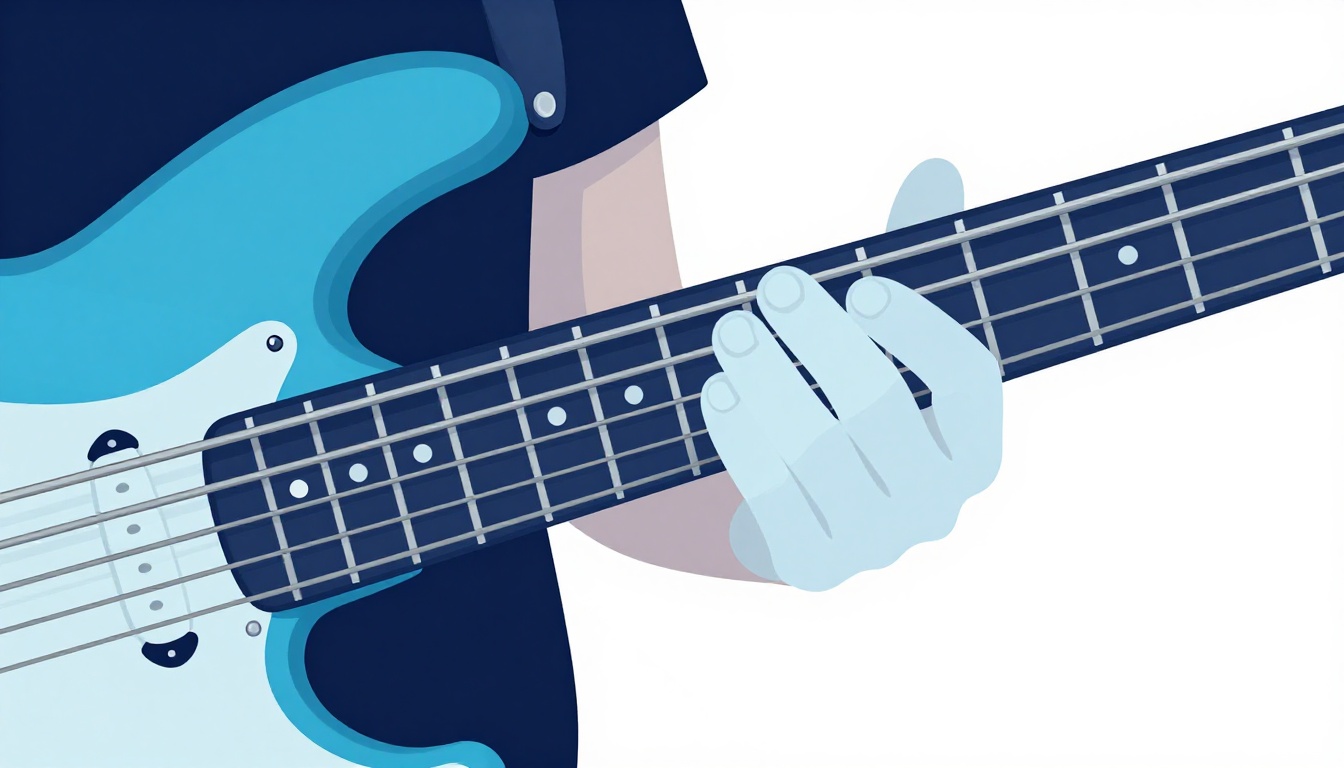
A hammer-on is fretting a note by striking the string with a fretting finger hard enough to sound the pitch, without plucking again. In tab it is written between two numbers on the same string, lowest to highest: 3h5 means pluck the 3rd fret, then hammer onto the 5th fret with another finger, no second pluck.
Pull-Offs (p)
A pull-off is the reverse: you are already fretting a higher note, and you release it with a slight downward flick, letting the string ring at a lower fret or open, without plucking again. Written 5p3, meaning you are already sounding the 5th fret and you pull off to the 3rd fret, still ringing from the same original pluck.
Hammer-ons and pull-offs are how basslines get their smoothness and their speed. A line full of separately picked notes sounds mechanical compared to the same line played with a few well-placed hammers and pulls, which is also why fast basslines almost always use them rather than picking every single note.
Slides (/ and \)
A forward slash means slide up in pitch, a backslash means slide down. 3/5 means fret the 3rd fret, pluck it, then slide your finger up to the 5th fret while it keeps ringing, without plucking again. 5\3 is the same motion in reverse, sliding down.
Slides are common at the start or end of a phrase, connecting one section of a bassline to the next with a smooth glide rather than a clean jump.
Bends (^ or b)
A bend means pushing or pulling the string sideways across the fret to raise its pitch without moving to a different fret. It is far less common on bass than on lead guitar, because thicker bass strings resist bending and the low pitches make small bends harder to hear clearly, but it does show up, especially in blues and rock basslines. Notation varies by tab site: a caret (^) above a number, or a "b" written after it, both mean bend.
Ghost Notes and Dead Notes (x)
An x on a tab means a muted, percussive note with no clear pitch: you rest your fretting hand lightly on the strings, enough to stop them ringing a real note, then pluck anyway, producing a click or thud instead of a tone. This is a real, deliberate part of a bassline's groove, not a mistake, and funk and slap basslines lean on it heavily.
Some tabs distinguish a full dead note (x) from a quieter ghost note written in parentheses, meaning play it, but much softer than the notes around it. Both exist to add rhythmic texture without adding melodic content.
Slap and Pop (S and P beneath the line)
Slap and pop is a bass-specific technique with no real guitar equivalent, which is part of why it gets its own notation. A capital S below the string line means strike that string with the side of your thumb, typically the low E or A string, producing a percussive, low thump. A capital P below the line means pop, hooking a finger under a higher string, usually the D or G, and snapping it away from the fretboard so it cracks back against the frets.
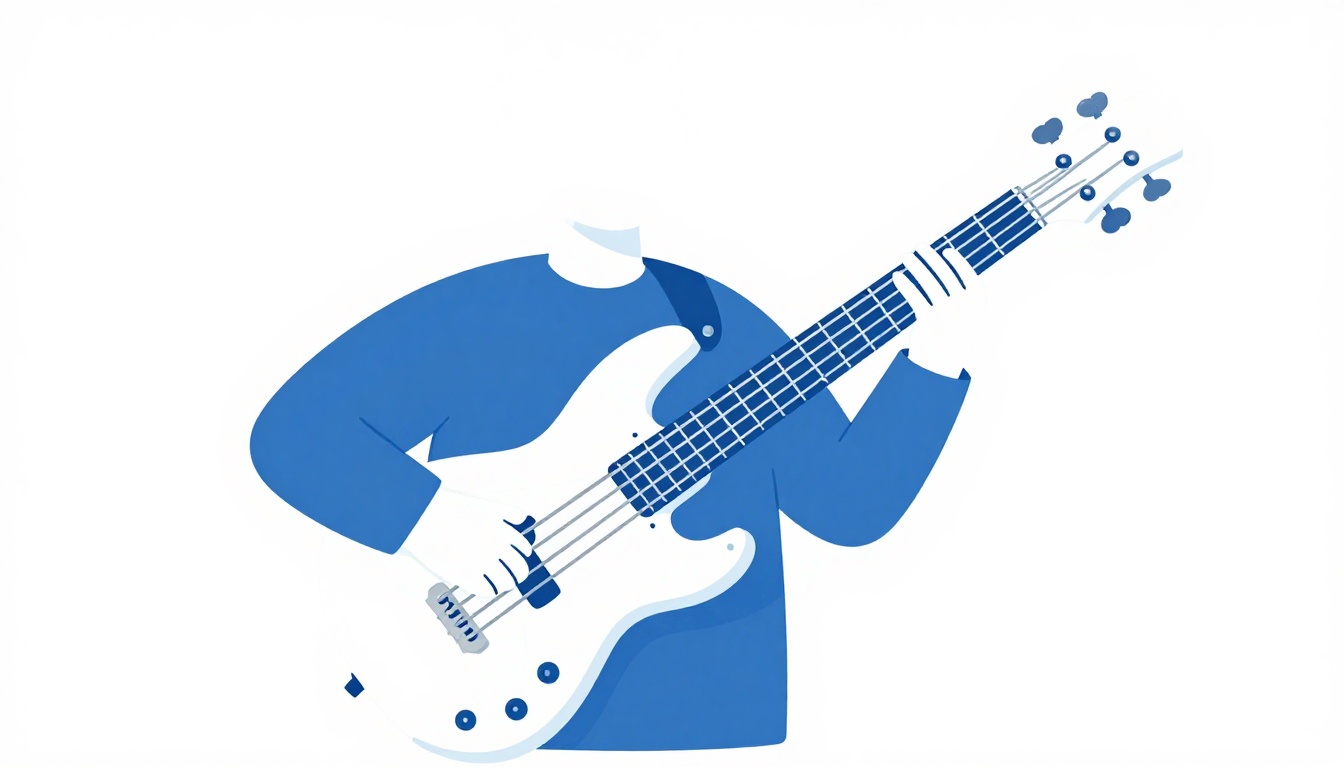
Slap and pop tabs read the same as regular tabs underneath, string and fret number, with the S or P added above or below to say how to strike that particular note. It is worth learning to recognize even before you can execute it cleanly, since it explains the punchy, percussive sound in a lot of funk and pop basslines that plain fingerstyle playing cannot reproduce.
Vibrato (~)
A tilde after a note means vibrato, a small, rapid wobble of pitch created by rocking your fretting finger back and forth while the note rings. It adds warmth and sustain to a held note, most useful on longer notes at the end of a phrase where the note has time to breathe.
Palm Muting (P.M.)
Written as "P.M." followed by a dashed line over the affected notes, palm muting means resting the edge of your plucking hand lightly across the strings near the bridge while you play, shortening the notes and giving them a tighter, thumpier sound. It is common in rock and punk basslines where a driving, muted eighth-note pulse is part of the song's identity.
Bar Lines, Repeats, and Reading a Full Line
A vertical line running through all four strings marks the end of a measure, called a bar, a fixed chunk of time, most often four beats in common time. Bar lines help you keep your place and count along, even without formal rhythm notation, because you can count "1, 2, 3, 4" evenly across the notes between two bar lines and get a rough sense of how they should land.
Two vertical lines close together, one thin and one thick, usually mark the end of a whole section or the song. A colon next to a bar line, like :| or |:, marks a repeat, telling you to go back and play the section again before moving on. Some tabs also write "x2" or "x4" above a section instead of using repeat marks, meaning play that chunk that many times through.
Longer tabs are almost always broken into labeled sections, verse, chorus, bridge, so you can find your place in a full song rather than reading one unbroken wall of numbers. When you sit down with a new tab, scan for these labels first and get a sense of the song's shape before you play a single note.
More detailed tabs, especially ones generated from Guitar Pro files, sometimes show a curved line connecting two identical fret numbers on the same string. That is a tie, telling you the first note is held through into the second beat rather than plucked again, a piece of rhythmic detail that plain text tab usually cannot show at all.
Five-String and Six-String Bass Tabs
Everything so far assumes a standard four-string bass, but a meaningful share of tabs online are written for five-string basses, which add a fifth line at the bottom of the tab for a low B string, tuned a fourth below the low E: B, E, A, D, G, low to high. That extra string is drawn as an additional line below the E, so a five-string tab looks like the four-string layout with one more row underneath.
G|------------------|
D|------------------|
A|------------------|
E|------------------|
B|--0-----3----------|
Six-string basses go a step further, adding both that low B and a high C string above the G, for six lines total. The reading rules do not change at all: bottom is still lowest, top is still highest, numbers are still frets. The only difference is more strings to track visually.
If you play a standard four-string bass and come across a tab with a fifth line at the bottom, you have two options: skip the notes written only on that B-string line, since your instrument cannot reach them, or shift the whole line up a string, playing the same fret pattern one string higher, which usually gets you close to the same shape, just voiced differently. Either works. Neither is "correct" in an absolute sense, since the tab was written for a different instrument than the one in your hands.
Note-for-Note Tabs vs Simplified Chord Charts
Not everything labeled a bass tab is a full note-for-note transcription. Some tab sites, especially for pop and worship music, publish simplified versions that give you the root note of each chord rather than the bassist's actual line, useful for playing along quickly but not accurate to the recording. A note-for-note tab tries to capture every note the original bassist played, including fills, slides, and rhythmic detail. A simplified or "chord tone" version gives you a serviceable line built from the chord changes, often just the root on beat one of each chord.
Neither is wrong, they serve different goals. If a tab you are learning sounds noticeably plainer or more repetitive than the recording, especially during a chorus or bridge where the real bassline gets busier, you may be looking at a simplified version rather than a full transcription. Checking the tab's description or comments, where many sites let contributors note "simplified" or "chords only," saves you the confusion of assuming you are misreading it.
Tab vs Standard Notation: Why Bass Players Lean on Tab
Standard notation, the five-line staff with note heads and stems, tells you exact pitch and exact duration, but it does not tell you where on the neck to play a note, and on bass, as on guitar, the same pitch often exists in more than one place. Tab solves that problem directly: it tells you exactly where to put your fingers, which is the part a beginner actually gets stuck on.
The trade-off is real. Tab's silence on rhythm is the price you pay for its clarity on fingering, and that is why the two systems often appear together on professional transcriptions, standard notation on top showing the rhythm, tab underneath showing the fret. If you only have plain text tab, you are supplying the rhythm half yourself, from your ears, every time. That is not a flaw in you or in tab as a system. It is simply what tab was built to do and not do.
Where to Find Tabs You Can Trust, and How to Catch a Wrong One
Community tab sites like Ultimate Guitar and Songsterr host the largest libraries and let other players rate a tab's accuracy, which is worth checking before you invest time learning one, since anyone can submit a tab and quality varies. A tab with a high rating and a lot of votes from other users is a reasonable starting point. A tab with no ratings at all is a coin flip.
The real test is always your ears against the recording. Play a phrase, then listen to the same moment in the song, and ask whether what you played matches what you heard. If it does not, the tab may be wrong, or you may be misreading it, and either way the fix is the same: find an isolated bass track or an ear-training video of someone playing along with the recording, and use it to confirm the fret numbers you are unsure about. Treat every tab as a first draft you verify, not a finished answer you accept on sight.
Tab Apps and Interactive Players
Plain text tab, the kind formatted with dashes and letters like the examples in this post, is only one format. Interactive players such as Songsterr display a similar string-and-fret layout but sync it to audio playback, moving a cursor across the notes in time with the song so you can see the rhythm you would otherwise have to guess at. Many of these tools also let you slow playback down without changing the pitch, which is one of the most useful practice aids available for a beginner working through a line that is too fast to read at full speed on a first pass.
Software such as Guitar Pro takes this further, storing tab in a file format that includes real rhythmic information, note duration, rests, and tempo, alongside the fret numbers, closer to a full transcription than plain text tab can offer. These files play back through the software itself, so you both see and hear an accurate rhythm rather than reconstructing one from spacing and guesswork.
None of this replaces the core skill this post is about. Whichever format you are looking at, you are still reading lines for strings and numbers for frets. Interactive tools simply fill in the timing gap that plain text tab leaves open, which makes them worth using once you have the basics down, especially for a song whose rhythm is hard to pin down by ear alone.
Common Beginner Mistakes When Reading Bass Tab
Confusing String Order
Reading the top line as the low E instead of the G is the single most common early mistake, because it is a natural assumption if you have never had it explained. If a line you are playing sounds wrong by roughly an octave, or the melody feels inverted, this is the first thing to check.
Ignoring Rests the Tab Never Drew
Plain text tab strings numbers together with no visual gap for silence, so beginners often play a line faster and more continuously than the recording actually calls for. Listen for the space in the bassline, not just the notes.
Skipping the Ear Check Entirely
Treating a tab as gospel rather than a best guess means any error in the transcription becomes an error you learn and repeat. Five minutes with the actual recording playing alongside your practice catches most of these before they become a bad habit.
Rushing Past Technique Symbols
Playing an h or a p as a separately picked note instead of an actual hammer-on or pull-off changes the whole feel of a line. It is a small difference on paper and a large one to the ear, since the smoothness of a bassline often lives entirely in those connecting techniques.
Practicing at the Recording's Full Speed From Day One
A tab gives you no tempo guardrails, so it is easy to try to match a fast recording immediately, get frustrated, and quit the phrase. Slow it down with a metronome, nail the fret order and the technique symbols cleanly, then bring the speed up in small steps.
Not Muting the Strings You Are Not Playing
A tab only tells you what to play, not what to silence, and a beginner's other fingers often rest against unused strings without realizing it, letting them ring or buzz underneath the intended note. Get in the habit of letting your fretting hand's unused fingers lightly touch the strings you are not using, muting them by default, especially on the strings above the one you are currently playing.
Assuming the Tuning Without Checking
Playing a tab written for Drop D or a five-string bass on a standard-tuned four-string, without adjusting, produces notes that are wrong in a way that has nothing to do with misreading the numbers. Check the header for a stated tuning before you decide a tab itself is inaccurate.
Reading Your First Line: a Worked Example
Here is a short practice line, written to illustrate the ideas above rather than copied from any particular song, so you can walk through it slowly without worrying about matching a recording yet.
G|--------------------------|
D|--------------------------|
A|--0-----3--5h7-------7p5--|
E|----------------3----------|
Read it left to right. Start on the open A string. Move to the 3rd fret of the A string. Hammer from the 5th fret to the 7th fret on the A string, without a second pluck. Drop to the 3rd fret of the low E string. Come back up and pull off from the 7th fret to the 5th fret on the A string. Every motion in that line is something this post has already covered: an open string, fretted notes, a hammer-on, a string change, a pull-off. Play it slowly, one motion at a time, before you try to connect it into a single smooth phrase.
How Basslines Read Differently Across Genres
The same tab-reading rules apply everywhere, but what the numbers tend to look like shifts noticeably by genre, and knowing what to expect helps you sanity-check a tab before you have even played it.
Rock and Pop
Rock basslines lean heavily on root notes and fifths, often locked tightly to the kick drum, so tabs in this style tend to show a lot of repeated single notes on one or two strings with a steady, even rhythm. If a rock tab looks unusually busy or spread across all four strings for a verse, it is worth a second look against the recording.
Reggae and Ska
Reggae basslines are built around space as much as notes, often landing on the off-beats rather than beat one, with long gaps where the tab reads as rests even though nothing marks them explicitly. A reggae tab that looks continuous and unbroken is a strong sign the transcriber compressed the rhythm and left the actual silences for you to hear yourself.
Funk
Funk basslines are syncopated and often built around slap and pop technique, so funk tabs are where you will see the S and P markers most often, along with a higher density of ghost notes and dead notes than other genres typically use.
Jazz
Walking jazz basslines move in a steady stream of quarter notes, one per beat, climbing and descending through a scale or arpeggio to connect one chord to the next. A jazz tab often looks deceptively simple, evenly spaced single notes, but the skill is in the note choices, not in any technique symbol.
Fills and Turnarounds in Tab
A fill is a short burst of extra notes a bassist plays to bridge two sections of a song, typically at the end of a verse or right before a chorus, and it is one of the places where tabs are most likely to feel harder to read than the surrounding line. Fills often move faster, cover more frets, and lean more heavily on hammer-ons, pull-offs, and slides than the steady groove around them, packing several techniques into a short space.
If a tab suddenly gets denser for one bar and then returns to something simpler, that bar is almost certainly a fill. Treat it as its own short phrase to isolate and slow down, rather than trying to read it at the same tempo as the surrounding groove on a first pass. Fills are also the part of a bassline most likely to vary between two different transcriptions of the same song, since a live or alternate recording often has a different fill than the studio version a tab was built from.
Easy Songs Bass Beginners Use to Practice Reading Tabs
Once the symbols feel familiar, the fastest way to get comfortable with real tab is to apply it to songs simple enough that a wrong note is obvious the moment you hear it.
| Song | Artist | What makes it a good first tab |
|---|---|---|
| Wicked Game | Chris Isaak | Sits almost entirely on the low E string with a simple, repeating shape |
| Three Little Birds | Bob Marley and the Wailers | A repetitive reggae line, forgiving for a first attempt |
| Message in a Bottle | The Police | A simple, recognizable line, so a wrong note is obvious by ear |
| 21 Guns | Green Day | A steady, driving line without fast technique to worry about yet |
None of these need slap, fast hammer-ons, or wide stretches to sound right, which makes them good proving ground for reading tab cleanly before speed or technique become the limiting factor. Search any of them by name on a community tab site, compare a couple of versions if more than one is available, and check them against the recording as you go, the same verification habit covered earlier in this post.
Weaning Off Tab: Reading Ahead and Playing by Ear
Tab is a starting point, not a permanent crutch, and most bassists gradually need it less as their ear develops. Two habits speed that shift along.
The first is reading ahead of where your hands are, the same skill a fluent reader uses on a page of text, glancing at the next few notes while your hands are still playing the current one, rather than reading and playing one number at a time. This takes deliberate practice, but it is what makes reading tab at performance speed possible at all, since reading strictly one note at a time will always lag behind the music.
The second is trying to work out a short, simple line by ear before you look at the tab at all, then checking your guess against the transcription. Even getting it partly wrong is useful, because it trains the connection between what you hear and where it lives on the neck, the exact skill that eventually lets you play along with a song that has no tab written for it yet.
Connecting Tabs to the Notes on the Neck
A fret number on a tab only means something once you know what note it actually is, and that mapping is worth learning even though tab does not require it up front. If you have not already, learning where the natural notes sit on all four strings turns "press the 3rd fret" into "that's a C," which makes it far easier to spot when a tab looks wrong, transpose a line into a different key, or eventually play by ear instead of by page.
From Tabs to Scales and Basslines
Tab shows you exactly where a bassline's composer chose to place their fingers, but most basslines are built from a small handful of scale shapes moved around the neck. Once reading tab feels comfortable, learning the small set of movable bass scale shapes is what lets you start writing your own lines instead of only reproducing ones you have read.
A Practice Routine for Learning to Read Tab Today
Pick one short tab, four to eight bars, of a song you already know well by ear. Read through it once without your bass in hand, just tracing the numbers with a finger and saying the string and fret out loud, "A string, third fret, hammer to fifth." Then pick up the bass and play it at a slow, even tempo, checking each note against what you said. Play it five times slowly before trying it any faster. Finally, play along with the actual recording at a reduced speed if your player supports it, and only move to full speed once the slow version is clean and matches what you hear.
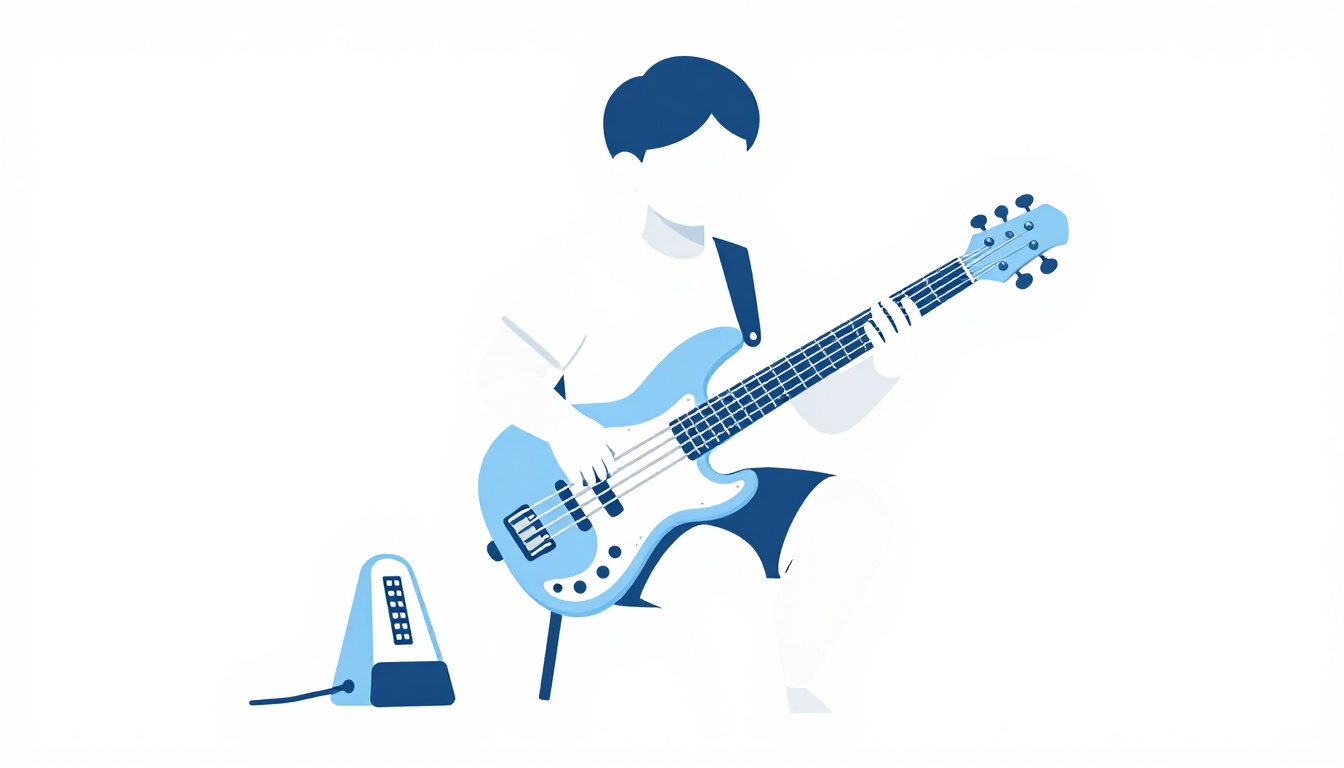
Fifteen minutes of this, done daily, builds tab literacy far faster than an hour once a week, because the pattern recognition, seeing a hammer-on symbol and immediately knowing what your hand should do, comes from repetition, not from a single long session.
FAQ
Do I need to know music theory to read bass tab?
No. Tab tells you exactly which string and fret to play, so you can follow it correctly without knowing note names, scale degrees, or key signatures. Theory becomes useful later, when you want to understand why a line works or write your own, but it is not a requirement to start reading tab today.
Why does the same tab sound different when two people play it?
Because plain text tab usually leaves out rhythm and dynamics. Two players reading the identical fret numbers can land on different timing, different note lengths, and different accents unless they are both cross-checking against the same recording.
Is tab less accurate than standard notation?
It answers a different question. Standard notation is precise about pitch and duration but silent about fingering position. Tab is precise about fingering position but usually silent about duration. Neither is strictly more accurate, they are built for different information.
Can I learn slap bass just from reading tabs?
You can learn where the notes and the S and P markers fall from tab, but slap and pop is a physical technique that depends heavily on hand motion, thumb angle, and timing that a page cannot fully convey. Pair slap tabs with a video of the technique so you can see the motion, not just the fret numbers.
What does a number in parentheses mean on a bass tab?
Most commonly a ghost note, a note played much quieter than the notes around it, adding rhythmic texture without standing out melodically. Some tabs also use parentheses to show a note that rings on from an earlier string change rather than being freshly plucked, so check a tab's legend if one is given.
How do I know if a tab I found online is wrong?
Play it slowly alongside the actual recording and listen for mismatches. A tab with a strong accuracy rating on a community site like Ultimate Guitar or Songsterr is a reasonable starting point, but your own ear against the recording is the only real confirmation.
Do all bass tabs use the same symbols?
The core symbols, h for hammer-on, p for pull-off, slashes for slides, x for dead notes, are close to universal, but small variations exist between tab sites and individual transcribers. Look for a legend at the top of a tab if a symbol you see is not one covered here.
Why is the low E string drawn at the bottom instead of the top?
Because the tab is drawn to match what you see looking down at your own bass while you play it, thick low E string closest to the floor, thin G string closest to your chin. The layout mirrors the instrument rather than following a numbered order.
I only have a four-string bass. Can I still use a five-string tab?
Yes, with one adjustment. Skip any notes written only on the bottom B-string line, since your bass cannot reach them, or shift that whole part of the line up one string, playing the same fret pattern a string higher, which usually lands close to the original shape.
What is the difference between a bass tab and a bass chord chart?
A tab gives you the exact fret and string for every note the bassist played, including fills and rhythmic detail. A chord chart just lists the chord names for a song, leaving you to build your own bassline from the chord tones. Tab is more specific and easier to follow exactly; a chord chart demands more theory but teaches you to construct a line yourself.
How long does it take to get comfortable reading bass tab?
Most beginners can decode the basics, string lines, fret numbers, open strings, within a single practice session. Reading fluently, at speed and without stopping to work out each number, tends to take a few weeks of regular short sessions, since it depends on pattern recognition building up through repetition rather than on memorizing a rulebook.
GuitarLowKey
Ready for fifteen focused minutes?
Open the web app and train the change that is blocking your song.