
Bossa Nova Chords for Guitar: The Shapes and the Groove
The open and moveable bossa nova chords for guitar, the half-diminished shape the style leans on, and the rhythm that makes them sound Brazilian.

Bossa nova chords on guitar are almost always seventh chords, not the plain major and minor triads you strum in folk or pop, and the four you need first are Am7, Dm7, G7, and Cmaj7. Play them in that order, once each, and you already have a loop that sounds like the opening bars of half the Brazilian songbook. The rest of this post is what turns that loop from "correct" into "bossa nova": the full open-position chord set, the moveable shapes that let you play any of them in any key, the half-diminished chord the style depends on, and the specific thumb-and-finger rhythm pattern that no chord chart on its own will teach you. Read straight through and you will come out the other side able to play the chords, name what they are doing, and place your hand on your guitar the way the style actually asks you to.
The Four Chords to Start With Today
These four shapes are all open position, meaning no barre, and together they form one of the most common chord loops in the bossa nova and jazz repertoire, a vi-ii-V-I in the key of C major.
| Chord | 6th string (low E) | 5th string (A) | 4th string (D) | 3rd string (G) | 2nd string (B) | 1st string (high E) |
|---|---|---|---|---|---|---|
| Am7 | Muted | Open | 2 (finger 2) | Open | 1 (finger 1) | Open |
| Dm7 | Muted | Muted | Open | 2 (finger 2) | 1 (finger 1, barre) | 1 (finger 1, barre) |
| G7 | 3 (finger 3) | 2 (finger 2) | Open | Open | Open | 1 (finger 1) |
| Cmaj7 | Muted | 3 (finger 3) | 2 (finger 2) | Open | Open | Open |
Play each chord for one full bar, four beats, moving to the next only when it feels settled under your fingers. Once that loop is comfortable, strum it slowly and notice something: every chord shares at least one open string with the next, which is exactly why this progression sits so well on guitar. Am7 and Dm7 both leave the high E string open. Dm7 and G7 both leave the B string mostly untouched. That overlap is not an accident of these four chords specifically, it is the reason bossa nova and jazz guitarists gravitate toward seventh chords built from nearby shapes rather than jumping between unrelated ones.
Where This Chord Vocabulary Comes From
Bossa nova took shape in Rio de Janeiro in the late 1950s, when guitarist and singer Joao Gilberto reworked the driving, percussion-heavy rhythm of samba into something quieter and more intimate, suited to a single voice and a nylon-string guitar rather than a full percussion section. Composer Antonio Carlos Jobim supplied much of the harmony for that new sound, and he wrote it using the vocabulary of American jazz, seventh chords, extensions, and borrowed chords from outside the home key, rather than the simpler triads that samba and other Brazilian popular music had used before.
That history is the direct answer to why bossa nova guitar chords look and sound the way they do. The rhythm is Brazilian, adapted from samba and scaled down for one guitarist playing alone. The harmony is largely borrowed from jazz, which is why learning bossa nova chords and learning basic jazz chords overlap so heavily, and why a half-diminished chord or a tritone substitution shows up in a Jobim song as readily as it does in an American jazz standard. Knowing that background is not required to play the chords correctly, but it does explain why a style that sounds so relaxed on the surface is built from harmony this detailed underneath.
What Actually Makes a Chord Sound Like Bossa Nova
A plain C major chord is three notes, the root, the 3rd, and the 5th. Bossa nova harmony, borrowed from jazz, almost always adds a fourth note, the 7th, and frequently a fifth, an extension like a 9th or a 13th. That extra color is not decoration. It is the difference between a chord that just names the key and a chord that tells you where the harmony is heading next.
Four chord types cover almost everything you will meet in a bossa nova chart:
- Major 7 (maj7): the "at rest" chord, used for the tonic, the chord a progression resolves to. Cmaj7, Fmaj7.
- Minor 7 (m7): relaxed and a little dark, used for minor tonics and for the "ii" chord in a ii-V-I. Am7, Dm7.
- Dominant 7 (7): the chord with forward motion, it wants to resolve down a fourth. G7 wants to resolve to C. A7 wants to resolve to D.
- Half-diminished (m7b5): minor and unsettled at the same time, almost always used as the "ii" chord in a minor key. Covered in full further down.
Learn to hear which of these four a chord is, rather than memorizing chord names one at a time, and unfamiliar bossa nova charts stop looking like a wall of new shapes. They start looking like four families you already know, transposed to a new root. Every chord shape and every song example later in this post is built from one of these four families, so this short list is worth committing to memory before anything else.
What the 9ths and 13ths You'll See Later Actually Are
Once you start reading real bossa nova arrangements rather than simplified lead sheets, you will run into chord names like D9, Gm7b13, or Cmaj9. These look intimidating, but they are built the same way the 7th was built onto a plain triad: one more note, stacked in thirds, added on top of a chord you already know.
A 9th chord is a 7th chord with the 9th degree of the scale added above it. A 13th chord adds the 13th degree the same way. Neither one changes whether the chord is major, minor, or dominant, it only adds a color tone on top, which is why a lead sheet will often let you substitute the plainer 7th chord for its extended cousin without the harmony sounding wrong. If a chart calls for D9 and you only know D7, playing D7 is not a mistake, it is simply a slightly less colorful version of the same chord doing the same job in the progression.
Treat every extended chord you meet this way at first: identify which of the four families from the previous section it belongs to, play the plain 7th version confidently, and only chase down the exact extended voicing once the plainer version is second nature. Chasing every extension by ear before the underlying chord families are solid is how a lot of players get stuck, since the extension is decoration on a structure they have not built yet.
This matters more in bossa nova specifically than in a lot of other guitar styles, because Brazilian composers writing on piano had all ten fingers available and reached for rich extended chords freely, in a way a guitarist reading the same chart from a fake book has to translate down to what six strings and four fingers can actually cover. Simplifying a written D9 to a D7 is not cutting a corner, it is doing on guitar what the composer would expect any single melodic instrument to do with a chord voiced for piano.
The Open-Position Bossa Nova Chord Set
Beyond the four starter chords, these five open-position seventh chords come up constantly in bossa nova songs, especially anything played or sung in the keys of C, G, D, A, or E.
| Chord | 6th string | 5th string | 4th string | 3rd string | 2nd string | 1st string |
|---|---|---|---|---|---|---|
| Em7 | Open | 2 (finger 2) | Open | Open | Open | Open |
| A7 | Muted | Open | 2 (finger 2) | Open | 2 (finger 3) | Open |
| D7 | Muted | Muted | Open | 2 (finger 3) | 1 (finger 1) | 2 (finger 2) |
| E7 | Open | 2 (finger 2) | Open | 1 (finger 1) | Open | Open |
| Fmaj7 | Muted | Muted | 3 (finger 3) | 2 (finger 2) | 1 (finger 1) | Open |
Em7 is the easiest seventh chord on the neck: play an open Em chord and lift your ring finger off the G string, leaving one finger down. A7 and D7 both come from adding a single fretted note to a shape you likely already know, A major and D major. E7 does the same to open E. Fmaj7 is the odd one out, since standard F needs a barre, but this no-barre version gives you the maj7 sound with three fingers and no wrestling with the low strings at all.
Between this set and the four starter chords, you can now play in the two most common bossa nova keys, C major and its relative, A minor, without a single barre chord.
Moving Those Shapes Anywhere on the Neck
Open chords only exist in a handful of keys. The moment a bossa nova song is in Eb, F, or Bb, which happens often since these tunes were mostly written on piano, you need shapes that move. The fix is the same one jazz guitarists use: strip the chord down to just the root, the 3rd, and the 7th, played on the 5th, 4th, and 3rd strings, and mute everything else.
| Chord type | 5th string (root) | 4th string (3rd) | 3rd string (7th) |
|---|---|---|---|
| Major 7 | fret R | one fret below R | one fret above R |
| Dominant 7 | fret R | one fret below R | same fret as R |
| Minor 7 | fret R | two frets below R | same fret as R |
Find the root on the 5th string, apply the formula for the chord quality you need, and you have a compact, moveable version of any Cmaj7, Dm7, or G7 anywhere on the neck. This three-note "shell" is the backbone of how jazz and bossa nova guitarists actually comp through a song, since it moves fast and never buzzes the way a full six-string shape does further up the neck. Jazz Chords for Guitar covers this shape in full, including the version rooted on the 6th string, if you want the complete picture.
Worked out on a chord with no easy open-position version, Fmaj7 with its root at the 8th fret of the 5th string, the formula gives you this:
| String | Fret | Note |
|---|---|---|
| 5 (A) | 8 | F, the root |
| 4 (D) | 7 | A, the 3rd |
| 3 (G) | 9 | E, the 7th |
The same three-fret relationship holds no matter where you place it. Slide the whole shape down two frets and the root lands on Eb instead, giving you Ebmaj7 with no other change to your hand at all. This is the entire advantage of shell voicings over open chords: one hand shape, one formula per chord quality, movable to any key a song happens to be written in.
The Half-Diminished Chord: Bossa Nova's Signature Minor ii
Bossa nova songs written in a minor key almost never use a plain minor 7 chord as the "ii" in their ii-V-i. They use a half-diminished chord instead, written as m7b5 or with a degree symbol and a slash through it. It looks unusual on a chart the first time you see it, but it is only a minor 7 chord with the 5th lowered by one fret, and once you have the shape, it moves exactly like the shell voicings above.
Here is the most common moveable version, shown rooted at the 7th fret, which makes it a Bm7b5:
| String | Fret | Finger |
|---|---|---|
| 6 (low E) | Muted | - |
| 5 (A) | 7 | 1 (index, barre) |
| 4 (D) | 9 | 3 (ring) |
| 3 (G) | 7 | 1 (index, barre) |
| 2 (B) | 8 | 2 (middle) |
| 1 (high E) | 7 | 1 (index, barre) |
Barre your index finger flat across the 7th fret, touching strings 5, 3, and 1 without needing to press strings 4, 2, or 6 (mute the low E with the side of the same finger). Drop your ring finger onto the D string at the 9th fret and your middle finger onto the B string at the 8th fret. To play a different half-diminished chord, slide the whole shape so your index finger sits on the new root note on the 5th string. Root on the 5th fret gives you Dm7b5, the exact chord that leads into the G7 in "Blue Bossa," covered below.
Half-Diminished Versus Fully Diminished: Chords That Look Alike but Aren't
It is easy to mix up a half-diminished chord with a fully diminished 7th chord, since both have an unsettled, minor-leaning sound and both get shortened to symbols that look similar on a page. The difference is one note. A half-diminished chord, m7b5, is a minor 7 chord with a lowered 5th, root, minor 3rd, flat 5th, and a regular minor 7th on top. A fully diminished 7th chord lowers that same 7th by another half step, stacking four notes that are each exactly a minor third apart, root, minor 3rd, flat 5th, and double-flat 7th.
That extra half step changes the chord's job. A half-diminished chord functions as a minor ii, the same role Dm7 or Am7 plays in a major key, and it wants to move to a dominant chord next. A fully diminished chord is more of a connector, often used to walk chromatically between two chords a whole step apart, and it does not carry the same "ii, about to resolve" feeling. Cdim on Guitar covers the fully diminished shape and its fingering in detail if you want to compare the two side by side.
Dominant 7 Chords and the Pull Toward Resolution
A dominant 7 chord is the one with a job to do. G7 is built from the notes of G, B, D, and F, and that F is a half step below the G in the Cmaj7 chord it resolves to, which is what creates the pull. Play G7 then Cmaj7 back to back and you can feel that half step resolve, even without knowing the theory behind it.
Bossa nova and jazz standards frequently swap a dominant chord for another one a tritone away, a substitution built on the fact that G7 and Db7 share the same two most important notes, the 3rd and the 7th. "Girl From Ipanema" famously uses a Gb7 in place of a C7 for exactly this reason, letting the bass walk down in half steps instead of jumping a fourth. You do not need to use the substitution yourself to benefit from knowing it exists. When a chart shows a chord that seems to arrive from nowhere, checking whether it is a tritone sub for a chord you were expecting usually explains it.
Away from open position, the dominant 7 shell formula from the previous section moves anywhere on the neck. Rooted at the 1st fret of the 5th string, it gives you Bb7, a chord that has no comfortable open-position version at all:
| String | Fret | Finger |
|---|---|---|
| 6 (low E) | Muted | - |
| 5 (A) | 1 | 1 (index) |
| 4 (D) | Open | - |
| 3 (G) | 1 | 2 (middle) |
| 2 (B) | Muted | - |
| 1 (high E) | Muted | - |
Slide that same three-fret shape to any root on the 5th string and you have every dominant 7 chord that does not sit comfortably in open position, which is most of them once a bossa nova song leaves the guitar-friendly keys.
The Bossa Nova Rhythm Pattern: What Your Right Hand Actually Does
This is the part every chord chart skips, and it is the actual reason a progression played correctly can still sound nothing like bossa nova. The chords are not strummed. They are plucked with a specific division of labor between your thumb and your fingers, the same way a classical guitarist separates bass and melody.
Your thumb plays the bass notes, alternating between the root and the 5th of the chord, landing on beats 1 and 3. Your index, middle, and ring fingers pluck the upper three strings together, as one unit, but not squarely on the beat. They anticipate, landing on beat 1 together with the thumb, then on the "and" of beat 2, then on beat 4, leaving a longer gap of silence across beat 3 while the bass note rings out underneath.
Beat:    1   +   2   +   3   +   4   +
Bass:    R                   5
Chord:   X           X               X
Count it out loud as "one and, two and, three and, four and" before you touch the guitar, tapping the chord hits with one hand and the bass notes with the other, until the gap over beat 3 stops feeling like you have missed something. That gap is not a mistake to fix, it is the entire character of the rhythm. Once it is internalized, add the guitar back in slowly, thumb first, chord fingers second.
Many bossa nova arrangements actually repeat this pattern over two bars rather than one, alternating which chord tone the thumb leans on so the bass line has more shape across a longer phrase. Once the one-bar version is solid, try holding the same chord for two bars and letting the thumb favor the root more heavily in the first bar and the 5th more heavily in the second, before both bars settle back into the plain alternating pattern. It is a small variation, but it is the kind of detail that separates a bossa nova rhythm played correctly from one played mechanically.
Getting Your Picking Hand in the Right Position
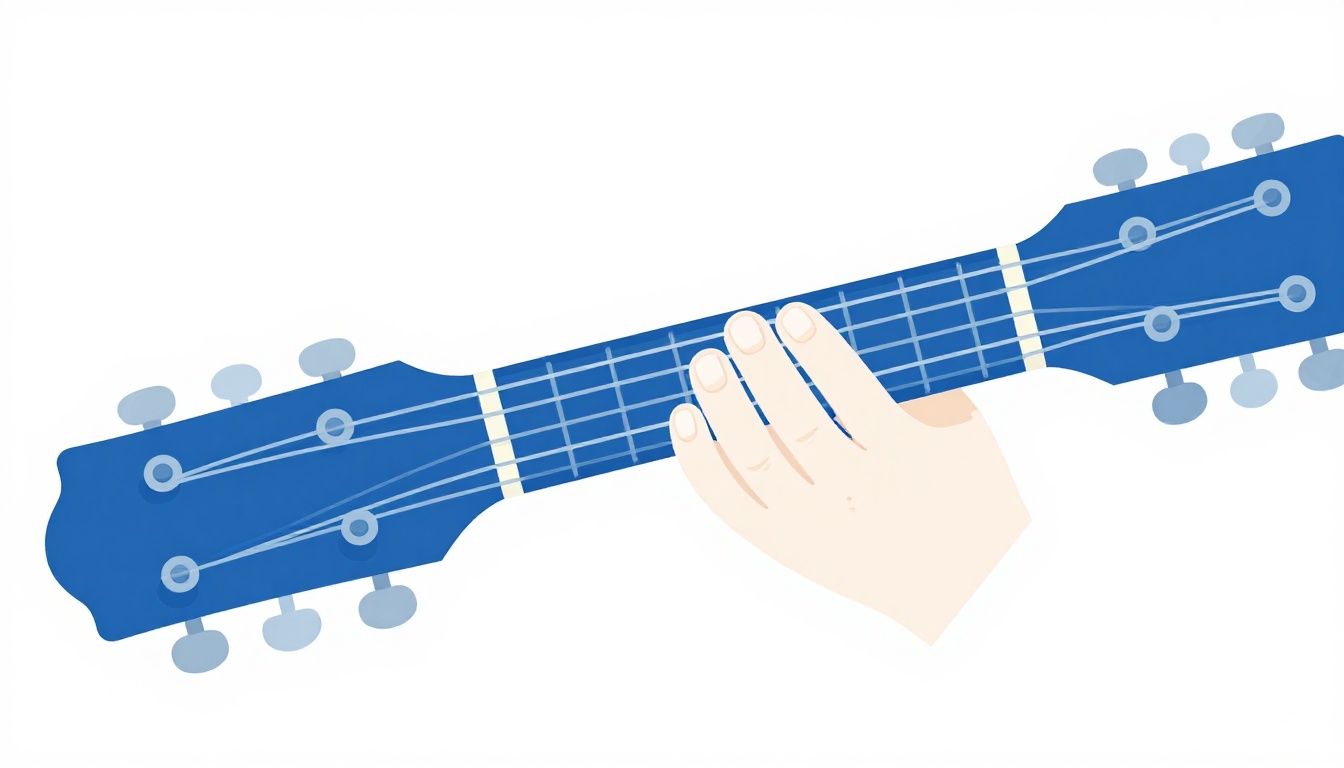
Classical guitar technique labels each digit of the picking hand, and it is worth knowing the names because bossa nova method books and video lessons use them constantly: thumb is p, index is i, middle is m, and ring is a, from the Spanish pulgar, indice, medio, and anular. In this pattern, p covers the bass notes and i, m, and a move together as a unit for the upper voices.
Rest your forearm on the upper bout of the guitar the way you normally would, but bring your hand slightly further from the soundhole than you would for a folk strumming pattern, closer to where a classical guitarist would sit. Your thumb should have a clear, unobstructed path to the 6th, 5th, and 4th strings, while your index, middle, and ring fingers rest lightly on the 3rd, 2nd, and 1st strings respectively, ready to pluck them together rather than one at a time.
Keep your thumb relaxed and slightly extended, moving from the knuckle rather than locking at the first joint, since a stiff thumb is the single most common reason the bass line rushes or drags under pressure. The fingers should move as a small, coordinated unit, almost like a light guitar pick made of three fingers at once, rather than three separate plucking motions that happen to land close together.
If you already play fingerstyle folk or classical pieces, this hand position will feel familiar, since it borrows directly from that technique. If your only picking-hand experience so far is strumming with a pick, expect the first week to feel clumsy no matter how clean your chord shapes are, simply because the thumb and fingers have never had to work independently of each other before. That coordination, not the chord shapes, is the actual new skill bossa nova is asking you to build.
A One-Bar Pattern You Can Play on Any Chord Today
If the syncopated pattern above feels like too much at once, start with this simpler version instead, and only add the offbeat anticipation once this one is automatic.
- Beat 1: thumb plays the root, fingers strike the full chord together.
- Beat 2: fingers strike the chord again, squarely on the beat.
- Beat 3: thumb plays the 5th.
- Beat 4: fingers strike the chord again.
Every hit lands directly on a beat, no anticipation yet, which makes it far easier to keep your thumb and fingers coordinated for the first few days of practice. Run it on Cmaj7 alone until your hand does it without thinking, then move to the syncopated version from the previous section, which is the one that actually sounds like bossa nova once your hand can manage it.
Why Your Bossa Nova Doesn't Sound Right Yet
You can have every chord shape in this post memorized and still play something that sounds closer to folk fingerpicking than bossa nova. That gap almost always comes down to the right hand, not the chords, so work through these six causes in order before assuming a chord shape is the problem.
You're strumming instead of plucking
A strummed bossa nova chord sounds like folk guitar with unusual chord names. The style depends on the bass and the upper voices being distinct, which only happens if your thumb and fingers strike separately rather than moving together as one strumming motion. Isolate the thumb first, silently, until it is steady on its own.
Your thumb isn't steady
The thumb is the metronome of this style. If it rushes, drags, or stops to "catch up" with a chord change, the whole pattern falls apart, because the fingers are timed relative to where the thumb already was, not the other way around. Practice the bass line alone, without fretting any chord at all, until it holds a steady pulse for a full minute.
Your chords land squarely on every beat
The syncopated pattern's chord hits fall on beat 1, the "and" of beat 2, and beat 4, not on beats 2 and 3 themselves. If every chord stab lines up with a downbeat, you are playing the simplified beginner pattern, which is a legitimate starting point, but it will sound stiff compared to the genuine syncopated feel once you are ready to move on.
You're muting the wrong strings
Shell voicings and half-diminished shapes only work if the strings you are not supposed to play stay silent. A stray low E ringing under a Dm7 shell voicing muddies the root the thumb is trying to establish. Rest the side of your fretting hand's index finger lightly against any string that is meant to be muted rather than trying to avoid it by aim alone.
You're playing it too fast
Bossa nova at its correct tempo feels unhurried, closer to a walking pace than a driving rhythm. Rushing the tempo to "get through" the syncopation usually means you have not internalized where the gaps sit yet. Slow the metronome down until the pattern feels almost too easy, then raise the tempo in small steps.
Your fretting hand is gripping too hard
Half-diminished barres and shell voicings only need enough pressure to stop the string from buzzing, not the full grip you might use for a wide open chord. Excess tension in your fretting hand slows down every chord change and makes the syncopated rhythm nearly impossible to keep up with, since a tense hand cannot reposition quickly. Check in on your grip mid-pattern and relax it by feel until only the necessary fingers are working.
The Minor and Major ii-V-I, the Backbone of Bossa Harmony
Almost every bossa nova progression, in every key, is built from two three-chord cells: the major ii-V-I and its minor counterpart, using the half-diminished chord from earlier.
| Progression | ii | V | I |
|---|---|---|---|
| Major, key of C | Dm7 | G7 | Cmaj7 |
| Minor, key of A minor | Bm7b5 | E7 | Am7 |
Play through both rows and you will notice the major version resolves to a settled, bright chord, while the minor version resolves to something darker and more restless, which is exactly the mood bossa nova songs move between, often within the same eight bars. Recognizing these two three-chord shapes inside a longer chart turns what looks like a dozen unrelated chords into two familiar patterns transposed to different roots.
The Chords Behind "Blue Bossa"
Kenny Dorham's "Blue Bossa" is one of the most commonly learned bossa nova standards, and its changes are almost entirely built from the two progressions above. The first half sits in C minor, moving between the tonic Cm7, a IV chord in Fm7, and the minor ii-V of Dm7b5 to G7, resolving back to Cm7. The second half briefly shifts up to the key of Db major by way of an Ebm7 to Ab7 ii-V, landing on Dbmaj7, before a final Dm7b5 to G7 turnaround brings it back home to Cm7.
| Section | Chords | What's happening |
|---|---|---|
| First half | Cm7, Fm7, Dm7b5, G7 | Tonic, then a minor ii-V leading back to the tonic |
| Second half | Ebm7, Ab7, Dbmaj7 | A ii-V-I that briefly visits the key of Db major |
| Turnaround | Dm7b5, G7, Cm7 | The same minor ii-V from the first half, resolving home |
Nothing in that progression is a new shape. It is the same shell voicings and half-diminished shape from earlier in this post, moved to new roots in a sequence that keeps returning to the same handful of chord families. That is the real skill "Blue Bossa" teaches: not new fingerings, but following a ii-V cell as it moves through different keys.
The Chords Behind "Girl From Ipanema"
Antonio Carlos Jobim's "Girl From Ipanema" opens on Fmaj7, the tonic, then moves to a G7, a chord borrowed from outside the key that jazz musicians call a dominant II, before settling into the more expected Gm7, the actual ii chord of F major. The verse repeats that push and settle a few times, using the tritone substitution mentioned earlier, a Gb7 standing in for what would otherwise be a C7, to create a smoother, half-step bass line under the melody. The bridge moves further out, through Am7 and a D7 with a flattened 9th, before returning to Gm7 and C7 to bring the harmony home.
You do not need every one of those chords memorized to take the lesson from this song. It is the clearest real-world example of how a bossa nova composer uses borrowed and substituted dominant chords to keep a progression moving without ever losing the underlying key.
The Chords Behind a Few More Bossa Nova Standards
Once "Blue Bossa" and "Girl From Ipanema" feel familiar, the same handful of harmonic tricks, the minor ii-V, the tritone substitution, and a resolution borrowed from a parallel key, show up again and again across the wider bossa nova songbook.
Jobim's "Corcovado" opens on a chord built from the 6th rather than the plain triad, creating a deliberately ambiguous start, before a diminished chord functions as an altered dominant leading into a straightforward ii-V-I in the key of F. Luiz Bonfa's "Manha De Carnaval," better known outside Brazil as the theme from "Black Orpheus," moves constantly between minor and major ii-Vs in the relative keys of C major and A minor, which is why it feels like it is shifting mood every few bars without ever truly changing key.
"Samba de uma Nota So," known in English as "One Note Samba," sits in the key of Bb and uses tritone substitutions to create a descending chromatic bass line under a melody that famously holds a single note. "Vou Te Contar," known as "Wave," runs a twelve-bar progression in D major, borrowing chords from the D Dorian mode for a bluesy color you would not expect from a bossa nova chart. Jobim's "Dindi" does something similar in Eb major, borrowing a chord from Eb Dorian and substituting an unexpected Eb6 in its bridge where a plain dominant chord would normally sit.
None of these progressions require new chord shapes beyond what is already in this post. What changes from song to song is only the key and the order the ii-V cells appear in, which is exactly why learning the shapes as movable families pays off faster than memorizing each song's chords as an unrelated list.
An Eight-Bar Progression to Loop and Practice With
Rather than jumping straight into a full song, it helps to have one loop that uses everything covered so far, built entirely from shapes already in this post, that you can repeat on its own until the chord changes and the rhythm both feel automatic together.
| Bar | Chord | Role |
|---|---|---|
| 1 | Cmaj7 | I, the tonic |
| 2 | Am7 | vi |
| 3 | Dm7 | ii |
| 4 | G7 | V |
| 5 | Cmaj7 | I, the tonic again |
| 6 | Am7 | vi |
| 7 | Dm7b5 | ii, borrowed from the parallel minor key |
| 8 | G7 | V, resolving back to bar 1 |
The first four bars are the same vi-ii-V-I loop from the start of this post. The second four bars repeat it, but swap the plain Dm7 for the half-diminished Dm7b5, borrowing a chord from A minor for one bar of extra color before resolving the same way. Loop the whole eight bars with the syncopated rhythm pattern, and you have a short piece of music that touches every chord family this post covers, major 7, minor 7, dominant 7, and half-diminished, inside sixteen seconds of music at a relaxed tempo.
Simplified Chords for Absolute Beginners
If seventh chords and shell voicings are more than you want to take on in your first weeks of playing, every bossa nova progression can be approximated with plain triads. The harmony loses some of its color, but the rhythm, which is most of what makes bossa nova recognizable, survives completely intact.
| Full chord | Simplified substitute |
|---|---|
| Cmaj7 | C |
| Am7 | Am |
| Dm7 | Dm |
| G7 | G |
| Fmaj7 | F |
| Em7 | Em |
Play the simplified chart with the rhythm pattern from earlier in this post, and it will sound recognizably like bossa nova, just with less harmonic detail. Move to the seventh chord versions whenever a plain triad feels comfortable and you are ready to add the extra color back in. There is no rule that says you have to start with the full voicings.
This is also a useful way to isolate the two skills bossa nova actually demands separately. If the syncopated thumb-and-finger pattern is what feels shaky, practice it on these simplified triads first, where the chord shapes themselves take almost no thought, so all your attention can go to the right hand. Once the rhythm is solid, switch back to the seventh chords and let the left hand catch up on its own, since by then the timing will no longer be the thing competing for your attention.
Changing Between Bossa Nova Chords Without Breaking the Groove
The shapes in this post were chosen partly because they share fingers and open strings with their neighbors, which matters more in bossa nova than in most other styles, since the syncopated rhythm gives you less time between chord hits to reposition your hand. Look at Dm7 to G7: the finger on the 3rd string barely moves, sliding from the 2nd fret to open, while the other two fingers reset in one motion rather than lifting off individually. G7 to Cmaj7 works the same way, with the finger on the 5th string simply shifting down one fret rather than lifting off the string entirely.
Practice chord changes in isolation, away from the rhythm pattern, moving only between two chords back and forth until the change takes less than half a second. Only then add the thumb and finger pattern back in. Trying to learn a new chord change and the syncopated rhythm at the same time is the most common reason bossa nova practice stalls, since both halves demand your full attention on their own.
The same shared-finger logic carries over to the moveable shell voicings once you are using them across a real progression. A ii-V-I built from shell voicings on the 5th string barely moves your hand up or down the neck at all, since the root notes of a ii, a V, and a I sit close together in fret position by design. Look for that kind of proximity whenever you are working out a new bossa nova progression, since a chart that looks harmonically complex on paper is often much smaller a hand movement than it appears.

Should You Use a Capo for Bossa Nova?
A capo is not traditional for bossa nova the way it is for singer-songwriter acoustic playing, but it solves a real problem: most of these songs were written on piano, in keys that are comfortable to sing but awkward to play in open position on guitar. If a song sits in Eb or Bb and you want to keep the open shell voicings and open-position chords from this post rather than switching to barred versions, a capo lets you do both.
Place the capo at the fret that shifts your open-position shapes into the song's actual key, then play the same Am7, Dm7, G7, and Cmaj7 shapes you already know relative to the capo. The chord names you say out loud will not match what is actually sounding, since the capo transposes everything up, but your hands are doing exactly the same work either way. This is a reasonable shortcut while you are still building comfort with the moveable shell voicings, and plenty of working guitarists use a capo on bossa nova arrangements for the same reason, easier hands over easier singing.
Does the Type of Guitar You Own Matter?
Bossa nova was written on nylon-string classical guitars, and that tradition still shapes how the style is usually played. A wider, flatter classical neck gives your right hand more room to separate the thumb's bass notes from the fingers' upper voices, and the softer nylon tone naturally suits the style's relaxed, unhurried feel better than a bright steel-string picking attack.
None of that makes a steel-string acoustic or an electric guitar the wrong choice. A steel-string will sound more percussive and a little brighter, which some players prefer for a more contemporary reading of the style, and the chords and rhythm pattern in this post apply to it without any change. An electric guitar played clean, with a light touch and maybe a touch of reverb, works well for bossa nova too, and it is a common choice in jazz settings where the guitarist is comping behind a singer or a soloist rather than performing solo. Play the guitar you already own. The rhythm pattern and the chord shapes are what make it sound like bossa nova, not the instrument underneath your hands.
A Practice Routine for Today
- Spend five minutes on the thumb alone: root, 5th, root, 5th, on a muted or unfretted string, at a slow, steady tempo, with no chord involved yet.
- Add the simplified beginner rhythm pattern, four even hits per bar, on a single chord, Cmaj7 or C, until it feels automatic.
- Move to the syncopated pattern, chord hits on beat 1, the "and" of 2, and beat 4, still on that one chord.
- Introduce the four-chord loop from the top of this post, Am7 to Dm7 to G7 to Cmaj7, one bar each, at a tempo slow enough that the change never rushes the thumb.
- Finish by running through the ii-V-I table, both the major and minor versions, back to back, to connect the shapes to the harmony they came from.
Fifteen minutes a day on this routine will get the rhythm into your hand faster than an hour spent once a week, since the thumb pattern is built from repetition, not insight.
If you want a longer view than a single session, spread the five steps above across a week rather than trying to force all of it into one sitting. Give the first two or three days entirely to the thumb and the simplified pattern, resisting the urge to add syncopation before the bass line is steady on its own. Bring in the syncopated version around day four, once the beginner pattern feels close to automatic rather than something you have to think about. Save the four-chord loop and the ii-V-I table for the final two or three days, once your hand has enough spare attention to handle a chord change without the rhythm falling apart. Players who try to add a new chord change and the syncopation in the same sitting tend to stall on both, while spacing them out lets each piece become automatic before the next one is layered on top.
FAQ
Do I need to know jazz theory to play bossa nova chords?
No. You need to recognize four chord families, major 7, minor 7, dominant 7, and half-diminished, and be able to find their shapes. The theory behind why they work is useful but not required to play the songs correctly.
Why do bossa nova songs use so many seventh chords instead of plain major and minor chords?
The style was built directly from jazz harmony by Brazilian composers in the late 1950s, and jazz harmony is built almost entirely from seventh chords and their extensions. A plain triad in a bossa nova chart tends to sound thin next to the surrounding chords, which is why even simple bossa arrangements usually keep at least the 7th on the tonic and dominant chords.
Can I play bossa nova with a pick instead of my fingers?
You can strum the chords with a pick and it will still sound musical, but you lose the separation between the bass note and the upper chord voices that defines the genre's rhythm. If you want the authentic sound, the thumb and finger technique is not optional.
What tempo should I practice bossa nova at?
Slower than feels natural at first. The style is meant to feel relaxed and unhurried even at a moderate tempo, and rushing it while you are still learning the syncopation tends to produce a stiffer, less convincing feel than practicing patiently at a slower speed.
Is bossa nova the same rhythm as samba?
They are closely related but not identical. Bossa nova grew directly out of samba, and both styles share a bass line built from alternating root and 5th notes, but bossa nova strips the rhythm down for a single guitarist, playing it quieter and more laid back than the fuller, percussion-driven feel of a samba band. If you already know a samba strumming pattern, the bossa nova pattern in this post will feel familiar, just calmer.
What is the difference between a minor 7 chord and a half-diminished chord?
A half-diminished chord, written m7b5, is a minor 7 chord with the 5th lowered by one fret. That single note is the entire difference, and it is what gives the chord its unsettled, "wants to move" quality when used as the ii chord in a minor key progression.
Why does the same chord sometimes appear written two different ways, like m7b5 and a degree symbol with a slash?
Both notations mean the same half-diminished chord. It is purely a difference in how different fake books and transcribers choose to write jazz harmony, not a difference in the chord itself.
Do I need to learn barre chords before I can play bossa nova?
Not to start. The four opening chords and the full open-position set in this post cover the two most common bossa nova keys without a single barre. Barre-based shell voicings and the half-diminished shape become useful once you want to play songs in other keys, which you can add once the open shapes and the rhythm feel solid.
How long does it usually take to make the rhythm pattern feel natural?
It varies by player, but most people who practice the thumb and finger separation daily start feeling the syncopation settle in within a couple of weeks, well before the chord changes themselves feel effortless. The bass line tends to click into place first, since it is a single repeating motion, while coordinating it smoothly with a changing chord progression takes longer simply because there is more happening at once.
GuitarLowKey
Ready for fifteen focused minutes?
Open the web app and train the change that is blocking your song.