
How to Play the F2 Guitar Chord (No Barre Needed)
The F2 guitar chord shape that skips the barre, why some charts call it Fsus2 instead, and how to move into and out of it cleanly.

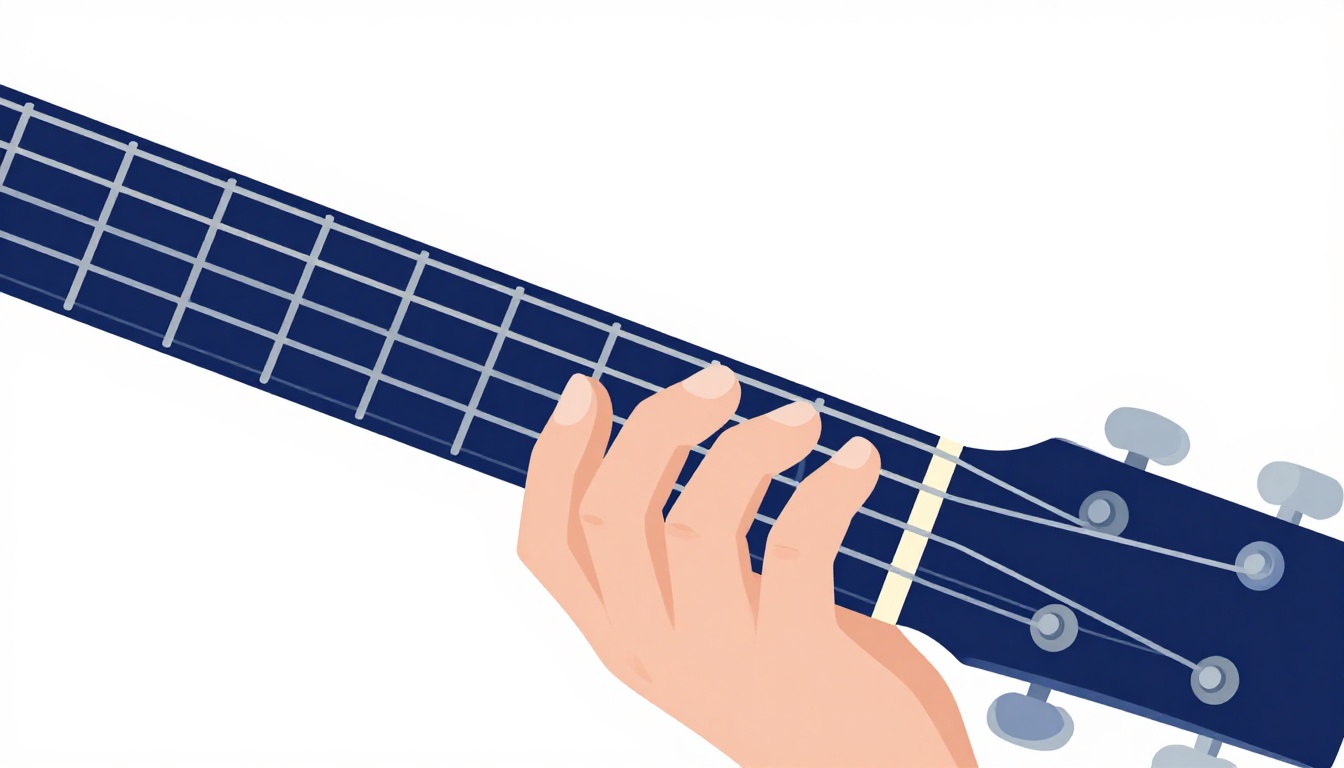
To play the F2 chord on guitar, mute the 6th and 5th strings, then fret the 4th string (D) at the 3rd fret with your ring finger, the 3rd string (G) at the 2nd fret with your middle finger, the 2nd string (B) at the 1st fret with your index finger, and the 1st string (high E) at the 3rd fret with your pinky. Strum only the four thinnest strings. No barre, no full hand clamp across the neck, just four fingers each holding their own string. That gives you F, A, C, and G, an F major chord with a second note (the "2") folded into the top of it. There is a second, unrelated chord some charts also call F2, and the rest of this post covers both, plus every other shape, fix, and chord change you will actually need once this one is under your fingers.
The F2 chord shape, string by string
Here is the full fingering for the compact, no-barre version, the one most players mean when they search "F2 chord" without any other label attached.
| String | Fret | Finger |
|---|---|---|
| 6 (low E) | Muted | - |
| 5 (A) | Muted | - |
| 4 (D) | 3 | 3 (ring) |
| 3 (G) | 2 | 2 (middle) |
| 2 (B) | 1 | 1 (index) |
| 1 (high E) | 3 | 4 (pinky) |
Every finger sits on its own string, and the whole shape lives within a three-fret span, from the 1st fret to the 3rd. That is a smaller reach than most players expect from an F-family chord, mostly because the 6th and 5th strings, the two that force a barre in standard open F, are left out entirely here.
Standard tuning, so the fret numbers make sense
Every fret number in this post assumes your guitar is in standard tuning. If a string has drifted, the same fingering produces a different chord entirely, so it is worth confirming before you troubleshoot an F2 that will not ring clean.
| String | Note | Pitch |
|---|---|---|
| 6 (thickest) | E | Low E |
| 5 | A | - |
| 4 | D | - |
| 3 | G | - |
| 2 | B | - |
| 1 (thinnest) | E | High E |
That is low to high: E, A, D, G, B, E. The 4th string, the one your ring finger frets at the 3rd fret in F2, is a D string, and pressing it three frets up lands exactly on F, which is why that note becomes the root of the chord even though it is not the lowest-pitched string you are playing.
Why you will see two different chords both called "F2"
Search "F2 chord" and you will run into a genuine disagreement between sources, not just casual mislabeling. Some guitar-specific chord guides treat "F2" as shorthand for "F add 2," meaning a regular F major triad with an extra note, the 2nd degree of the scale (the same pitch as the 9th), layered on top. That is the shape at the top of this post, and it is the version this page is built around, because it is what the most guitar-focused references settle on when the term is searched directly.
A smaller number of sources use "F2" as shorthand for Fsus2, a chord that removes the 3rd of F major entirely and replaces it with that same 2nd degree. The two chords share one note and a name, but they are not the same shape and they do not sound the same. F2 (the add version) keeps the resolved, major quality of F and just colors it. Fsus2 strips that resolved quality out and leaves something unresolved, almost suspended in air, which is exactly what "sus" means in a chord name.
If the chart in front of you says "F2" and the rest of the song is ordinary major-key pop or worship changes, the add-2 version at the top of this post is very likely what is meant. If the song leans on suspended chords throughout, with that floaty, unresolved character running through the whole progression, you may be looking at the Fsus2 meaning instead. Both get covered in full further down, including a side-by-side fingering table, so you can check the shape against what you are hearing.
What notes are actually in the F2 chord
The add-2 version of F2 is built from four notes.
| Note | Role |
|---|---|
| F | Root |
| A | Major 3rd |
| C | Perfect 5th |
| G | 9th (added 2nd) |
F, A, and C are the same three notes as a plain F major chord. That major 3rd, the A, is what makes F major sound resolved and settled on its own. The G is the addition, sitting a whole step above the root, and it is what gives F2 its slightly open, unresolved edge without ever losing that underlying major sound. Because the 3rd stays in the chord, F2 is technically an "add" chord rather than a true suspension, even though the "2" in its name can make it look like a suspended chord at a glance.
The easier, three-finger version to start with
If four fingers spread across four separate strings feels like a lot at once, build up to it in two steps. Start with the plain, no-barre open F shape that many beginner books teach on its own, which uses only three fingers and leaves the pinky out entirely.
| String | Fret | Finger |
|---|---|---|
| 6 (low E) | Muted | - |
| 5 (A) | Muted | - |
| 4 (D) | 3 | 3 (ring) |
| 3 (G) | 2 | 2 (middle) |
| 2 (B) | 1 | 1 (index) |
| 1 (high E) | Open | - |
That is F, A, and C, a plain F major triad with no barre and no pinky. Once those three fingers land cleanly and the open high E string rings without buzzing against anything, add your pinky to the 3rd fret of that same string. The other three fingers do not move at all. That single addition is the entire difference between this easier shape and the full F2 above, so there is no need to relearn anything, just extend a hand you already trust.

The full barre version of F2
If you already play the standard, full six-string barre F chord, there is a version of F2 that grows directly out of it, and it gives you a fuller, six-string sound instead of the compact four-string voicing above.
| String | Fret | Finger |
|---|---|---|
| 6 (low E) | 1 | 1 (barre) |
| 5 (A) | 3 | 3 (ring) |
| 4 (D) | 3 | 3 (ring) |
| 3 (G) | 2 | 2 (middle) |
| 2 (B) | 1 | 1 (barre) |
| 1 (high E) | 3 | 4 (pinky) |
This is the ordinary barre F shape with one change: instead of leaving your pinky free or letting the barre cover the high E string at the 1st fret, you stretch your pinky up to the 3rd fret of that same string. Every other finger stays exactly where it already sits for standard F. That one stretch swaps the doubled root on the high E string for the 9th, turning plain F into F2 without changing anything else about the shape. GuitarLowKey's guide to the standard F chord covers the full barre shape itself, along with every buzz it tends to produce, in more depth than fits here.
The stretch is the hard part. Your index finger is already committed to the barre, so the pinky has to reach three frets past it on its own, with no help from the rest of the hand. Practice that reach slowly, checking that the barre has not loosened while the pinky moves, before you try it inside a full strum.
A movable barre version, further up the neck
Because the barre version above is built on the same shape used for any major chord barred at the low E string, the same logic works for an A-shape barre chord rooted on the 5th string instead. Moved up to the 8th fret, that root lands on F again, giving you a second full F2 voicing higher up the neck.
| String | Fret | Finger |
|---|---|---|
| 6 (low E) | Muted | - |
| 5 (A) | 8 | 1 (barre) |
| 4 (D) | 10 | 3 (ring) |
| 3 (G) | 12 | 4 (pinky) |
| 2 (B) | 10 | 2 (middle) |
| 1 (high E) | 8 | 1 (barre) |
This shape is genuinely movable. Slide the whole thing up or down the neck and the root changes with it, root on the 5th string wherever your index finger barres, while the relationship between the fingers, and the fact that it is an F2-type chord rather than a plain major, stays identical. It is a useful shape to know once you play in other keys, since it is the same fingering pattern no matter which fret you start it on, just relabelled to match wherever the barre lands.
F2 versus Fsus2
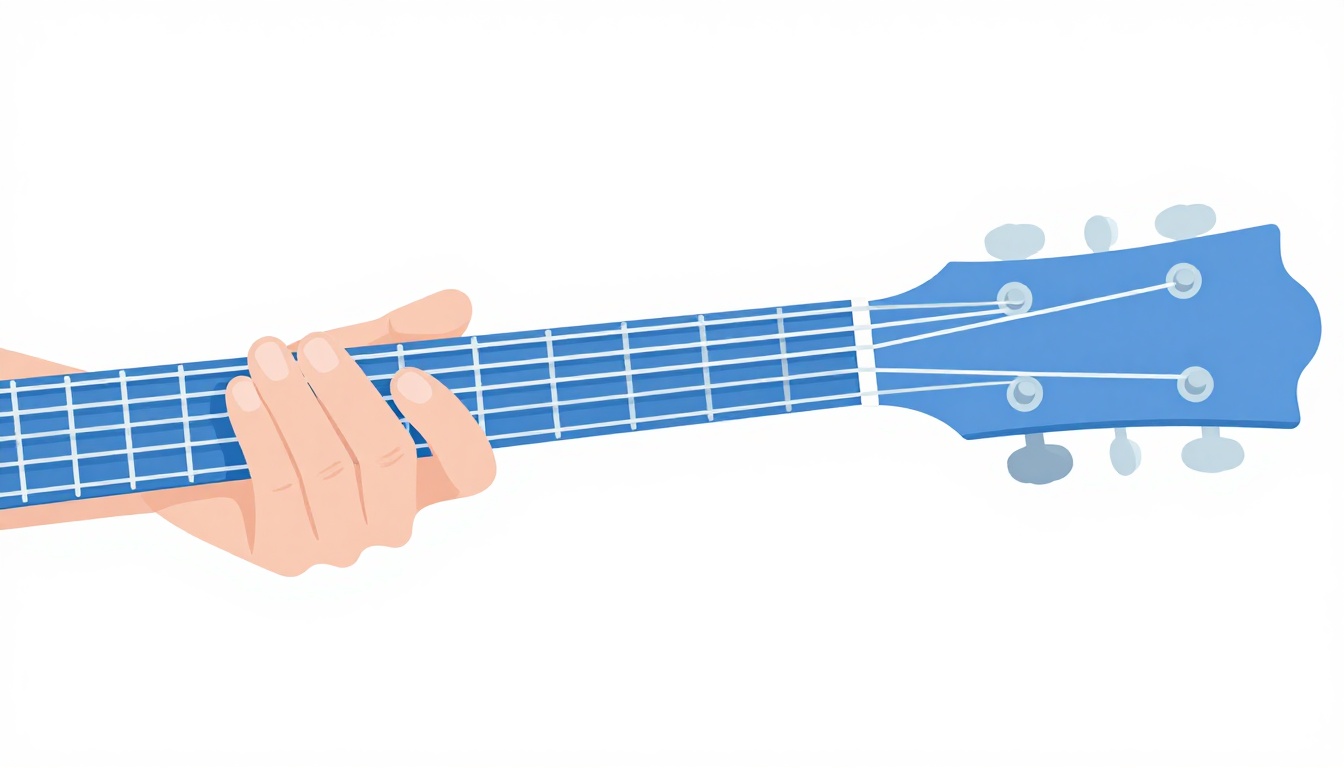
Since both names get used for the "2" chord depending on where you look, it helps to see them side by side. Fsus2 replaces the 3rd of F major with a 2nd, so the A disappears from the chord entirely.
| String | Fsus2 fret | F2 (add) fret |
|---|---|---|
| 6 (low E) | Muted | Muted |
| 5 (A) | Muted | Muted |
| 4 (D) | 3 | 3 |
| 3 (G) | Open | 2 |
| 2 (B) | 1 | 1 |
| 1 (high E) | 3 | 3 |
The two shapes differ on a single string, the 3rd, and that is exactly where the note deciding whether the chord is major (F2) or suspended (Fsus2) lives. Fsus2 leaves that string open, which removes the A and leaves the chord sounding unresolved and restless rather than colorfully major. F2 fretting that same string at the 2nd fret puts the A back in, which is why it still sounds like an F chord with something extra rather than a chord searching for a resolution.
If you are working from a chart that labels this shape Fsus2 rather than F2, use the fingering in that column above, since it is a genuinely different chord even though it shares most of its shape with F2.
F2 versus Fadd9
This one is simpler: F2 and Fadd9 are the same chord under two different names. Both describe an F major triad (F, A, C) with an added G, whether you call that G the "2" (counting it as the second note of the F major scale) or the "9" (counting it an octave higher, the way jazz theory stacks chord extensions). The note is identical either way, it is just a naming convention that depends on which corner of the guitar world wrote the chart. Pop, worship, and general songbook charts tend to write "2." Jazz charts and more formal theory writing tend to write "add9." If you have played or read about Fadd9 before, everything in this post applies to it as well.
Beyond "F2" and "Fadd9," the same chord occasionally shows up written as "Fadd2," "F(add2)," or "F add 2" spelled out in full. All of these point at the identical chord covered at the top of this post. The parentheses around "add2" are a formatting habit some chart writers use to make clear a note is being added rather than substituted, which matters more in denser jazz charts scanning through several extension types in the same song. On a simple pop or worship chart, "F2" remains the shorter, more common shorthand.
Where the "9" in Fadd9 comes from
Chord tones are usually counted within a single octave: root, 3rd, 5th, and so on. Once a chord uses a note that repeats a tone already in the scale but an octave higher than where extension numbering normally stops, theory writing keeps counting past 7 instead of wrapping back to 1. The 2nd degree of the F major scale, counted an octave higher, becomes the 9th. It is the identical note, G, either way, the same pitch class whether it rings low in the chord or up near the top of it. Guitarists reach for "9" instead of "2" mainly when a chord already has a 7th in it and needs to describe both extensions at once, which is why "add9" shows up far more often in jazz-adjacent writing than in a straightforward pop or worship chart, where "F2" says the same thing in a shorter, more guitar-friendly way.
F2 versus Fmaj7
Fmaj7 is a different color layered onto the same F major triad, and it is easy to confuse with F2 since both are described as a "prettier" or "jazzier" alternative to plain F. Where F2 adds the 2nd degree (G) on top of F, A, and C, Fmaj7 adds the major 7th (E) instead. The two extensions sit right next to each other on the piano, a half step apart, but they pull the ear in different directions. F2 keeps a bright, open, almost folk-like quality, since a 9th is a wide, consonant interval away from the root. Fmaj7 sounds noticeably softer and more wistful, since a major 7th sits close enough to the octave above the root to create gentle tension against it. If a chart calls for one and you play the other, the chord will still be recognizably F-based, but the mood of the line will shift. Neither is a substitute for the other, they are two separate colors built on the same triad, and it is worth learning to hear the difference rather than treating them as interchangeable just because both avoid the plain, unadorned sound of a basic F chord.
F2 versus a plain F major chord
Play a plain, three-finger open F, then add the pinky to switch into F2 and back again. The only string that changes is the 1st, and the difference is subtle on paper but not subtle to the ear. Plain F resolves. It sounds complete and settled, which is why it works so well as a chord you land on at the end of a phrase. F2 keeps that same foundation but adds a touch of tension from the G, so it tends to sound less like a full stop and more like a comma, a chord you can rest on for a bar or two while it still wants to move somewhere.
That distinction is the whole reason a songwriter reaches for F2 instead of plain F in the first place. It is not a substitute for F major, it is a deliberate choice to color an F chord that would otherwise sound too plain or too final in context. A verse that opens on F2 rather than plain F often carries a slightly more reflective, less declarative feel from its very first chord, purely because of that one added note.
Why your F2 isn't ringing clean
Four fingers, each on its own string, with two strings that need to stay silent underneath, gives you several places for the sound to go wrong. Here is each one on its own.
The muted strings are ringing when they shouldn't
Strings 6 and 5 are not fretted in the compact F2 shape, which means they need to be deliberately kept quiet rather than simply ignored. If your ring finger, fretting the 3rd fret of the D string, leans back far enough to touch the A string, it can accidentally silence it, which is what you want, but inconsistently, so it sometimes rings through as a dull thud. Let the underside of that same finger rest lightly against the 5th string on purpose, and keep your strumming hand's downstroke starting from the 4th string rather than sweeping in from the 6th.
The high E string buzzes at the 3rd fret
Your pinky is the weakest finger on most hands, and asking it to hold a clean note on its own, without support from a neighboring finger, is exactly where buzzing shows up first. Press it firmly, right up against the fret wire, and check that it is arched enough that it is not accidentally brushing the 2nd string next to it.
The B string sounds muted or choked
Your index finger holds the lightest fret in the chord, the 1st fret on the B string, and it is easy to under-press out of habit if your hand is used to bigger stretches elsewhere in this chord. A string fretted too close to the middle of the fret space, rather than right behind the fret wire, is the most common cause of a dead or muffled note here.
The G string buzzes or sounds thin
Your middle finger is holding the 2nd fret of the G string, sandwiched between the ring finger below it and the index finger above it. If your hand is cramped from trying to keep four fingers close together, that middle finger is often the one that ends up flattened or under-pressed. Give it a fraction more room by arching your ring finger slightly higher, which frees the middle finger to press straight down rather than at an angle.
Your thumb is creeping over the top of the neck
A thumb wrapped too far around the neck pulls your whole hand forward and flattens your fingers, which is what causes most of the muting and buzzing problems above in the first place. Keep your thumb roughly behind your middle finger, low on the back of the neck, and let your fingers curl down onto the strings from above rather than reaching around a thumb that is doing the reaching for them.
You're pressing harder than the chord needs
Once F2 rings clean, more pressure will not make it ring cleaner, it will just tire your hand out faster and slow down every chord change that follows. Once every string sounds clear, back off until you find the lightest touch that still holds the note.
The guitar itself is working against you
If you have checked finger placement, arch, and thumb position and a specific string still will not ring, the problem may not be your technique. Strings that have gone dull lose their ability to ring clearly no matter how well they are fretted, and a guitar with the action set too high demands more finger pressure than a well-adjusted one, which tires your hand and makes every fret harder to seat cleanly. If one string buzzes on every chord you try, not just F2, that points at the instrument rather than the shape.
Checking each string on its own
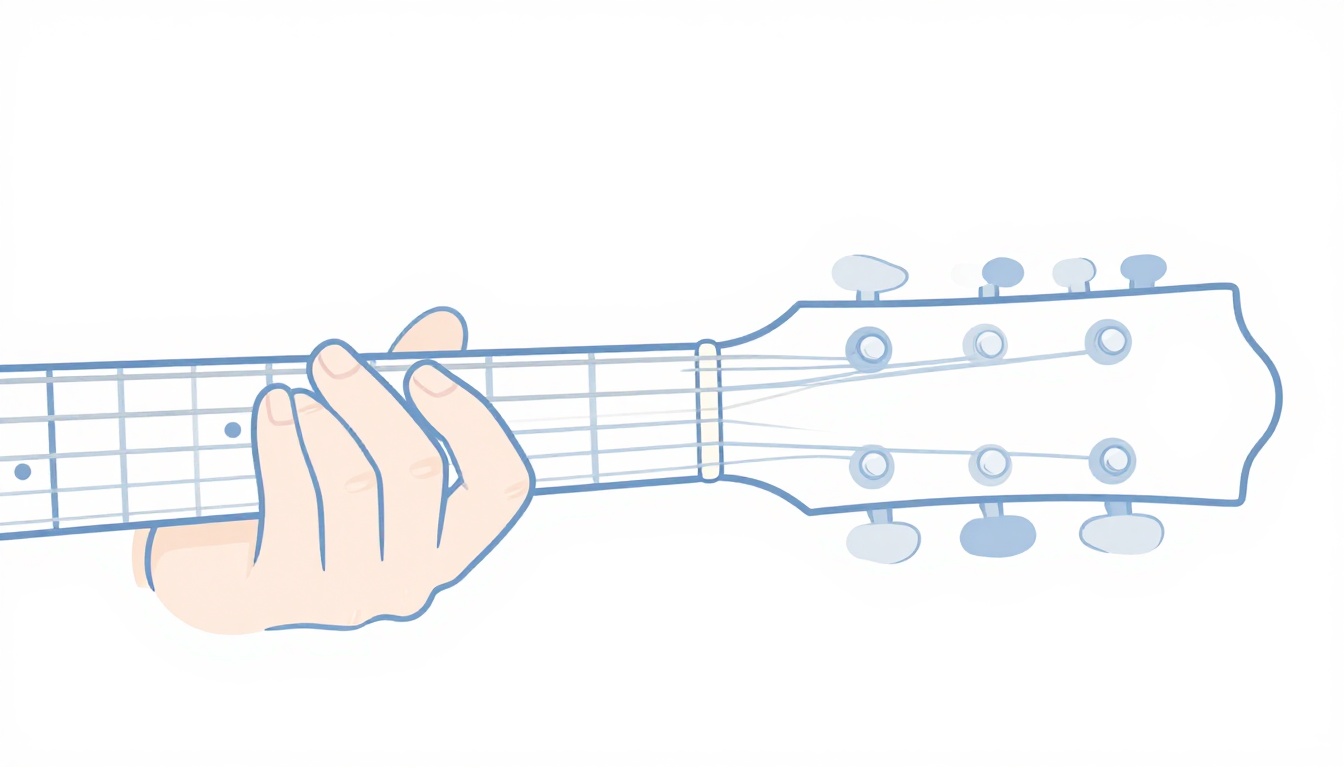
Strumming all four strings at once and listening for "does that sound right" hides exactly which string is causing a problem. After fretting F2, pick each of the four strings individually, slowly, and listen to that one note in isolation before you strum the chord as a whole. A muted or buzzing string is obvious on its own and easy to miss inside a full strum, especially once you are moving between chords at tempo and no longer paying close attention to any single note.
Mistakes that have nothing to do with buzzing
Not every problem with a new chord shows up as a bad sound. Some of the most common issues with F2 happen before your fingers ever touch a string.
Stopping the strumming hand while the fretting hand searches
When a new shape is still unfamiliar, it is tempting to freeze your strumming hand while your fretting hand finds each finger's spot, then resume strumming once the chord is in place. That habit is exactly what causes a visible, audible gap every time you change into F2 in a real song. It is better to keep your strumming arm moving in time, even muting the strings with your fretting hand if you are not ready, than to stop the rhythm entirely while you search for the shape.
Watching your fretting hand for the whole chord
Looking at your hand to check finger placement is a normal part of learning a new shape, but if you are still looking down every single time you play F2 weeks after first learning it, that is a sign the shape has not moved from conscious memory into muscle memory yet. Deliberately practicing a few repetitions without looking, even if you get the fingering wrong at first, speeds up that transition considerably.
Letting the guitar's tuning drift unnoticed
F2 relies on four fretted notes landing at very specific pitches relative to each other to sound like a clear add9 chord rather than a slightly sour version of plain F. If an F2 that used to sound right suddenly sounds slightly off in a way you cannot pin to a specific finger, check your tuning before you assume your technique has gotten worse.
How to strum an F2 chord
Strum only the four thinnest strings, the D, G, B, and high E. The 6th and 5th strings are deliberately left out of this chord, not because they would sound wrong exactly, but because they are not fretted and would ring as open low notes that do not belong to the chord you are playing. A slow, deliberate down-up-down-up, starting each stroke from the D string rather than sweeping in from the low E, will tell you quickly whether you are catching only the strings you mean to.
If you are coming from chords that ask you to strum all six strings, this habit of starting your strum from a specific string rather than the low E takes a little conscious practice. It is worth building early, since several other common chords, including some versions of D and Dm, ask for the same discipline.
Fingerpicking an F2 chord
F2 works well fingerpicked, since each of its four notes sits on its own string with a finger already assigned to it. A simple pattern to start with: thumb on the D string (string 4), index on the G string (string 3), middle on the B string (string 2), ring on the high E string (string 1), picked in that order and then back down through the middle and index fingers. Because every string in the chord is fretted rather than open, the notes stay consistent no matter how slowly or unevenly you pick through the pattern, which makes F2 a forgiving chord to practice fingerstyle technique on before moving to shapes with a mix of open and fretted strings.
Changing from F2 into C, G, Am, and Dm
The shape itself is rarely the hard part. What trips players up is getting into and out of it without a visible gap in the strumming pattern.
F2 to C
Your index finger does not move at all. It holds the 1st fret of the B string in both F2 and standard open C, so it acts as an anchor while the rest of the hand resets around it. Your middle finger moves from the G string over to the 2nd fret of the D string, and your ring finger moves from the D string over to the 3rd fret of the A string, both keeping the same fret they already held, just shifting one string across. Your pinky lifts off entirely, since C leaves the high E string open. With one finger already in place, this is one of the easiest changes in this post once you notice the index finger never has to move.
F2 to G
This is a bigger jump than F2 to C, since standard open G uses three fingers spread across three widely separated strings. The one shortcut is the high E string: it stays fretted at the 3rd fret in both chords, so instead of lifting your pinky and refretting with another finger, let your ring finger settle onto that same spot as your pinky relaxes off it. Your middle finger makes the largest move, from the G string over to the 3rd fret of the low E string. Your index finger shifts from the B string to the 2nd fret of the A string, one string over and one fret up. Because the middle finger travels the furthest, practice that single move in isolation before adding the rest of the chord back around it.
F2 to Am
Your index finger does not move, just as with the change into C. It holds the 1st fret of the B string in both F2 and standard open Am. Your middle finger moves from the G string over to the 2nd fret of the D string, and your ring finger moves from the D string down to the 2nd fret of the G string, taking over the spot your middle finger just left. Your pinky lifts off entirely, since Am leaves the high E string open. Because the index finger stays anchored in exactly the same place for both C and Am, once you have one of these changes comfortable the other follows quickly.
F2 to Dm
Your middle finger does not move at all, it stays on the 2nd fret of the G string for both chords. Your index finger, on the B string in F2, slides over to the 1st fret of the high E string. Your ring finger, on the D string in F2, moves across to the 3rd fret of the B string. Your pinky lifts off entirely, since Dm does not use the high E string in this position, the open D string underneath becomes the root instead. With one finger already anchored in place, this is the shortest move in the group after F2 to Am.
Using F2 as a passing chord back to F
One of the most natural uses for F2 is not as a chord that lives in a progression on its own, but as a brief stop between two other chords, most often sliding from F2 back into plain F major. Because the only difference between the two is a single finger, the pinky, landing on or lifting off the high E string, you can add F2 as a quarter-beat passing chord right before you land on F, giving an ordinary F-based progression a small lift without changing its overall structure. It is a low-risk way to make a simple progression sound slightly more considered without learning a single new shape.

Where F2 sits in the key of F
F2 is built on the root of the key of F major, so it functions the same way a plain F chord does in a progression, it just carries a different color while it does it.
| Degree | Chord | Roman numeral |
|---|---|---|
| 1st | F major (or F2) | I |
| 2nd | G minor | ii |
| 3rd | A minor | iii |
| 4th | Bb major | IV |
| 5th | C major | V |
| 6th | D minor | vi |
| 7th | E diminished | vii° |
F2 substitutes for the I chord in that list. It shares a root and a function with plain F major, so anywhere a progression calls for F, F2 is a drop-in replacement that adds a bit of color without changing the harmony the rest of a band, or the rest of your own chord progression, is built around. GuitarLowKey's guide to the F major scale covers the notes and fingerings behind this key in more depth if you want to see where each of these chords comes from.
Common progressions built around F2
Because F2 shares its root and function with plain F, it slots into the same progressions guitarists already use F in, usually replacing one specific F in the sequence rather than every one. A common pattern opens a section on F2 instead of plain F, then resolves into the plain chord partway through the bar, for example F2 into F into C into G. Another common use is at the end of a phrase that returns to F, sliding through F2 on the way, which is the passing-chord use described above. Because F, C, and Bb are common chords built from the same key, F2 tends to show up specifically in progressions built on those chords rather than in progressions that wander further afield.
Playing F2 with a capo
Clamping a capo on does not change the shape you are fretting, it changes what the chord sounds like. If a song is written in a different key but you want to play out of familiar F-shaped chords, a capo lets you fret the same F2 shape covered in this post while the actual sounding chord shifts up by however many frets the capo sits at. If you already know how to read a capo chart, the same logic applies to F2 as it does to plain F: whatever chord F becomes at a given fret, F2 becomes the "add 2" version of that same chord at the same fret.
F2 on electric versus acoustic guitar
The fingering does not change between instruments, but the chord behaves differently on each. An acoustic guitar's strings sustain naturally and the compact F2 voicing, with only four strings ringing, tends to sound clear and defined without much extra effort. On electric guitar, especially with distortion or overdrive engaged, the tighter voicing actually works in F2's favor compared to a fuller, six-string chord, since fewer ringing strings means less for the gain to smear together into mud. If you are using the full barre version of F2 rather than the compact one, a lighter touch and cleaner muting between strums matters more with any gain applied, since distortion amplifies looseness in the fretting hand along with the notes themselves.
Left-hand posture for F2
Beyond the specific causes of buzzing already covered, general fretting-hand posture matters for every chord you play, and F2 is a reasonable shape to build good habits on since each finger has a clearly defined job. Keep your wrist roughly straight rather than bent sharply forward, since a bent wrist reduces how far your fingers can reach and encourages the flattening that causes muted strings. Bring your elbow in close enough to your body that your forearm and the neck of the guitar form a natural, relaxed angle rather than reaching out and away from you. And keep your fingers hovering just above the strings between chord changes rather than lifting them high in the air, since a shorter distance to travel makes every change, not just the ones covered here, faster and more accurate.
Slowing down chord changes with a metronome
Chord changes that fall apart at full speed almost always hold together at half speed, which is what makes a metronome useful here. Set it slow enough that you can complete a full change into or out of F2 comfortably before the next click, then nudge the tempo up only once the change is clean and unhurried at the current speed. A full walkthrough of metronome practice for rhythm guitar covers starting tempos and subdivision drills in more depth, but the short version for a single chord change is simple: if you cannot make the change cleanly at a slow tempo, a faster tempo will not fix it, it will only expose it more clearly.
Recognizing F2 by ear
Once the shape is under your fingers, it helps to know what you are listening for so you can spot an F2 in a recording without reading a chart at all. Play a plain F major, let it ring, then switch to F2 and let that ring too. F2 sounds almost identical at first, same root, same major quality, but slightly more open, as though one note is standing slightly apart from the rest instead of blending fully in. That is the added G doing its job. Compare it next to an Fsus2, and the difference becomes much clearer: the sus2 version loses the settled, resolved quality entirely and sounds like it is waiting for something to happen, while F2 never stops sounding like an F chord underneath the extra color.
This kind of ear training pays off well beyond F2 itself. Once you can reliably hear the difference between a resolved major chord and the same chord with one extra color tone added, you start noticing the same trick everywhere, a Cadd9 instead of plain C, a Dadd9 instead of plain D, a Gsus4 resolving into G. The specific note changes, but the effect on the ear is consistent, and F2 is as good a chord as any to build that recognition on, since the shift from plain F to F2 asks for only one finger and produces a clearly audible result.
Songs and charts where you'll meet F2
The "2" naming shows up most often on chord charts written for congregational, acoustic, and alternative rock songs, the kind of chart that leans on open, ringing chords rather than dense jazz voicings. You will see it written as F2, Fadd9, or Fadd2 depending on which chart you are reading, sometimes within the same song section on different websites. That inconsistency is exactly why the naming discussion earlier in this post matters more than it might seem at first, since two charts for the same recording can genuinely disagree on what to call the shape you are hearing, even when they agree on which notes to play.
Practicing F2 today
Start with the easier three-finger version until it rings clean every time, no buzzing, no muted or choked strings, checked one string at a time. Once that is reliable, add the pinky for the full four-finger F2 and repeat the same string-by-string check. From there, spend five minutes moving slowly between F2 and plain F, back and forth, focused only on that one finger landing cleanly on the high E string and lifting cleanly off it. Finish by picking one of the chord changes above, whichever one you play most often in the songs you already know, and practice it in isolation, away from a full strumming pattern, until the move feels automatic rather than something you have to think through.
A short, focused session like that, five to ten minutes on F2 specifically rather than an hour spread thin across everything you are working on, tends to move the shape into muscle memory faster than an occasional long session does. Come back to it daily for a week rather than once for an extended stretch, and check in on the same three things each time: is every string ringing clean, is your thumb staying low on the back of the neck, and can you land the shape without looking down. Once all three are consistently yes, fold it into the actual song or progression you learned it for, since a chord that only works in isolation still has one more step to go before it is genuinely useful.

Quick reference: every shape in this post
With four different fingerings covered above, it helps to have them side by side once you know which one you are reaching for.
| Version | 6 (low E) | 5 (A) | 4 (D) | 3 (G) | 2 (B) | 1 (high E) |
|---|---|---|---|---|---|---|
| F2, compact (4 fingers) | Muted | Muted | 3 | 2 | 1 | 3 |
| Easier open F (3 fingers) | Muted | Muted | 3 | 2 | 1 | Open |
| F2, full barre | 1 | 3 | 3 | 2 | 1 | 3 |
| F2, movable barre (shown at fret 8) | Muted | 8 | 10 | 12 | 10 | 8 |
| Fsus2 (the other "F2") | Muted | Muted | 3 | Open | 1 | 3 |
Start from the top of this table when you are unsure which shape a chart is asking for, and work down only if the chord you land on does not match what you hear in a recording.

FAQ
Is F2 the same as Fadd9?
Yes. Both names describe an F major chord (F, A, C) with an added G. "2" and "9" refer to the same note counted at two different octaves, and the choice between the two names is a convention that depends on the chart, not a difference in the chord itself.
Is F2 the same as Fsus2?
No, even though the names look related. F2 keeps the major 3rd (A) and adds a G on top. Fsus2 removes the major 3rd entirely and replaces it with that same G. They share a note but not a sound, and they are fingered differently on the guitar.
Do I need to mute the low strings when I play F2?
Yes, for the compact four-finger version. The 6th and 5th strings are not fretted in that shape, so they need to stay quiet, either by resting an adjacent finger lightly against them or by simply starting your strum from the D string rather than the low E string. The full barre version does not have this issue, since every string is fretted or barred.
Why does my F2 sound the same as a plain F chord?
Check that your pinky is actually landing on the high E string at the 3rd fret and pressing firmly. That note is easy to under-press with a weaker finger, and an F2 where that string buzzes out or does not sound at all will be very hard to distinguish from plain F by ear.
Is F2 hard for a beginner to learn?
It is easier than the full barre F chord, since the compact version needs no barre at all. It does ask for a pinky stretch that some beginners have not built up yet, which is why starting with the three-finger open F and adding the pinky afterward, as described earlier in this post, is worth doing before attempting all four fingers at once.
What is the easiest chord to move to from F2?
Am or C, since your index finger does not move at all for either one, it holds the same fret on the same string in F2, Am, and C. Only the middle and ring fingers need to reposition.
Can I use F2 in place of F every time a chart calls for F major?
You can, since the two chords share a root and function, but it will change the character of the song wherever you do it. F2 adds a lighter, slightly unresolved color, so swapping it in for every F can make a progression sound like it never quite settles. It works best used deliberately, at a few chosen points, rather than as a blanket substitute.
Does F2 sound different on a 12-string guitar?
Yes, more than most chords, since a 12-string doubles most strings an octave apart. The added G note in F2 rings out on two extra courses instead of one, which makes the color of the chord noticeably more prominent than it is on a standard six-string. The fingering does not change at all, only the density of the sound does.
Why does the same chord get written so many different ways across different charts?
Guitar chord notation grew out of several separate traditions, jazz lead sheets, folk and pop songbooks, and worship team charts among them, and each developed its own shorthand before the internet made it easy to compare charts side by side. "F2," "Fadd9," and "Fadd2" all survived because each made sense within the tradition that produced it, and none of the communities using them had a strong reason to standardize once their own charts already worked. The practical fix is the one this post leans on throughout: learn to recognize the shape and the sound, not just the name, and the notation stops mattering.
GuitarLowKey
Ready for fifteen focused minutes?
Open the web app and train the change that is blocking your song.