
How to Play the F6 Guitar Chord (No Full Barre Needed)
The easiest F6 shape with no full barre, the standard barre version, a capo trick, and how F6 relates to F major, Fmaj7, and Dm7.

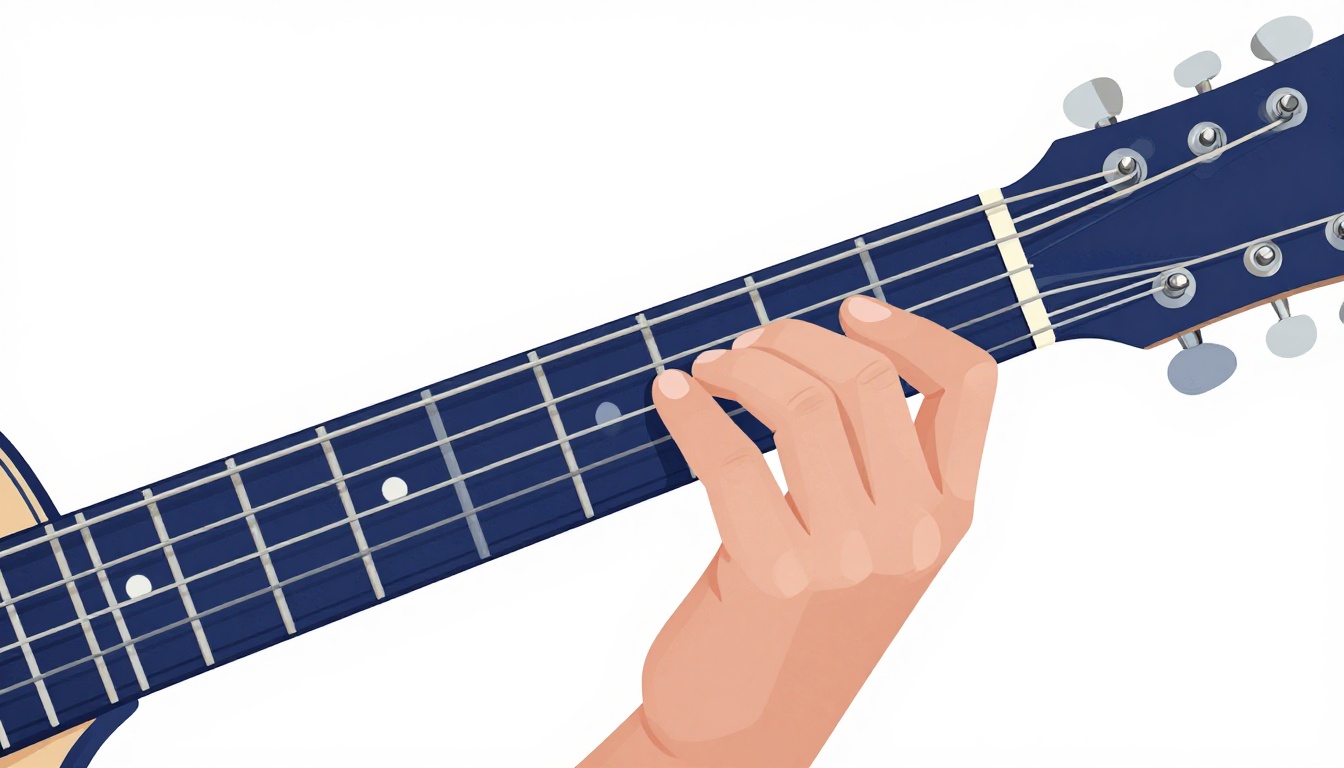
The easiest way to play F6 on guitar skips the barre entirely: mute the low E string, play the A and D strings open, put your ring finger on the 2nd fret of the G string, and lay your index finger flat across the B and high E strings at the 1st fret. Strum from the A string down. That gives you A, D, A, C, and F, which is every note an F6 chord needs (F, A, C, and D), with the root landing on top. Below is the full shape as a table, the barre version, a capo shortcut, and how F6 relates to the plain F chord, Fmaj7, and Dm7, which shares every one of its notes.
The easy F6 chord, string by string
This is the shape most players reach for first, because it needs no full barre and only two fretting fingers.
| String | Fret | Finger |
|---|---|---|
| 6 (low E) | Muted, do not play | - |
| 5 (A) | Open | - |
| 4 (D) | Open | - |
| 3 (G) | 2 | 3 (ring) |
| 2 (B) | 1 | 1 (index) |
| 1 (high E) | 1 | 1 (index) |
Your index finger lies flat across the B and high E strings at the 1st fret, a small two-string barre rather than a full six-string one, while your ring finger reaches for the G string one fret up. Strum from the A string through the high E string and leave the low E string out entirely.
Play each string on its own before strumming the chord as a block. If the B or high E string sounds dead, your index finger has probably rolled too far onto its fingertip pad instead of lying flat along its side, which is the part of the finger that presses down evenly across two strings.
What notes are in an F6 chord
F6, short for F major sixth, is built from the 1st, 3rd, 5th, and 6th notes of the F major scale: F, A, C, and D. The first three of those, F, A, and C, are the plain F major chord. The 6th, D, is the note that gets added on top, and it is the note that gives F6 its character: a rounder, jazzier color than a plain major chord, without the darker pull of a minor 7th.
You do not need all four notes played at once for a voicing to count as F6. Most guitar shapes double the root or the 3rd and quietly drop one note to keep the fingering playable, the same way an open C chord skips its 5th. What matters is that the D is in there somewhere. Leave it out and you are just playing F major again.
The interval math, if you want it
Counting in semitones from the root gives you the exact recipe for any 6 chord, not just this one. A major 3rd sits 4 semitones above the root, a perfect 5th sits 7 semitones above the root, and a major 6th sits 9 semitones above the root. From F, that lands on A (4 semitones up), C (7 semitones up), and D (9 semitones up), which is exactly F6. The same recipe, root plus 4 plus 7 plus 9 semitones, builds a 6 chord from any root on the neck, which is worth knowing if you ever need to work one out somewhere a chord chart does not cover.
| Note | Interval from F | Role in the chord |
|---|---|---|
| F | Root | Root |
| A | Major 3rd | Gives the chord its major quality |
| C | Perfect 5th | Fills out the triad |
| D | Major 6th | The note that makes it a 6 chord |
F6, Fadd6, and Fmaj6: the same chord, three names
You will see this chord written three different ways across different songbooks: F6, Fadd6, and Fmaj6. All three point at exactly the same four notes, F, A, C, and D. "Fadd6" is the most explicit about what happened to the chord (a 6th got added to a major triad), "Fmaj6" spells out that it is the major rather than minor version, and plain "F6" is simply the shorthand everyone defaults to once they know a bare 6 means major. Play whichever one you see the same way.
The full barre F6 chord
This version uses the same finger pattern as the well-known open E6 chord, moved up so the barre sits at the 1st fret instead of open strings.
| String | Fret | Finger |
|---|---|---|
| 6 (low E) | 1 | 1 (index, barre) |
| 5 (A) | 3 | 3 (ring) |
| 4 (D) | 3 | 4 (pinky) |
| 3 (G) | 2 | 2 (middle) |
| 2 (B) | 3 | 3 (ring, second note) |
| 1 (high E) | 1 | 1 (index, barre) |
Your index finger barres the full 1st fret across all six strings, forming the floor of the chord. Your middle finger sits on the G string one fret higher, and your ring and pinky fingers stretch out to the 3rd fret on the A, D, and B strings. The ring finger has to cover both the A string and the B string, which are on opposite sides of the neck, so it usually ends up angled rather than flat, pressing the A string with its tip and the B string with the pad just below the first knuckle.
This shape plays every note in F6 at least once, including two D notes (on the low D string and the B string), which is why it sounds fuller and jazzier than the open version. It also takes more hand strength and more practice to fret cleanly, so it is worth learning the open version first and coming back to this one once barre chords in general feel comfortable.
A thumb-over shortcut for this shape
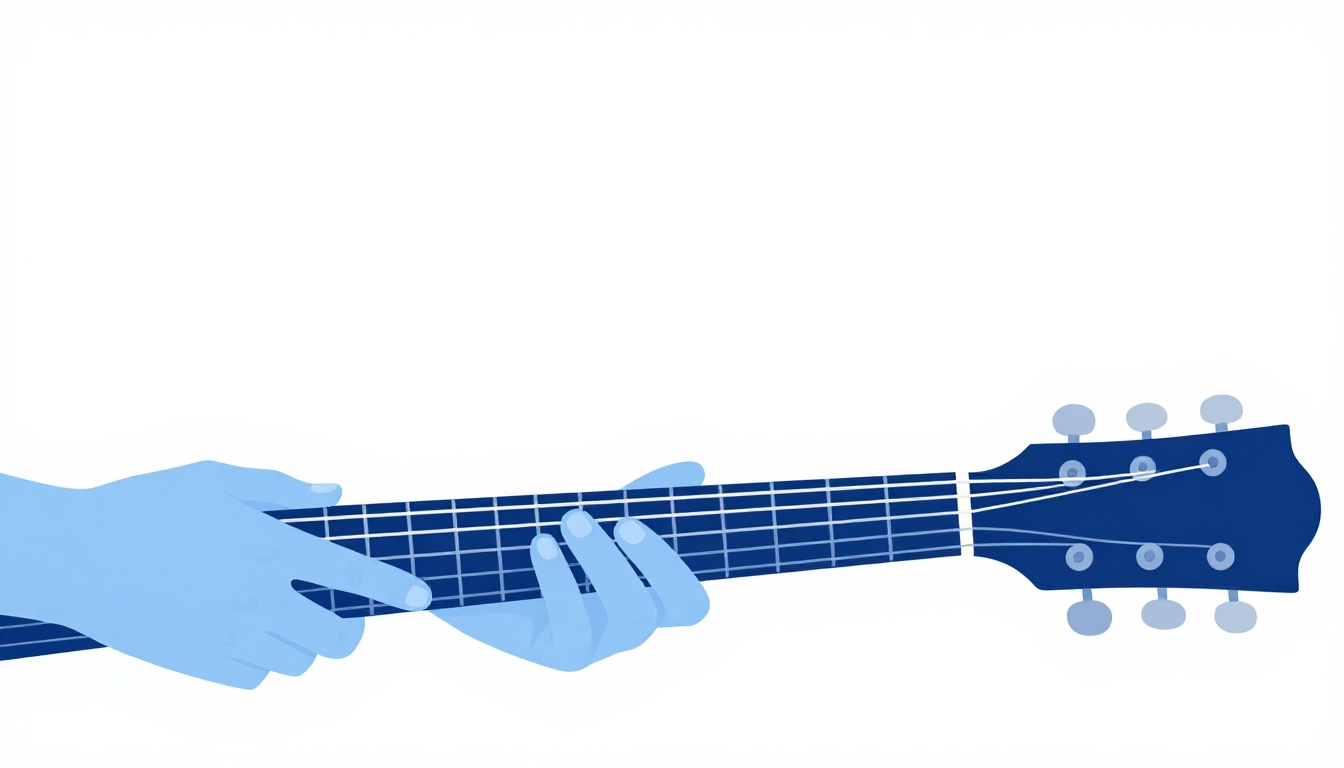
If you already fret a standard F chord by wrapping your thumb over the top of the neck onto the low E string, the same trick works here. Let your thumb take the low E string at the 1st fret instead of your index finger, and your index finger only has to hold the high E string at the 1st fret on its own, a single note rather than a barre. Your middle, ring, and pinky fingers keep the same jobs on the G, A, D, and B strings.
This is not a shortcut every guitarist can use. It depends on having a neck slim enough for your thumb to comfortably reach over the top, and it will not work on a wide classical guitar neck. Where it does work, it turns the widest stretch in this post into a chord with no barre at all.
What a capo can do for F6
Avoid the barre entirely
If the full barre version is the sound you want but your index finger is not holding the barre cleanly yet, a capo does the barre's job for you. Clip a capo onto the 1st fret, then play the open E6 chord shape as if the capo's fret were the nut: low E string open, A string 2nd fret, D string 2nd fret, G string 1st fret, B string 2nd fret, high E string open. With the capo raising every open string by a semitone, that E6 fingering rings out as F6, note for note identical to the full barre version above.
This is a genuine trick, not a downgrade. Plenty of guitarists on recordings use a capo specifically to avoid a demanding barre in a key that would otherwise force one, and the chord that comes out the other end is indistinguishable from the barred version to a listener. The only cost is that you need a capo within reach, and every other chord in the song has to be transposed to work with it.
Play other 6th chords with the easy F6 shape
The easy open-position F6 shape from earlier in this post is not limited to F. Since it does not use any open strings that are unique to the key of F, moving a capo up the neck and playing that exact same shape produces a different 6th chord at every position.
| Capo fret | Shape you play | Chord that sounds |
|---|---|---|
| No capo | Easy F6 shape | F6 |
| 2nd fret | Easy F6 shape | G6 |
| 4th fret | Easy F6 shape | A6 |
| 5th fret | Easy F6 shape | Bb6 |
This is worth knowing any time a song calls for a 6th chord built on a root that has no comfortable open-position shape of its own, since a capo plus a shape you already know is often faster to reach for than learning an unfamiliar movable barre chord from scratch.
F6 compared with a plain F chord
The standard F barre chord (index across all six strings at the 1st fret, ring and middle and pinky filling in a triad shape at the 2nd and 3rd frets) plays only F, A, and C, the plain major triad. F6 takes that same triad and adds a D somewhere in the voicing.
The practical difference is bigger than one note suggests. A plain F major chord is stable and a little plain, the kind of chord that wants to resolve or move on immediately. Add the 6th and the chord gets a lingering, unresolved quality that sits comfortably as an ending, which is why F6 shows up so often as a final chord rather than a passing one. If a song chart shows F where a recording clearly has a softer, jazzier color under it, F6 is a common reason.
If you already know C6's open shape, the pattern here is the same one repeating: take the plain major triad you already know, keep every one of its notes, and add its own major 6th somewhere in the voicing. C6 adds an A on top of C major; F6 adds a D on top of F major. Once that pattern is familiar for one chord, it is easier to recognize for the next.
F6 compared with Fmaj7 and F7
F6 and Fmaj7 are easy to mix up because both are dressed-up versions of plain F major, and both get called "the jazzy F chord" in casual conversation. F7 gets thrown into the same conversation too, even though it belongs to a different family entirely. Lining up all four side by side settles it.
| Chord | Notes | Added note |
|---|---|---|
| F major | F, A, C | - |
| F6 | F, A, C, D | Major 6th (D) |
| Fmaj7 | F, A, C, E | Major 7th (E) |
| F7 | F, A, C, Eb | Minor 7th (Eb) |
The 6th (D) sits a whole step below the root, F. The major 7th (E) sits a half step below the root. That half-step distance is what gives Fmaj7 its shimmering, slightly tense sound, the kind that wants to hang in the air. F6's whole-step 6th sounds settled by comparison, closer to F major with extra warmth than to something searching for resolution. If you already know the Fmaj7 shapes on this site, listen for that difference directly: play Fmaj7, then F6, back to back, and the gap in tension is the whole story.
F7's minor 7th (Eb) pulls in yet another direction. Where F6 and Fmaj7 both sound complete on their own, F7 is a dominant chord, built to create tension that resolves somewhere else, typically to a chord a perfect 4th up. Confusing F6 with F7 because both get called "the F chord with something extra" is an easy mistake on a chord chart with sloppy handwriting, but the two do almost opposite jobs: F6 wants to stay put, F7 wants to move.
F6 and Dm7 are the same four notes
This is the fact that trips up more players than any other part of learning F6: an F6 chord and a Dm7 chord are built from the exact same four notes, F, A, C, and D. The only difference is which note the ear treats as "home."
- Dm7 = D, F, A, C, with D as the root.
- F6 = F, A, C, D, with F as the root.
Because a guitar chord shape does not announce its own root, the open F6 shape earlier in this post (muted low E, open A and D, ring finger on the G string, index barring the B and high E strings) fingers identically to an open Dm7 chord, and can be, and often is, labeled Dm7 in chord charts. The fingering is identical either way. What changes the label is context: if the chord resolves like a D minor moment in the song, or the bass note underneath is a D, call it Dm7. If it resolves like an F major moment, or the bass note is F, call it F6. Some jazz players treat the two names as interchangeable on the guitar for exactly this reason, and either name is defensible for the same physical shape.
Is F6 the same as Dm6
No, and this is where the naming pattern breaks: Dm6 is a different chord entirely, not another name for F6. Dm7 shares every note with F6 because a minor 7th chord and the major 6th chord a minor 3rd above it are always the same four notes. Dm6, by contrast, is D, F, A, and B, a D minor triad with its own major 6th (B) added on top, which is not one of F6's four notes at all. The similar names make Dm6 and Dm7 easy to mix up on a chord chart, but only Dm7 is interchangeable with F6.
An even easier two-finger version
If the small barre in the open shape still feels like a stretch, you can drop the G string from the chord and keep only the notes on the outer strings.
| String | Fret | Finger |
|---|---|---|
| 6 (low E) | Muted, do not play | - |
| 5 (A) | Open | - |
| 4 (D) | Open | - |
| 3 (G) | Muted, do not play | - |
| 2 (B) | 1 | 1 (index) |
| 1 (high E) | 1 | 1 (index) |
This keeps the A (3rd), D (6th), C (5th), and F (root) notes, every tone F6 needs, and asks for exactly one fretting finger: a two-string barre at the 1st fret. It is a genuinely complete F6, not a simplified stand-in, and it is the fastest way to get the chord under your fingers on day one. Mute the G string by letting the underside of your index finger brush against it, or simply strum carefully around it once you can hear where it sits.
A movable F6 shape higher up the neck
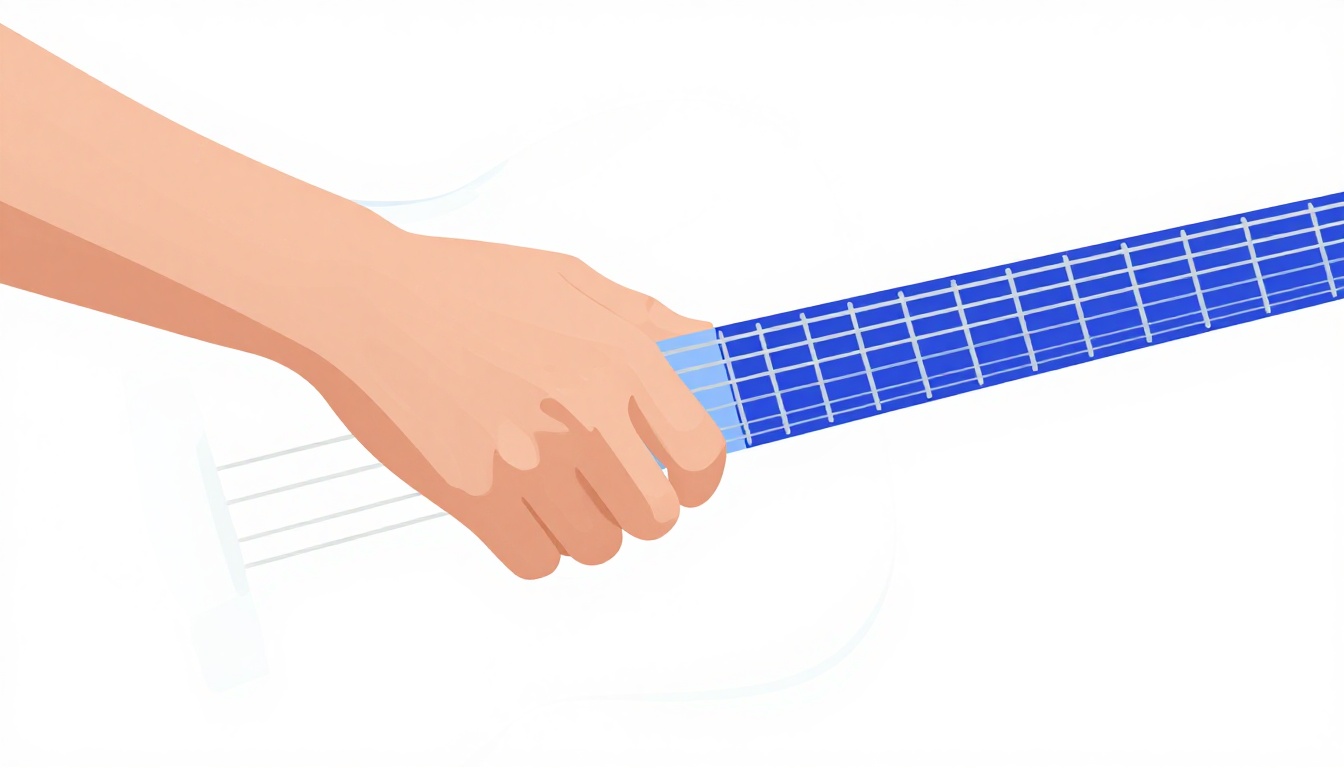
Once the open-position version feels automatic, this A-shape voicing gives you the same chord in a different register, useful when a song is already sitting higher up the fretboard and jumping back down to the open position would break the flow.
| String | Fret | Finger |
|---|---|---|
| 6 (low E) | Muted, do not play | - |
| 5 (A) | 8 | 1 (index) |
| 4 (D) | 10 | 2 (middle) |
| 3 (G) | 10 | 3 (ring) |
| 2 (B) | 10 | 4 (pinky) |
| 1 (high E) | 10 | Barre with pinky or lay flat |
The root sits on the A string at the 8th fret, with the D, G, B, and high E strings barred two frets higher at the 10th fret. This is the same shape guitarists use to play A6 down at the open position (A string open, D-G-B-E strings all at the 2nd fret), just moved up the neck so the root lands on F instead of A. Because it is a movable shape, sliding the whole thing to any fret gives you the 6th chord for whatever note is under your index finger on the A string.
| Root on the A string | Chord |
|---|---|
| 3rd fret | C6 |
| 5th fret | D6 |
| 8th fret | F6 |
| 10th fret | G6 |
Once your index finger knows where the notes fall on the A string, this single shape covers every 6th chord you are likely to need higher up the neck, without learning a separate fingering for each one.
A three-note jazz voicing for comping
Jazz rhythm playing rarely uses full six-string chords. A smaller, three-note "shell" voicing lets the chord sit inside a band mix without crowding the bass or piano.
| String | Fret | Finger |
|---|---|---|
| 6 (low E) | Muted, do not play | - |
| 5 (A) | Muted, do not play | - |
| 4 (D) | 3 | 1 (index) |
| 3 (G) | 2 | 2 (middle) |
| 2 (B) | 3 | 4 (pinky) |
| 1 (high E) | Muted, do not play | - |
That covers the root (F), 3rd (A), and 6th (D) in a tight cluster on the middle three strings, with the 5th (C) left out entirely, which is standard practice in jazz comping since the 5th adds little to a chord's identity. Because it only uses three adjacent strings, this shape slides cleanly into chord-melody playing and works well right after the full barre version in a practice routine, since your fretting hand is already in a similar shape.
A second three-note voicing, higher up
A companion shape sits on the top three strings instead of the middle three, useful when a melody note needs to sit on top of the chord rather than buried inside it.
| String | Fret | Finger |
|---|---|---|
| 6 (low E) | Muted, do not play | - |
| 5 (A) | Muted, do not play | - |
| 4 (D) | Muted, do not play | - |
| 3 (G) | 2 | 1 (index) |
| 2 (B) | 3 | 3 (ring) |
| 1 (high E) | 1 | 2 (middle) |
That covers the 3rd (A), 6th (D), and root (F) again, this time on the G, B, and high E strings, with the root sitting on top where a melody line can sit clearly above the chord underneath it. It is a small stretch across three frets in a row, so it rewards a light touch rather than force.
Fingerpicking F6
If you would rather pick F6 than strum it, the easy open shape (muted low E, open A and D, ring finger on the G string, index barring the B and high E strings) is the one to start with. Rest your thumb on the A string and your index, middle, and ring fingers on the G, B, and high E strings.
A simple pattern to begin with: thumb plays the A string alone, then index, middle, and ring pick the G, B, and high E strings together as one soft chord, then thumb plays the D string alone, then the same three fingers again. That alternating bass under a light block chord is the foundation most fingerpicking patterns on this site build from, and it works cleanly here because both the A string and the D string, F6's 3rd and 6th, make sensible bass notes on their own.
Once that feels steady, break the block chord into a roll, picking the index, middle, and ring fingers one after another instead of together. It is the same right-hand motion used across most open chords, and it transfers directly once you can hold the F6 shape without thinking about it.
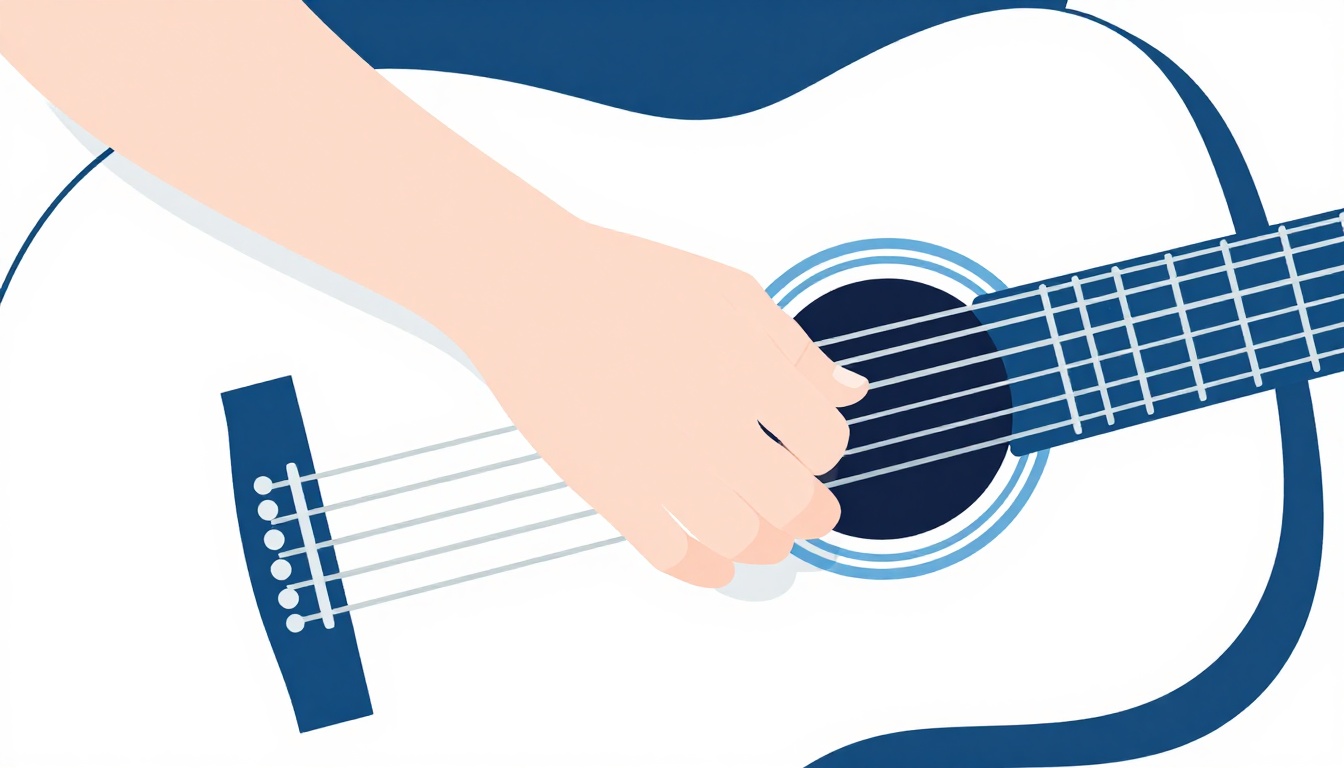
The open F6 shape transfers directly to a nylon-string or classical guitar. The wider string spacing on most classical necks gives the ring finger and the two-string mini barre more room to land precisely, and the lower string tension common on nylon strings can make the mini barre easier to hold clean if that has been a sticking point on steel strings.
F6 in chord progressions
The jazz ii-V-I turnaround
In the key of F, the most common run into the tonic chord is a two-chord cadence called a ii-V: Gm7 moving to C7, then resolving to F. Bebop and swing players developed a specific habit at that final resolution: land on the 6th chord rather than the plain major triad or the major 7th. That preference traces back to the era's melodic phrasing, which leaned on the 6th degree specifically when a line landed on the tonic, and guitarists comping behind a soloist picked up the same habit, voicing the tonic as F6 instead of F or Fmaj7 at that exact moment.
A full turnaround loop works the same way: F6, Dm7, Gm7, C7, then back to F6. Because F6 and Dm7 are built from the same four notes, as covered above, the first two chords in that loop barely ask your fretting hand to move if you are using the open F6 and open Dm7 shapes, since one slides into the other on the same strings.
The doo-wop I-vi-IV-V progression
F6, Dm, Bb, and C together give you the I-vi-IV-V pattern often nicknamed the doo-wop changes or the 50s progression, one of the most recognizable chord cycles in popular music. Swapping the plain F for F6 at the top of the cycle softens the move into Dm, since F6 and Dm7 already share three of their four notes, so the ear barely notices the chord change until the color shifts underneath it. Loop F6, Dm, Bb, C slowly and listen for how much of that cycle's familiar sound comes from how smoothly each chord leans into the next.
The scale that fits over F6
If you are soloing or improvising over an F6 chord, the F major scale is the natural starting point, since all four of F6's notes (F, A, C, and D) already belong to it. Every other note in the scale, G, B, and E, works as a passing tone that connects the chord tones rather than clashing with them. Players coming from a blues or rock background often reach for the F major pentatonic scale instead, which strips the F major scale down to five notes and happens to include the 6th (D) as one of them, giving that lighter, more soulful phrasing its own connection to what makes F6 sound the way it does.
Does Drop D tuning change the F6 shape
If your guitar is in Drop D tuning, where only the low E string is tuned down a whole step to D, most of the shapes in this post are unaffected, since none of the open-position, two-finger, or three-note versions use the low E string at all.
| Tuning | 6th string, open | Fret needed for F on that string |
|---|---|---|
| Standard (low to high: E A D G B E) | E | 1st fret |
| Drop D (low to high: D A D G B E) | D | 3rd fret |
The one shape this touches is the full barre version, which normally uses the low E string at the 1st fret for a root F. In Drop D, that same 1st fret now sounds D#, which does not belong in F6. The simplest fix is to mute the 6th string entirely when playing the full barre shape in Drop D. The chord stays complete without it, since the D string, untouched by the tuning change, already carries a second F an octave higher at the 3rd fret in that same shape.
Why your F6 isn't ringing clean
A muted G string in the open shape
The most common issue with the easy open-position F6 is a dead or buzzing G string. Your ring finger needs to come down close to the fret wire, not in the middle of the fret space, and it needs to arch enough that it does not lean over and touch the B string beside it. Check by plucking the B and G strings separately right after fretting the chord.
The B and high E strings sound thin or buzz
Because the index finger is only barring two strings rather than six, players sometimes press too lightly, assuming a two-string barre needs less force than a full one. It still needs the finger to lie flat along its side, with even pressure across both strings, not resting more on one than the other.
The low E or A string sneaks into the strum
In every open-position version of F6 above, the low E string must stay silent, and in the full barre version it is deliberately included, which is the opposite mistake in reverse: skipping it there leaves the chord thin. Check which shape you are playing and match your strumming range to it. For the open shapes, start your downstroke on the A string and let your ring finger's underside lean back to damp the low E if it keeps ringing.
The barre version buzzes at the 1st fret
A low-fret barre is genuinely harder to fret cleanly than the same barre shape higher up the neck, because the strings sit slightly higher off the frets near the nut on most guitars. Roll your index finger very slightly toward its side rather than flattening it completely, and make sure your thumb sits behind the neck roughly under your middle finger, pushing forward rather than gripping from the side.
The stretch to the 3rd fret feels impossible
In the full barre shape, the jump from the 1st fret barre to the 3rd fret notes is the widest stretch in this post. Keep your thumb low and your wrist slightly bowed outward rather than tucked in, which gives your ring and pinky fingers more reach without straining. If the stretch still will not close, the open-position or capo versions get you the identical chord without asking for it.
It sounds right alone but muddy in a full band mix
A shape that rings perfectly clean on its own can still sound cluttered once a bass player and a keyboard or second guitar are also playing under it. This is usually not a fretting problem at all. The full six-string barre version doubles the root and the 6th across low and high registers, which is exactly what a solo guitar wants but can crowd a bass line built around the same root note. Switching to the three-note jazz voicing or the two-finger version in a full band setting, both of which leave the low strings out entirely, usually clears the mud without changing the chord.
Getting the most out of these shapes
Common mistakes that aren't about fretting
Not every problem with F6 lives in your left hand.
Confusing it with F#6. F6 and F#6, one fret higher, are close neighbors on the fretboard in every movable shape in this post. A chord chart with a small or unclear sharp sign is the most common reason a player ends up a fret off on a barre-based version. If the chord around it sounds like it clashes by a half step, check the chart before assuming your fretting is wrong.
Rushing through it when it wants to ring. F6's whole appeal is a settled, slightly wistful color. Strumming through it as quickly as every other chord in a fast progression buries the exact quality that makes it worth choosing over plain F in the first place. If a chart specifically calls for F6 rather than F, give it a little more time to ring than the chords around it, at least the first time through a section.
Assuming F6 always works as a substitute for F. F6 and F major sit close together, not on top of each other. In a rock or punk context, or anywhere the plain triad's directness is the point, swapping in F6 can sound like the wrong genre wandered into the room. Try the swap by ear in the actual song before committing to it.
Forgetting which strings are muted. Every shape in this post relies on at least one muted or skipped string. Strumming through a muted string out of habit, especially the low E string in the open-position shapes, is the fastest way to turn a clean F6 into a muddy one, even with otherwise perfect fretting.
Which F6 shape should you learn first
With this many versions on one page, it helps to have a plain answer.
- New to F6 entirely: start with the easy open shape, or the two-finger version if even that feels like a stretch. Both are complete, correct F6 chords, not simplified placeholders.
- Already comfortable with barre chords: learn the full barre version next. It is the fullest-sounding voicing in this post, and the one most chord charts assume when they simply write "F6."
- Playing in a band or alongside another chordal instrument: the three-note jazz voicing keeps you out of the way of a bass player or pianist already covering the rest of the chord.
- Already sitting higher up the neck in a song: reach for the movable A-shape version instead of jumping back down to open position.
- Struggling specifically with the barre, not the rest of the shape: the capo trick gets you the exact same sound as the full barre version with none of the barre.
None of these is more "correct" than another. Each is a complete F6 chord; the differences are in hand position, fullness, and where on the neck they sit. If you only take one shape away from this whole page, make it the easy open version at the top: it is the fastest route to hearing F6 correctly, and every other shape here is a variation on getting that same four-note idea to sit somewhere else on the neck.
F6 for left-handed guitarists
Everything above describes a right-handed guitar, strung with the low E string closest to the ceiling when the guitar is held in playing position. On a left-handed guitar, strung and flipped as a mirror image, every shape in this post is identical but reversed: the fretting hand is the left rather than being described from the player's right, and a mini barre like the one in the easy open shape still lands across the same strings by name, the B and high E strings. The physical direction of the barre finger and its position in the room simply flip left to right. String names, fret numbers, and finger numbers stay exactly the same either way, so none of the tables in this post need any adjustment beyond mentally mirroring the diagram.
Changing into and out of F6
The shape is rarely the hard part once you can hold it; the hard part is arriving at it and leaving it without a gap in the strum. F6 tends to show up next to a small handful of chords, and each pairing has its own shortcut.
F6 to C. Since F6 and C major share no fretting fingers in common positions, plan the move as a full reset rather than trying to walk fingers over one at a time. Practice the two chords back to back slowly until your hand learns the jump as one motion instead of four separate finger placements.
F6 to Dm7. If you are using the open F6 shape (muted low E, open A and D, ring finger on the G string, index barring B and high E), this move can be nearly free. Since Dm7 is commonly played as the same shape, the same fingers, only the bass note underneath changes, sometimes nothing in your fretting hand needs to move at all.
F6 to Bb. Both chords commonly use barre shapes rooted nearby on the neck. Keep your index finger's barre pressure constant and slide the whole hand shape rather than lifting off between chords, which keeps the transition from putting a gap in the rhythm.
F6 to plain F. Since F6 is F major plus one note, this is the smallest move in the post. In the open F6 shape, lifting the ring finger off the G string and letting it ring open turns the chord straight into an F major sound built on the same fingers, useful as a quick embellishment inside a strumming pattern rather than a full chord change.
F6 to Gm7. This pairing shows up constantly in the turnaround covered earlier, since Gm7 is the ii chord leading back toward F. If you already know the movable Gm7 barre shape at the 3rd fret (3-5-3-3-3-3, low E to high E), keep your index finger's barre pressure steady through the change and let your other fingers reposition around it, rather than releasing the barre and re-forming it from nothing each time.
Where F6 shows up in real music
F6 and chords like it are a staple of jazz standards, bossa nova, and vintage pop, where a plain major triad can sound a little bare as a resting point. Songwriters and arrangers reach for the 6th chord specifically as an ending, landing a song or a section on F6 instead of plain F to leave a warmer, less final-sounding close in the listener's ear. It shows up constantly as a substitute for a I chord (the tonic) in the key of F, and because it shares its notes with Dm7, it also slides naturally into progressions that move between the two.
In bossa nova playing specifically, a chord like F6 is usually fingerpicked rather than strummed, using a technique where the thumb alternates between the root and the 5th on the strong beats while the index, middle, and ring fingers pick out the rest of the chord on the off-beats, which is what gives the style its gentle, syncopated pulse instead of a hard strum. The fingerpicking pattern earlier in this post is a simplified version of that same thumb-and-fingers coordination, worth returning to once the chord itself feels automatic.
Electric versus acoustic
The shape and fingering are identical on either instrument, but the tone changes. On a clean electric tone, especially with a touch of reverb or chorus, F6's warmth comes through as a lush, almost keyboard-like color, part of why 6 chords turn up so often in soul and R&B rhythm parts. On acoustic, the same shape reads as brighter and more percussive, especially strummed rather than picked, since the open A and D strings in the easy shape ring with more natural sustain against a wooden top than they do through an amplifier.
A practice routine for today
Spend five minutes on this sequence, in order, before moving to whatever song you are working on:
- Fret the easy open F6 shape and strum it four times, checking that all five strings ring clean each time.
- Lift off completely, then fret it again from nothing. Repeat ten times, aiming for a clean chord within one second of starting to move your hand.
- Alternate F6 and plain F major, four strums each, four rounds. Listen for the one-note difference each time you switch.
- If you already know Dm7, alternate F6 and Dm7 using the same physical shape, focusing only on how the bass note changes the feel.
- Loop the Gm7 to C7 to F6 turnaround slowly, four beats per chord, even if the Gm7 and C7 shapes are still shaky. Getting the ear used to that resolution matters as much as getting the fingers used to it.
- Once the open shape is solid, spend the last minute on the full barre version, even if it only rings clean once or twice. Barre strength builds from repetition, not from getting it right the first time.
Once this routine feels easy, extend it by fingerpicking the open shape instead of strumming it for one full pass, using the thumb-and-fingers pattern from earlier in this post. Alternating strummed and fingerpicked practice on the same chord builds a more complete feel for it than repeating the same right-hand motion every time.
FAQ
Is F6 a hard chord for beginners? The open-position version (muted low E, open A and D, ring finger on the G string, index barring the B and high E strings) is genuinely beginner-friendly, since it needs only two fretting fingers and no full barre. The full six-string barre version is harder and is worth saving until barre chords in general feel comfortable.
What is the difference between F6 and F6/9? F6/9 adds a fifth note, the 9th (G), on top of F6's four notes (F, A, C, D). It is a denser, more modern-sounding jazz voicing built on the same foundation as F6, not a separate chord family.
Can I play F6 instead of a regular F chord? In most pop and folk contexts, yes, especially as the last chord before a song settles or pauses. It will sound noticeably jazzier than plain F, so it is worth trying by ear in context rather than swapping it in everywhere automatically.
Why do some chord charts call this shape Dm7 instead of F6? Because the two chords share every note. The label depends on which note the surrounding music treats as the root: F for F6, D for Dm7. The fingering does not change.
Do I need a capo to play F6? No. The open-position shape and the movable A-shape version further up the neck both need no capo at all. A capo is only useful as a shortcut if you specifically want the full barre voicing's sound without holding the barre yourself.
Why does my F6 sound the same as a plain F chord? The D note (the 6th) is likely getting muted or not fretted at all. Check the shape you are using against the tables above and pluck the string carrying the D on its own to confirm it rings.
Is F6 the same shape as A6? Not the open versions, but the movable A-shape version of F6 (root on the A string, 8th fret) uses the identical finger pattern as the open A6 chord, just moved up the neck. Slide that same shape to any fret and you get the 6th chord for whatever root note sits under your index finger.
Does F6 sound right in a fast, aggressive strumming song? Usually not. F6's appeal is its settled, slightly wistful color, which is easiest to hear when the chord has a moment to ring. In fast, hard-driving strumming, that color mostly disappears, and a plain F chord will often serve the song better.
What is the difference between F6 and F/A or F/C? F/A and F/C are slash chords, meaning a plain F major chord played over a different bass note, A or C. Neither adds a new note the way F6 does with its D. F6 is a genuinely different four-note chord, not a re-voiced F major.
Is there a quick way to remember which note the 6th is? Count a whole step down from the root. F down a whole step is D, and D is F6's 6th. The same shortcut works for any major 6th chord: a whole step below the root is always the note you are adding.
Can I slide the full barre F6 shape to play other 6th chords? Yes. Because it uses no open strings, the full barre shape is entirely movable. Slide it to any fret and the root note under your index finger on the low and high E strings tells you which 6th chord you are playing.
How can I tell by ear whether a recording is using F6 rather than plain F? Listen for whether the chord sounds like it wants to keep going or like it has already arrived. A plain F triad tends to sound like it is mid-sentence, waiting on the next chord. F6 sounds like the sentence has finished, warmer and a touch wistful, which is the effect of that extra D note sitting on top. Playing both back to back on your own guitar, as suggested earlier in this post, trains that difference faster than trying to isolate it from a recording alone.
GuitarLowKey
Ready for fifteen focused minutes?
Open the web app and train the change that is blocking your song.